Gender segregation does not remove barriers. It builds a wall

The bill expanding gender segregation in Israeli higher education goes to its final readings in the Knesset this week, after clearing the Education Committee. Until now, the Supreme Court and the Council for Higher Education allowed segregation as a narrow exception: undergraduate degrees, the ultra-Orthodox community, inside the classroom only, and with an explicit ban on discriminating against women lecturers.
This bill extends the permission to master’s and doctoral programs. It opens segregation to any population that asks for it. And it reaches past the lecture hall into clinical placements and direct patient care. The exception is becoming policy, and once segregation is written into primary legislation rather than resting on a court ruling, stopping it becomes far harder.
The bill’s sponsor, MK Limor Son Har-Melech, says the law will let women break through a glass ceiling. Yet by the Council for Higher Education’s own figures, roughly two-thirds of the students from ultra-Orthodox schooling now in Israeli higher education are women.

Last week, the journalist Chen Artzi-Sror revealed in Ynet a study on gender segregation that the Council for Higher Education itself had commissioned. It examined segregated master’s programs in psychology and art therapy for the ultra-Orthodox community, and asked whether such programs had any real value, and whether anyone actually wanted them. The findings were clear. Mixed-gender learning has distinct value in the therapeutic professions, and separation can cause professional harm. Above all, the intended beneficiaries themselves responded warmly to the idea of studying without segregation. The report was submitted in 2024. It never came before the Council’s plenum, and it never reached the Knesset committee that debated the bill. The vote is being held without the findings of the study the Council itself ordered.
What it costs
This has a price, and not only a moral one. A small country that lives on research, medicine and technology cannot afford to waste talent. Broad segregation means running the system twice over: faculty used inefficiently, teaching and research narrowed to fit whoever is sitting in front of them. Instead of an open market of expertise, the system learns to sort by gender. Who may teach whom. Who is in the room. Who is asked to wait outside.
And the cost does not fall only on the women who study. It falls on the women who teach. A lecturer who cannot be assigned to a segregated track loses courses, and a teaching load is not an abstraction: it is a salary, a promotion file, a career. The Supreme Court understood this, which is why its ruling barred discrimination against women lecturers outright. This bill leaves that ban standing on paper while building a system that cannot function without breaking it.
Professor Orna Kupferman of the Hebrew University, who was responsible for ultra-Orthodox integration at her institution, told the Knesset committee what had actually happened. Every fear about the separate undergraduate tracks came true, and the cost is enormous, because each lecture has to be delivered three times over: once for everyone, once for the women, once for the men. In a separate track, she said, ultra-Orthodox students receive an inferior product. The Treasury told the committee the bill costs the state nothing, because the higher education budget is closed. Which means the cost does not vanish. It moves to other institutions.
When the state signals that gender is a legitimate consideration in the allocation of opportunity, the message does not stay inside the academy. It seeps into the labor market. If a university can keep women lecturers out of certain tracks in the name of cultural accommodation, why not separate professional training tomorrow, and separate promotion tracks? This is how a new glass ceiling gets built, through “consideration” and “choice.”
This week, the deans of all nine of Israel’s medical schools wrote to the Knesset, warning that the bill puts gender ahead of expertise, damages clinical training, and threatens the international standing of Israeli medical education, down to the ability of Israeli doctors to take fellowships at leading hospitals abroad. Their letter asked lawmakers one question, and every one of them should answer it before voting: if someone in your family needed surgery, would you want the best surgeon, or one of the correct gender? Israel’s university heads had already said the same.
Not scattered incidents
News also broke this week that in Bnei Brak, on the instruction of the city’s rabbis, the municipality is preparing to separate the sidewalks on two streets, with signage and physical changes to the public space, so that men and women will not walk on the same pavement. The plan is to apply the rule elsewhere as well.
In her book Separate and Unequal: Gender Segregation in Israel, Professor Yofi Tirosh of Tel Aviv University’s law faculty sets out a long line of court rulings and shows that segregation is not a scattering of incidents. It is a mechanism. It travels from the bus to the university, from public prayer to the funeral, and now to the sidewalk. Tirosh petitioned the Supreme Court against segregation in the academy in 2017. The ruling that came out of that case, which permitted segregation only within strict limits, is the one this bill was written to bypass.
What we learned at the rabbinate examinations
This is not theoretical for me. I am one of the petitioners in a case, filed in 2019 and led by ITIM, the Rackman Center at Bar-Ilan University and Kolech, for the right of women to sit the Chief Rabbinate’s examinations in Jewish law on the same track as men, so that what they know would be recognized and carry professional weight. The petition rests on the principle that separate is not equal, and about a year ago, it produced a ruling allowing women to be examined exactly as men are. Throughout the case, we said, carefully, that we would not fight a battle over the mere possibility of a separate room. We had gathered our own learning in private frameworks for women, because that is where Orthodox women can reach advanced knowledge of Jewish law.
Experience taught us otherwise.
The rabbinate examinations this past April were the first in which women sat for senior ordination, the level known as yoreh yoreh. A few days before the exam, the women were told we were being moved. Not to the convention center, where thousands of other candidates would be sitting, but to the offices of the Ministry of Religious Services. We had not asked to be separated. It was imposed on us.
A few months earlier, I had read Tirosh’s book, and it had left me alert. I recognized the trap in time. I did not sit the exam. I was not going to sign my name to the opposite of everything we had argued, so I chose to wait for a date on which the conditions would be equal in fact, not on paper.
On the day itself, the men were examined as usual, in the halls of the convention center. The three women who did come were held up for hours. The exam finally took place only because the Supreme Court intervened and ordered its own ruling enforced. We learned firsthand how quickly “separate” becomes “unequal.”
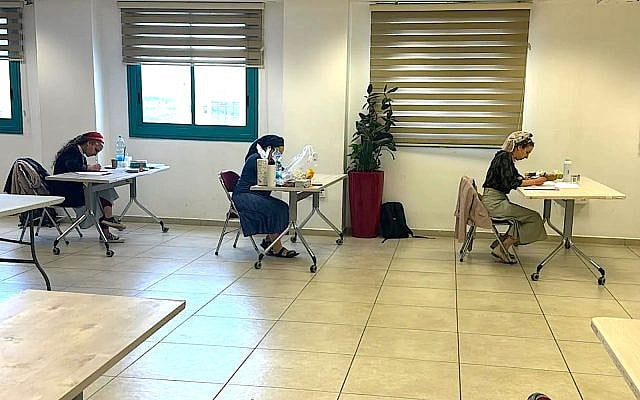
Now, ahead of the next round of examinations in October, the question returns. Would it be right to accept a separate room if one were offered? In the past, we might have said this is not a fight worth having. Today, we cannot afford to be naive. A state examination has to be run under uniform rules, and in a space that does not mark women as an appendix to the system.
We are taught to accept the truth from whoever speaks it. Nowhere are we taught to check first who is speaking. Jewish law is dear to me. I am not willing to watch it turned into a civic language of coercion, one that always ends with women stepping aside. There is a place for the women’s section of the synagogue and for the customs of a community. A rule imposed by the state is not the same as a decision made in a private wedding hall.
Rabbi Isaac Herzog, the first Chief Rabbi of the State of Israel, earned his doctorate at the University of London, where women and men sat in the same lecture halls. He was not the last. Rabbis and Torah scholars of the first rank, women among them, hold degrees from universities where no one sat behind a partition. They are teaching today, and they came back to Torah with more, not less.
Segregation that does not discriminate can exist only when it is exceptional, genuinely voluntary, and does no harm to the rights of other women. The moment it becomes broad public policy, it is no longer an accommodation. It is a wall. And walls, even when they go up in the name of cultural sensitivity, very quickly mark whom the space belongs to, and who is merely allowed in conditionally.
Separate classrooms, separate keys
In the elementary school I attended, we were divided at the start of fifth grade into a girls’ class and a boys’ class. We went on meeting the boys only in the English and mathematics tracks, and in religious studies, the separation opened gaps in knowledge. The boys were given Talmud. We were given the laws of kashrut and how a religious woman is meant to live.
There, in fifth grade, one of the girls sitting in that class with me was Limor Son Har-Melech, who today sits in the Knesset and who wrote this bill. What she took out of that classroom is hers to say. I know what I took. It taught me that some rooms would not simply open, and it took me years to stop believing that was the natural order of things. I think about it when I watch my daughters study Talmud in their Orthodox school in New York, alongside the boys, from the first moment. That is the whole of my case against this bill. Separation teaches, quietly and early, who holds the key, and it goes on teaching it: in a classroom, in an examination room, on a public sidewalk, and now, if this bill passes, in the lecture halls and libraries of every university in the country.
I grew up in the moderate stream of religious Zionism (the original kind!). It has since radicalized, and that radicalization has never stayed inside religious society. This bill troubles me not only as a liberal citizen, but as a religious woman, and above all as a rabbanit. I am not seeking to erase religious ways of life. I am seeking to keep the shared civic space from becoming an extension of religious stringency. Israel needs a faith that is not afraid of human dignity, and does not mistake humanism for an enemy.
They call it removing a barrier. It is the building of a wall in a space that belongs to all of us.