Speaking Hebrew in Laquia
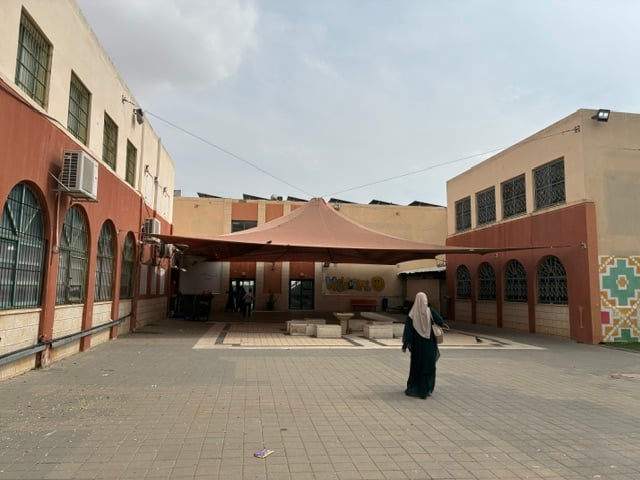
There is still much to be done in Israel, and this year I decided to take part in a new project: volunteering to teach Hebrew and speak with students at a junior high school in the Bedouin town of Laqiya, in the south, near Arad. We started this morning.
When I was a student at the University of Haifa, there were many Arab students in my courses. Their Hebrew was excellent. We became friends and visited each other in our homes. When I went to visit them, everyone spoke Hebrew with me. It was common knowledge that in order to advance in your career in Israel, you had to know Hebrew and English. It is true that this was a very shortsighted view, because most Israelis did not know or learn Arabic. Instead, we studied French as a second language.
I remember that when we returned from the US and traveled to the Western Galilee, we passed through an Arab village. It was before the days of GPS, and we lost our way and asked Arab children for directions. We were surprised to discover that they didn’t know Hebrew. This was in the early 1990s, and today, in Laqiya, I saw that seventh-grade students still don’t know Hebrew.
The project I joined, run by Brothers and Sisters for Israel – Hamal Ezrachi, aims to help Bedouin children who have no opportunity to speak and practice Hebrew by giving them a chance to speak the language.
By chance, on the same day that I spent at the school in Laqiya, I also took part in a Zoom meeting about higher education with Professor Alean Al-Krenawi, a university professor and representative of the Ra’am party. The talk was organized by the Bashaar organization (Academic Community for Israeli Society). Two Jewish professors talked with Al-Krenawi about the challenges faced by Palestinian Israelis in higher education. Among other things, he said that students who manage to gain admission to universities abroad spend a fortune on their education. This is a well-known problem for all students who study abroad.
There is no reason why Arab students should have to go abroad to study. We have good universities and many ways to help students who are struggling with their studies. It is true that the challenges faced by Arab children at all stages of their education are great, but learning to speak, write, and read Hebrew at an early age could improve their chances of getting into university, make their educational journey easier, and help them build successful careers.
I commend projects like ours in Laqiya, which help students become more familiar with Hebrew, but I am afraid that a program that teaches seventh graders Hebrew for just one hour a week is too little and too late. Still, I can only hope that after the elections, there will be changes in the failing Ministry of Education, that we will have a worthy minister who genuinely cares about education, and that the new government will better understand the importance of ensuring that Arab children receive serious Hebrew instruction from an early age.