

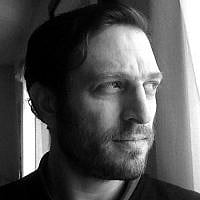
Gérard Bensussan Interview | Alexandre Gilbert #314.2
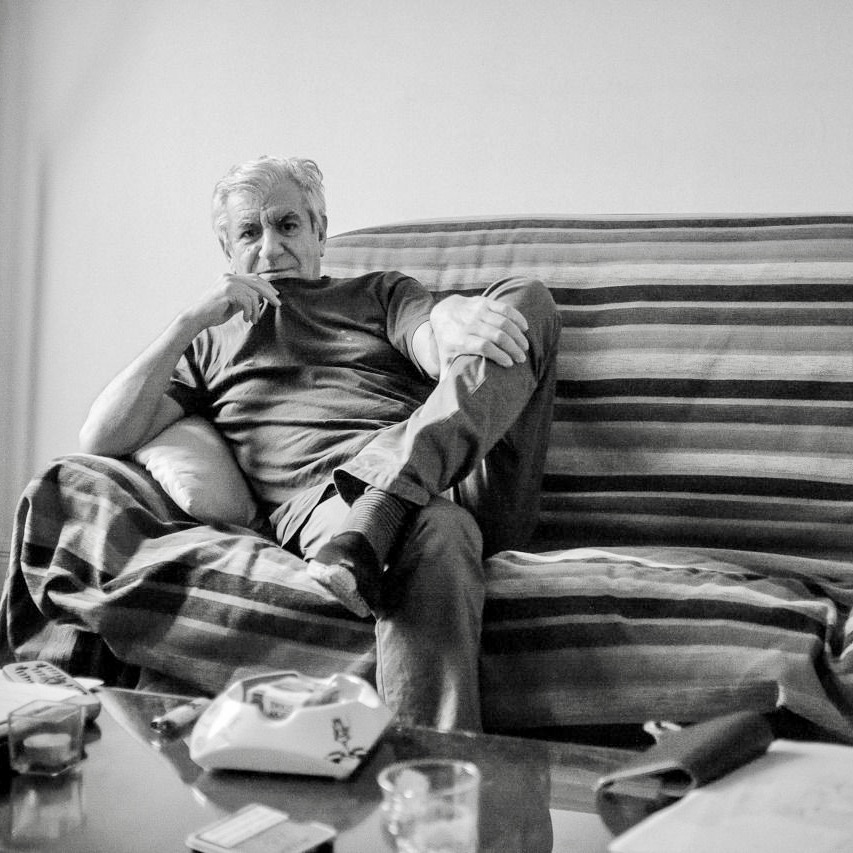
Gérard Bensussan is a philosopher and professor emeritus at the University of Strasbourg. The Japanese translation of The Two Morals (Vrin, 2019) is scheduled for publication in 2026.
Something unprecedented then occurs: if the other, the wholly other, anyone at all, is indeed the other man, this expression, the other man, can only be approached from an unprecedented and irreducible asymmetry—so much so that in Levinas it signifies “morality” in its entirety. The other and I, the face and the abasement in which it holds me from the height it occupies, we are in no way instances of the same ontological genus, two equal individuals, and indifferently situated in a relation. The other is not a man, if I may say, the other man is not a man, as I am a man, as he or she or they are men.
In the Levinasian topography, the objection that morality addresses to the ethical duo and the scene it invents is a humanist objection: how to render justice to human beings, to all other men, to all these “thirds” to whom my submission to the singular face of the other necessarily entails violence toward ? The moral request opposed to ethics is neither illegitimate nor unacceptable, but it can only be sustained in the aftermath of ethics. The other presents themselves only from the irreducible and unique singularity of the self, of the self that I am and only I, insofar as this place cannot be ceded. It is this relation, which is not a relation, that Levinas calls ethics.
By undoing all reciprocity, reversibility, and isonomy, asymmetry signifies that from an ethical point of view the relation to the other cannot be mediated. It does not transit through mediations that would render it intelligible and relative, that is, taken in a relation between terms. It cannot because the other stands in an absolute and an absolution in which I have no part. Levinas speaks of a relation/non-relation between me and the other. In the strongest sense, there is no relation where each would be relative to the other, where I could possibly be the other of the other and the other an other me, the famous alter ego. It is rather a matter of exposure and the absolute impossibility of escaping the call of a face, whether I respond or evade. It is a structural dis-interestedness of the subject, the withdrawal of its being that is, its interest. A subject is a being that undoes itself from its condition of being. To be human, to be a human subject, is not to be a being among beings, a being in being, one more being, a class in a general ontology or a region of being. To be a subject, for the dispossessed, deposed self, is to have no place in being; to be-at-home is to nomadize being in its entirety.
One understands that two logics confront herthe withdrawal of its beine, or better, two languages: that of the two (self and face) and that of the multiple (thirds). They cannot, as such, communicate, find a genuinely shared space. Their questionings do not overlap.
Indeed, to morality, one must ask: where do you come from? (this is the meaning of any genealogy of morality); but this essential question in no way cancels, on the contrary, the other question, the one to be addressed to ethics: where are you going? for what purpose? Caught between these two fundamental temporal questions, what in German is called Herkunft and Zukunft, origin and destination, the language of infinite gift and the language of regulated equivalence cannot understand each other, even if they speak to each other. Between them, the misrecognition is perpetual. If one recklessly mixed these two registers, what would result would be disastrous, unless God himself were to intervene according to a famous midrash. In The Two Morals, I have tried to show what these catastrophic effects are, regarding violence, love, hospitality, even reaching the question of terrorism.
In a way, one could say that ethics interrupts morality, because the “where are you going?” is not satisfied with “where do you come from?” It engages the action of the immediate subject; it calls beyond its intention or mediated will, beyond its presence of mind, as Levinas says. In several texts, I have tried to bring closer Levinas’s “anarchic” or “pre-origin” and Proust’s involuntary.
The philosophical interest of Proustian descriptions of the involuntary, in the madeleine episode and beyond, lies in what could be called a coherence without concept, a descriptive or narrative rigor that does not reduce to a mere hypothetico-deductive process. These long Proustian developments on the involuntary strip the conatus of its (pseudo-) natural status, and thereby intersect “ethics” or rediscover certain motifs. What is natural is to yield to a force that acts upon the passive self: a passivity more passive than all passivity is more “natural” than the perseverance-in-itself which is tension, action, effort, as the Latin word conatus says. “It is necessary,” says Levinas, “that justice recover itself through an effort on the self surpassing and assuming ethics.” One could say: the conatus is necessary, “there is” the conatus, but there is no original concept of the conatus.
I have named this dispossessive effect conatus interruptus, letting it echo what I explained above, namely that ethics interrupts morality. Montaigne expressed it, reporting what he calls “experiences,” the most diverse, to a “I escape,” to an evasion. My I escape and, escaping, it regains its freedom in a way. I do not depend on myself, on my self, on my conatus. This approach to the paradox of heteronomous freedom, as Levinas says, literature has the infinite power to describe, delimit, and transmit, in this singular mode of interruption of the conatus (Spinozist) and of knowledge (Socratic).
The idea of conatus, I recall, is closely associated with the idea of accord, conformity, a pre-established harmony, a continuity between the orders it determines, natura naturata and natura naturans, for example, or God and nature according to the sive rule (Deus sive natura). The conatus, one could say, is exactly this: that which cannot be interrupted from within or broken from within, since it denotes the effort of a being, whatever attribute it is a mode of, to persevere in its being, according to its power of being, according to its essence. Spinoza says of the conatus that it is what makes singular things “live and remain in God,” the very life of God as expressed in the infinite diversity of things, and to different degrees of their expression. My hypothesis of a conatus interruptus therefore rests on a paradox whereby the whole of Spinoza’s philosophy is weakened, questioned, which posits that every being carries within it a power of being that it cannot surpass by an interruption since it is riveted to it. One measures a vast tectonic fault that separates Spinoza from Levinas.
The question of the conatus intersects exactly with that of nihilism, which, according to Jacobi, characterizes the entirety of modern Western metaphysics. There is indeed, Levinas has remarkably analyzed in very profound pages of Otherwise than Being, a nihilism of essence. Morality itself unfolds in the play of perpetuating idealist truth in its closure, in its inescapable confinement within what remains inside essence; in the case of morality, in the closed circle of the play of being and of what ought to be. This “game” is a game of hide-and-seek, playing at ‘Being and Nothingness’, “inside the bipolarity of Essence.” All possibility is permitted within this circle traced by essence in its inveterate narcissism (Jacobi had already noted this trait). Indeed, essence fills everything, leaving no interval of void to interrupt its exercise, its routine of essence. It is conatus, and the conatus is certainly a satisfied nihilism. The entirety of the perseverance of being—otherwise nothing—leaves no possibility of interruption. The other regime, extra-essential, would be that of the “conatus reversed,” as Levinas says, of the interrupted conatus. It is the face, for Levinas, that names this interruption. Without the face, being walls itself in, “everything forms a whole,” where all absorbs into all, where nothing is left outside the unity or community of essence. This nihilism of essence is a galley, says Levinas, and the nihil that ensures its cohesion is what chains the galley slaves to each other, without escape, doomed to the ‘there is’ (il y a, in Levinas’s technical sense) to this “horrible eternity at the bottom of essence,” at the bottom of suffocating holds where the galley slaves of the nihil row endlessly.
This horizon of the nihilism of the conatus was opened by Levinas. The Two Morals have, I hope, prefigured the entire problematic—trying above all to pose the question of morality in its historical entirety and its sharpest conceptual determinations. I can only express my gratitude to Ryohei Kageura and to my Japanese publisher for having grasped its interest and wanting to translate and offer it to Japanese readers.
Gérard Bensussan
Strasbourg, August 2025