Gesher Tzar Meod
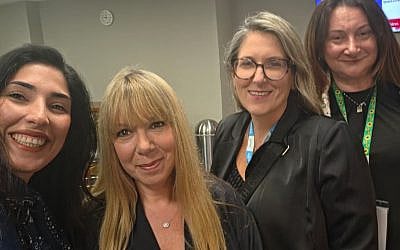
Today, I attended a gynecology conference in London to speak about DES—a topic I have explored in previous blog posts. I spoke about patient experience, medical harm, and the heavy physical toll women carry from decisions made before they could ever consent.
But the most striking encounter of the day did not happen during my own session.
It came from meeting two professionals from the Hillel Yaffe Medical Center, in Hadera, Israel: one Israeli Jew and one Israeli Arab. They work side-by-side in breastfeeding and midwifery, and had travelled together to present their work to medical colleagues in the UK.
There was something quietly extraordinary about them.
To understand why, you have to look at where they come from. Hillel Yaffe is a major public hospital that sits at a unique geographical and cultural crossroads. It serves a diverse population of over half a million people—stretching from coastal Jewish hubs like Netanya and Zikhron Ya’akov to the Arab towns of the Triangle and Umm el-Fahm along the Green Line. On any given day, its wards are a microcosm of the region’s complexity, bringing together Jews, Muslims, and Christians, veteran citizens, and new immigrants. Coexistence there isn’t a policy paper; it is the default operational reality.
Yet, seeing them in London, their partnership felt extraordinary. Not because their presence was theatrical. Not because it was framed as a grand peace project. And certainly not because anyone was pretending the world outside that conference room was simple.
It was extraordinary because it was ordinary.
Two colleagues. One field of care. One shared professional language. One mutual commitment to mothers and babies.
In an era where public conversation routinely reduces human beings to rigid categories, slogans, and existential threats, the sight of these two women working together in the most intimate field of care felt like a small act of moral clarity.
Coexistence, I realized, is not always a loud declaration. Sometimes, it is a handover on a maternity ward. Sometimes, it is helping a mother feed her baby. Sometimes, it is knowing that the person beside you speaks another language, carries a different history, and prays differently—or not at all—and still choosing to share the work.
The Narrow Bridge
Rabbi Nachman of Breslov famously taught: Kol ha’olam kulo gesher tzar me’od – the whole world is a very narrow bridge.
The traditional song finishes with the line: Veha’ikar lo lefached klal—and the essential thing is not to be afraid at all.
But I have always wondered if that teaching is better understood not as the complete absence of fear, but as the stubborn refusal to be governed by it. In fact, Rabbi Nachman’s original Hebrew text uses the reflexive verb form lo yitpached—suggesting not a command to be fearless, but an instruction to not turn ourselves into fear, or let fear become our active master.
Because the fear is real. It has become the daily emotional weather of Jewish life. Since October 7th, fear has quietly underpinned our most ordinary activities: going to shul, posting online, traveling, speaking publicly, explaining ourselves, or choosing not to.
It also shadows the relationships between Jews and Arabs, Jews and Muslims, Israelis and Palestinians, and Diaspora communities and their neighbors. To pretend otherwise would be dishonest.
The bridge is narrow. Exceptionally narrow. But the teaching does not say there is no bridge.
A Kitchen in Leeds
A week before the conference, I visited Marlows British Kitchen. It is a grassroots collaboration between Jewish and Muslim communities that has recently caught the public imagination, promoted widely on social media by barrister and TV presenter Rob Rinder.
This is not an abstract slogan; it is a practical reality built on the most iconic of British comfort foods: fish and chips. Founded by two Muslim business partners, Jenade Yamin and Arabaab “Paddy” Munir, Marlows is 100% halal while simultaneously providing the area’s first certified kosher fish and chip facilities in half a century.
Rather than keeping their communities separate, local Orthodox leadership, including Rabbi Anthony Gilbert, stepped in to help guide the strict kashrut standards. The collaboration runs so deep that local Jewish community members have even pitched in to cover longer shifts when the Muslim kitchen staff were fasting during Ramadan.
As Rinder beautifully highlighted in his videos, inside Marlows you see side-by-side halal and kosher fryers, and one long queue of Orthodox Jews, Muslim families, and neighbors from every background ordering the same national dish. Everyone remains unmistakably themselves, but they have simply chosen to widen the table.
There is something deeply Jewish about using food as a bridge. A dinner table naturally lowers the temperature of ideology. A kitchen demands action rather than declarations. A shared meal creates a temporary community between people who may not agree on everything, but who can still sit, eat, and recognize one another’s shared humanity.
That matters immensely right now. Coexistence cannot survive if it only exists on protest posters, panel discussions, and carefully worded corporate statements. It has to be practiced somewhere tangible.
A ward. A kitchen. A classroom. A table.
Learning the Other Language
When I was in Israel, I heard Hersh Goldberg-Polin’s cousin, Rebecca Bardach—a writer and prominent advocate for Arab-Jewish integrated education—speak about the grueling work of bridging cultural gaps. She did not use the sentimental, sanitized language of traditional peace-building. She spoke in the language of necessity.
Drawing from her personal experience as a parent and activist within the mixed school network, she talked about children learning alongside one another, and the vital importance of learning each other’s languages.
That idea stayed with me. Language reduces fear because it makes the “other” much harder to demonize. A name pronounced correctly, a greeting understood, a joke translated, or a vulnerable mother reassured in her native tongue—these are not small things. They form the human infrastructure of trust.
Coexistence Is Not Innocence
To be absolutely clear: none of this erases October 7th. None of this erases the profound grief, trauma, rage, betrayal, or fear that now sits in the homes of Israeli families and Jewish communities worldwide. Just as none of it erases the catastrophic devastation, loss of innocent life, and overwhelming human suffering enduring in Gaza. None of this asks people to pretend that trust has not been shattered, nor does it magically answer complex political questions.
It brings to mind Naomi Shemer’s timeless Israeli anthem, Al Kol Eleh. She famously prayed: “Al hadvash ve’al ha’oketz, al hamar vehamatok”—bless the honey and the sting, the bitter and the sweet. Shemer understood that to survive, one must possess the disciplined capacity to hold space for opposing realities at once. We cannot wish away the sting of our current reality, but we cannot let it poison the honey of our future, either.
Despair simply cannot be our only honest response.
There must still be room for the people doing the daily, unglamorous work of keeping human contact possible. The Israeli Jewish midwife and the Israeli Arab midwife; the Jewish and Muslim cooks in Leeds; the children in mixed schools; the person learning another language because fear grows fastest where imagination fails.
These people are not naïve. They are disciplined. They are actively crossing a narrow bridge.
The Body, Again
Perhaps it is no accident that the encounter which prompted this reflection happened at a gynecology conference. So much of my own work around DES has centered on the physical body: harm carried silently, consequences emerging across generations, and the medical necessity of listening to patients as whole people rather than clinical case studies.
Breastfeeding and midwifery are among the most intensely embodied forms of care. They deal with birth, nourishment, pain, exhaustion, touch, and the terrifying vulnerability of new life.
If coexistence can happen there, it ceases to be theoretical. It is happening at the visceral level of breath, milk, language, and care. Peace, if it is ever to be real, cannot remain in the realm of political speeches. It must enter the body of daily life.
The Work of Bridging
In frightened times, it is incredibly tempting to retreat into absolute certainty. To decide definitively who is safe and who is not; who belongs and who does not; who can be trusted and who cannot.
Some of those distinctions are necessary. There are real threats, profound wounds, and valid reasons for caution. But there is an equal danger in letting fear become our sole organizing principle. If we declare every single bridge unsafe, eventually we stop crossing altogether.
And then our world becomes smaller, harder, and fundamentally less human.
Crossing Anyway
What stayed with me from the conference was not a grand geopolitical statement, but the ordinary courage of shared work. Two women from Israel, one Jewish and one Arab, standing together in the UK to teach others how to care for mothers and babies.
What stayed with me from Leeds was not a slogan, but a hot meal. What stayed with me from Israel was the reminder that children who learn each other’s languages might grow up just a little less afraid.
These are narrow bridges, but they are bridges nonetheless. In a world where so many forces are heavily invested in widening the chasm, the act of crossing is itself a quiet form of resistance.
The Main Thing
Rabbi Nachman never claimed the bridge was wide. He didn’t promise it would be easy, safe, or that we wouldn’t tremble as we walked across it. He simply stated that the whole world is a very narrow bridge.
And the essential thing is not to make fear our master.
Perhaps coexistence begins exactly there. Not with certainty, innocence, or forgetting, but with two people willing to stand beside one another and simply do the work.
A hospital ward. A kitchen. A school. A shared language.
One crossing at a time.