
Writer covering Israel–Africa, Jewish affairs, and Israel worldwide
Gideon, the 300, and Israel’s Unseen Spiritual Army
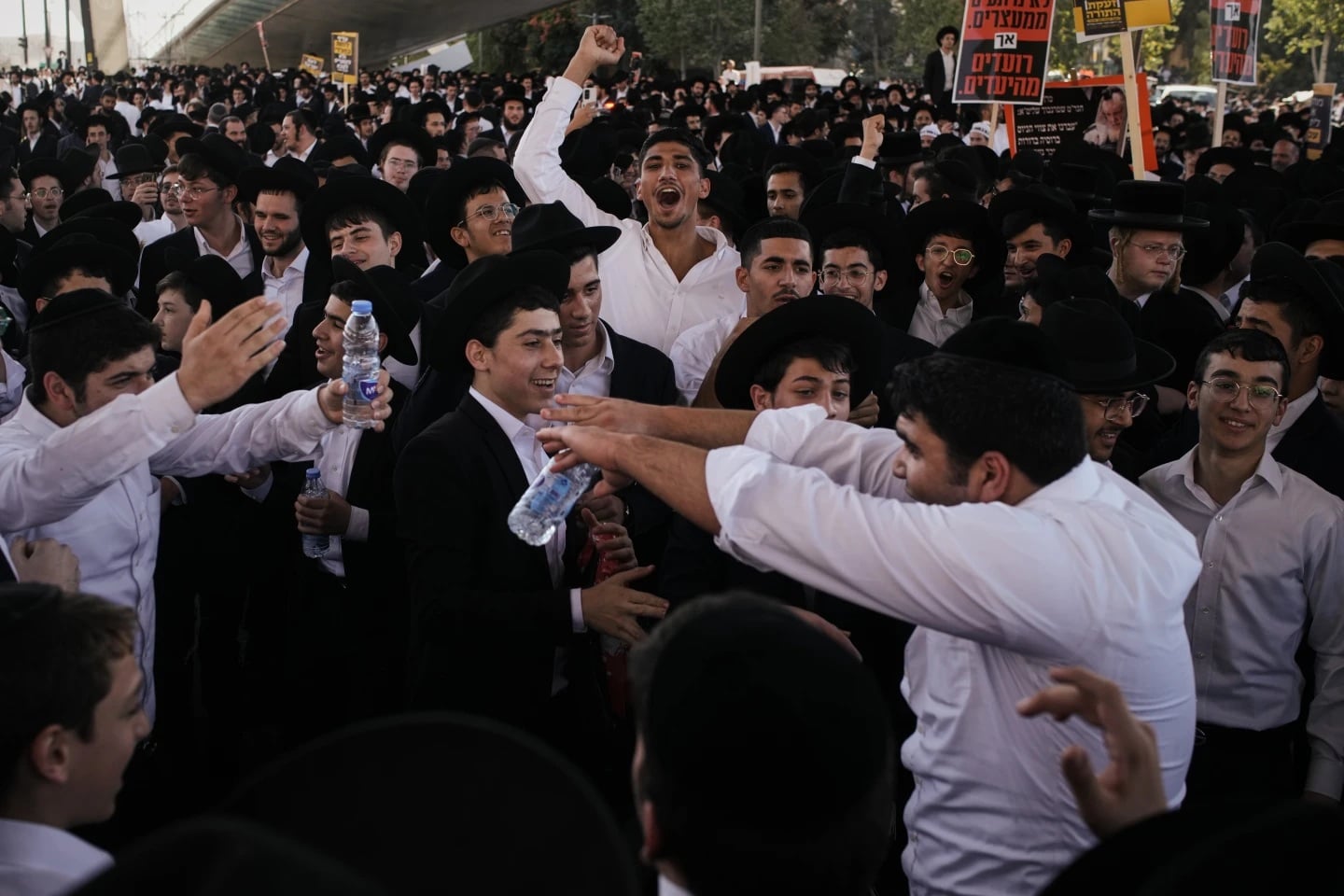
Ultra-Orthodox Jewish men protest against plans to force them to serve in the Israeli military, in Jerusalem, Thursday, Oct. 30, 2025. (AP Photo/Leo Correa)
Israel loves a debate, and none is louder than who protects the nation: soldiers in uniform or scholars in holy texts? Judges 7 tells the story of Gideon’s 300 — a tiny force achieving victory through strategy and faith. Perhaps strength is not only in numbers, but in focus, devotion, and unseen effort.
When Divine Strategy Outweighs Numbers
In Judges 7, the Bible recounts one of the most dramatic examples of unconventional military strategy:
“The Lord said to Gideon, ‘The people with you are too many for me to give the Midianites into their hands, lest Israel boast against me, saying, “My own hand has saved me.”’ So the Lord said to Gideon, ‘The people with you are too many; take them down to the water, and I will test them for you there.’” (Judges 7:2‑3, ESV)
Gideon begins with an army of 32,000 men. God’s instructions whittle it down to just 300. The logic is startling: too many soldiers, and Israel might credit their own strength instead of divine guidance. Fewer soldiers? Every victory clearly points to God’s intervention.
As an observer, this story reads like a masterclass in minimalism and faith-based strategy. It’s not just about reducing numbers—it’s about creating conditions where cleverness, discipline, and morale can multiply effectiveness far beyond the size of the army. The 300 men, equipped only with trumpets, jars, and torches, rout a massive Midianite force.
It’s the ultimate example of quality over quantity. And it’s easy to see why some modern thinkers, or anyone pondering unconventional approaches to national defense — might read this and ask: if divine guidance once favored a tiny, committed force over a vast army, could Israel today benefit from valuing focus and devotion alongside raw manpower?
Could Torah Study Be a Form of Defense?
Hear me out: imagine that spiritual devotion is another layer of national protection. The quiet turning of pages, the hum of prayers, the unassuming intensity of study.
In this line of thinking:
-
Spiritual dedication builds resilience against despair, disunity, and moral erosion.
-
Devotion can act as an unseen shield, complementing conventional defense.
-
If Gideon’s 300 sufficed once, perhaps focused effort and faith could still provide formidable defense in different ways.
It’s not that anyone is shirking responsibility — rather, strength might take forms that are invisible to the casual observer.
Modern Israel: Drafts, Protests, and the Weight of Choice
Fast forward to today: Israel’s government has been trying to enforce conscription among ultra-Orthodox youth, a move that has sparked massive protests. Tens of thousands gather in Jerusalem, waving signs and voicing deep convictions about community, faith, and duty.
The government’s position is clear: Israel needs manpower, reserves are stretched, and compliance is critical. Yet only a small fraction of those summoned actually report to duty. For an observer like me, it’s a drama that blends history, religion, politics, and social dynamics into something utterly unique: a debate about national survival filtered through millennia of belief, culture, and law.
Mirroring the Logic, Not Claiming the Position
I should stress: I’m not speaking for anyone here. I’m simply exploring the logic as if it were a thought experiment: if Gideon’s 300 could prevail through strategy and faith, could modern Israel similarly benefit from recognizing multiple forms of service?
Perhaps the nation can be protected not only by soldiers in uniform, but also by those dedicating themselves to spiritual, moral, and social resilience. It’s a provocative idea — one that invites curiosity, discussion, and even admiration for the ingenuity of human reasoning.
Imagining a Balanced Defense
What if Israel could fully embrace this dual approach?
-
A layered defense: troops for physical threats, scholars and community leaders for moral and social resilience.
-
Respect for different callings: some fight with rifles, others with study and prayer, yet both serve the same nation.
-
A society strengthened by diversity: acknowledging that not all battles are fought on traditional battlefields.
Even as a observer, I can’t help but admire the elegance of such a concept — messy in execution, yes, but fascinating in principle.
Reflection: Between Sword and Scroll
There is something almost mesmerizing about Israel’s balancing act — a nation where the clang of boots and the quiet rustle of pages coexist, each rhythm as vital as the other. Between the sword and the scroll, between the battlefield and the study hall, Israel traces a path that is uniquely its own. Some defend with rifles, charging forward under the sun, counting on strategy, training, and sheer will. Others defend in silence, turning pages, whispering prayers, debating the subtleties of law and ethics — building invisible walls of resilience around the nation’s spirit.
From the outside, it looks like a paradox: the loudest and quietest forms of defense operating side by side. Yet it is a harmony born of necessity. The sword meets the scroll; action meets reflection. One without the other risks imbalance, but together they form a complex, living tapestry of protection.
And perhaps there is poetry in that: the same land that has faced invaders and exile now nurtures a dual army — one of strength, one of devotion — both aiming to preserve the same people, the same ideals, the same future.
Between stone and scroll, sword and soul,
Israel strides its eternal path.
Some defend with arms, others with minds,
Yet all serve the same sacred mission.
This duality, both practical and symbolic, is what makes Israel endlessly fascinating to observe. A nation negotiating faith, history, and survival — all at once — where each contribution, visible or unseen, carries weight.
Lessons from Gideon for a Nation Today
Gideon’s 300 remind us that victory isn’t always measured by numbers alone. Sometimes it’s measured by focus, ingenuity, and faith. Yet, as any attentive observer quickly realizes, divine strategy only goes so far — someone still has to show up with boots, rations, and a healthy respect for mortars.
Israel today faces a complex reality. Spiritual dedication, Torah study, and unseen resilience all matter, but so do soldiers on the front lines — the ones who have brought victories against Hamas in Gaza, Hezbollah in Lebanon, and who continue to keep a wary eye on Iran. Let’s be honest: no miracle of strategy or prayer alone will hold the border if no one is willing to march, fire, and occasionally curse the morning alarm.
And yet, perhaps the lesson from Gideon is not to replace one with the other, but to see both as indispensable: the scholar and the soldier, the study hall and the battlefield, each playing a part in the defense of a nation that is always balancing history, faith, and survival.
From the outside, it’s astonishing to watch. A tiny country managing huge threats, a population negotiating multiple visions of duty, and a debate over whether the greatest army is the one in uniforms or the one in yeshivas. The truth, of course, is both.
Victory, in Israel as in Gideon’s story, comes from strategy, devotion, and boots — preferably all in harmony.
So perhaps the real miracle is that Israel manages to hold it all together: its soldiers in the field, its scholars in study halls, and the nation’s heart somehow beating in unison — at once spiritual, practical, and unapologetically complex.
And yet, one question lingers, teasing both prayer and policy alike: which way, Israel — will the yeshiva continue its sacred studies, or will it transform into a battalion?
Related Topics
Related Posts