
CEO of Time to Stand Up for Israel
The Units That Stand Between Israel and Its Enemies
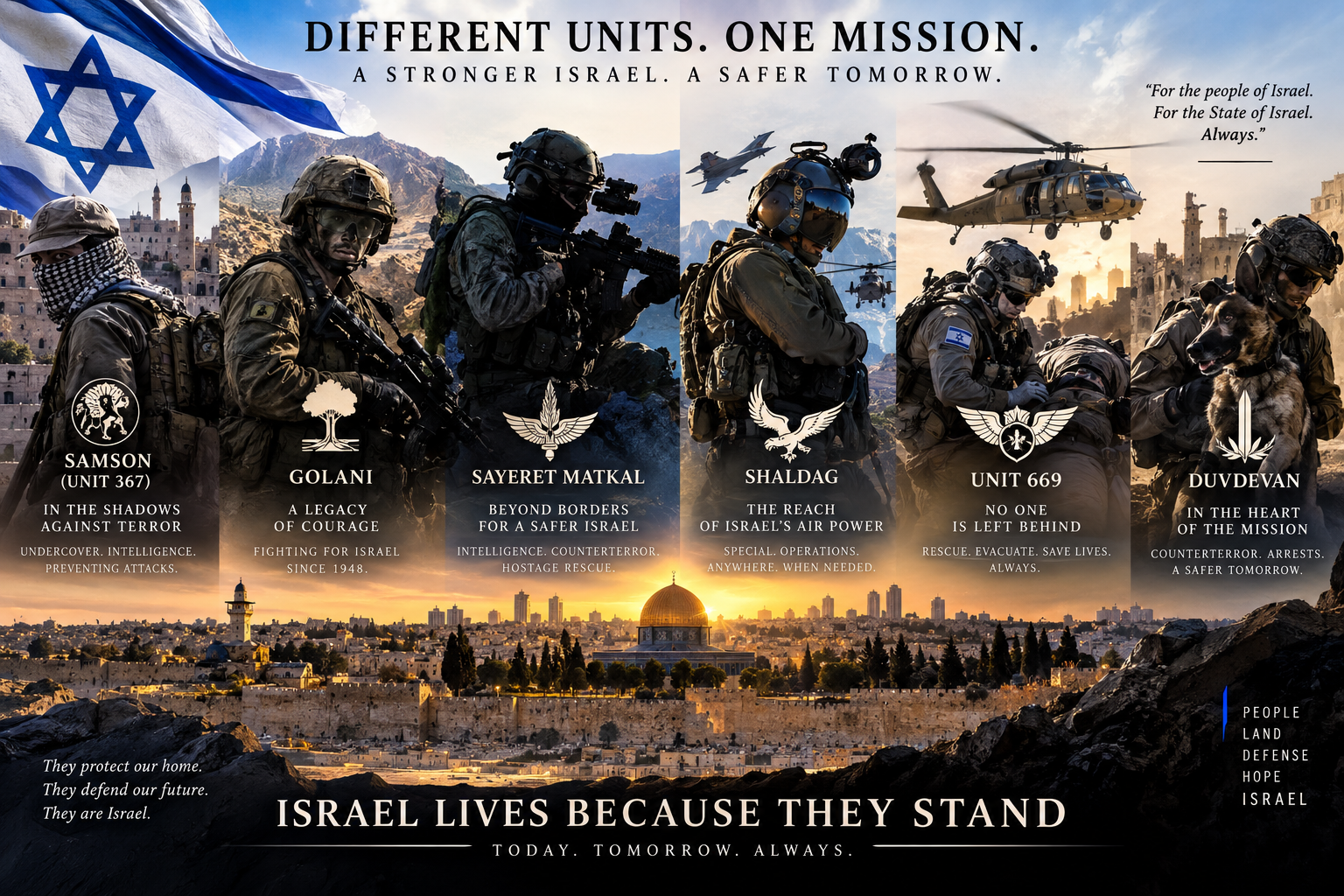
Photo Credits: Sabine Sterk ( AI)
The Units That Stand Between Israel and Its Enemies
There are military units that become famous because of a single battle, there are units remembered because of one extraordinary commander, and then there are units whose names become part of the identity of a country because generation after generation they have been sent to places where failure was simply not an acceptable option.
Israel has several of them.
Golani. Sayeret Matkal. Shaldag. Unit 669. Duvdevan. And once, operating in an entirely different world of undercover warfare, there was Samson.
Their missions have been different, their methods have been different, and much of what some of these units have actually done will probably remain classified for decades, but they share something fundamental. They were created because Israel learned very early that a small country surrounded by serious security threats cannot always depend on numbers. It has to depend on intelligence, speed, initiative, training and people prepared to make extraordinarily difficult decisions under pressure.
Samson, the soldiers who disappeared into the environment
One of the most fascinating examples was Unit 367, better known as Samson or Shimshon.
Samson was an undercover special operations unit that operated in the Gaza Strip between 1986 and 1996. Its soldiers belonged to the world of the mista’arvim, Israeli personnel trained for undercover operations within Arab environments, and its responsibilities included intelligence gathering and counterterrorism operations against militants. Veterans of the unit describe a legacy built around creativity, persistence and the fight against terrorism.
Think about what that required.
A conventional infantry soldier can enter battle visibly carrying the identity of his army. An undercover operator may have to suppress almost every outward sign of who he really is. Language, behavior, appearance, knowledge of local customs and the ability to remain composed when one mistake could expose an entire operation all become part of the weapon.
Samson was eventually disbanded following the political agreements concerning Gaza, but the concept did not disappear with it. Duvdevan, established in 1986, developed its own specialization in counterterrorism operations in Judea and Samaria, including both overt and undercover operations. During the terrorism wave that began in 2015, Duvdevan participated in the arrests of suspects accused of several deadly attacks, and in 2016 the unit received a Chief of Staff citation for its operations during that period.
This is an aspect of Israel’s defense that outsiders often fail to understand. Preventing an attack can require enormous effort while producing almost no dramatic photograph afterward. When intelligence and special forces succeed, the result may simply be that the bombing, shooting or kidnapping that was being prepared never happens.
Golani, fighting since the birth of Israel
Then there is Golani.
Unlike Samson, Golani is not a small undercover unit. It is one of the historic infantry brigades of the IDF, established in 1948 and continuously connected to Israel’s military history from the War of Independence onward. According to the IDF’s historical account, Golani has participated in every Israeli war and some of the country’s hardest battles.
Its history reads almost like a military map of Israel itself.
During the War of Independence Golani fought against invading Arab armies. In 1956 it fought around Rafah. During the Six Day War its soldiers fought the brutal battle for Tel Faher on the Golan Heights. In 1973 Golani fought for Mount Hermon, after the Israeli position there had fallen to Syrian forces at the beginning of the Yom Kippur War. The first attempt to retake the position failed, but during Operation Dessert, Israeli forces including Golani ultimately recaptured the strategically important Hermon positions.
That history matters because Golani represents something deeper than military hardware.
Weapons change. Technology changes. Intelligence systems change. The battlefield changes. But eventually there are moments when somebody still has to physically move forward into dangerous territory and hold it.
For more than seven decades, Golani soldiers have repeatedly been among those people.
Its reconnaissance tradition is equally remarkable. The origins of Golani’s reconnaissance element reach back to the War of Independence, when small commando teams operated within the brigade. Decades later its reconnaissance fighters were involved in operations ranging from Beaufort in Lebanon to discovering terrorist tunnels in Gaza.
Sayeret Matkal, when intelligence becomes action
Perhaps no Israeli special operations unit has acquired greater international recognition than Sayeret Matkal.
Established in 1957, the General Staff Reconnaissance Unit was created primarily for strategic intelligence gathering deep behind enemy lines, although its responsibilities developed to include counterterrorism and hostage rescue beyond Israel’s borders. Much of its operational history remains classified.
And then there was Entebbe.
In June 1976 an Air France aircraft traveling from Tel Aviv via Athens was hijacked and ultimately taken to Entebbe, Uganda. Israeli and Jewish passengers were separated from other hostages. Israel faced an almost absurd military problem. Its citizens were being held thousands of kilometers from home, in another country, with armed terrorists and Ugandan forces present.
Israel chose to attempt the rescue.
Israeli commandos flew across Africa, landed at Entebbe and rescued 103 hostages. The operation became one of the best known hostage rescue missions in modern military history.
The significance of Entebbe goes far beyond the tactical achievement. It demonstrated a principle that has shaped Israeli security thinking for generations. Distance does not automatically make Israelis unreachable, and taking Jews hostage does not guarantee that Israel will accept the situation as irreversible.
Shaldag, the Air Force soldiers on the ground
People often imagine an air force entirely in terms of aircraft, pilots and missiles, but some of the most interesting capabilities of the Israeli Air Force operate on the ground.
Shaldag is one of them.
Created in 1974 following lessons from the Yom Kippur War, Shaldag initially developed from a reserve company associated with Sayeret Matkal before becoming an operational unit directly under the Israeli Air Force. Its precise activities remain largely classified, which is exactly what should be expected from such a unit.
What is publicly known is already impressive.
Shaldag participated in Operation Solomon in 1991, when Israel airlifted thousands of Ethiopian Jews to Israel. It later operated in Lebanon during Operation Accountability in 1993 and Operation Grapes of Wrath in 1996, and during the Second Lebanon War its personnel carried out operations deep inside Lebanon against Hezbollah.
There is something characteristically Israeli about Shaldag. It connects intelligence, aviation and ground operations instead of treating them as completely separate worlds.
Unit 669, the people who go back for you
And then there is a unit whose purpose says something extraordinary about the values behind an army.
Unit 669.
The Israeli Air Force’s tactical rescue unit was established after the Yom Kippur War, when Israel recognized the need for a dedicated capability to rescue aircrews who had gone down in hostile territory. Its responsibilities eventually expanded far beyond pilots, and today its mission includes rescuing soldiers and civilians under extraordinarily difficult conditions.
Its soldiers are trained to enter the very environment from which everybody else is trying to escape.
During the Second Lebanon War, for example, Unit 669 was dispatched to rescue naval commandos in Tyre after a soldier was critically wounded. According to the IDF’s account, the rescue team treated the wounded soldier while operating under the threat of attack and evacuated him by helicopter, with a unit doctor performing an emergency airway procedure that helped save his life.
That may be one of the most powerful ways to understand Israel’s special units.
Some exist to find the enemy.
Some exist to gather intelligence.
Some exist to rescue hostages.
Some exist to penetrate territory that conventional forces cannot easily reach.
And Unit 669 exists in large part to make sure that when Israelis go into danger, somebody is prepared to go into that same danger to bring them home.
More than famous names
There are many more remarkable IDF units whose stories deserve their own articles, including Shayetet 13, Maglan, Egoz, Yahalom and Oketz. The IDF itself currently identifies Sayeret Matkal, Shayetet 13, Shaldag and Unit 669 among its four elite units, alongside numerous other specialized and commando formations.
But what fascinates me is not simply how elite these soldiers are.
It is why Israel repeatedly needed units like them.
Israel was not given the luxury of building its defense doctrine in peace and then waiting decades to discover whether it worked. From 1948 onward, Israeli military doctrine was repeatedly tested by wars, terrorism, infiltrations, hijackings, hostage situations, rockets and attacks on civilians.
Mistakes therefore carried consequences measured not merely in territory but in human lives.
That pressure produced a military culture in which intelligence had to be connected with action, improvisation had to coexist with discipline, and tiny groups of extraordinarily well trained people sometimes had to accomplish missions completely disproportionate to their numbers.
Of course, no military unit is infallible, and military history should never be turned into mythology. Operations fail, intelligence fails, commanders make mistakes and soldiers pay terrible prices. Israel’s own military history contains all of those painful chapters.
Perhaps that is exactly why these units deserve respect.
Their remarkable character is not that their soldiers are somehow superhuman. It is that ordinary human beings are trained to function in situations most of us will never experience, knowing that behind them is a country small enough for almost every casualty to feel personal.
For decades, Golani soldiers have fought Israel’s hardest ground battles. Samson’s operators entered an undercover world in which exposure could mean death. Sayeret Matkal developed the ability to take Israeli power far beyond Israel’s borders. Shaldag connected the reach of the Air Force with soldiers operating on the ground. Unit 669 built an entire culture around reaching the wounded when reaching them seems impossible.
Different uniforms. Different missions. Different generations.
The same country.
And ultimately the same purpose.
To make sure that the State of Israel, surrounded by enemies that have repeatedly tried to destroy it, remains capable of defending its citizens and bringing its people home.
That is not merely military history.
It is part of the story of how Israel survived.
Related Topics