
Working to protect people and our shared planet.
Glancz Family Shows How to Be Immortal through Tzedek DC
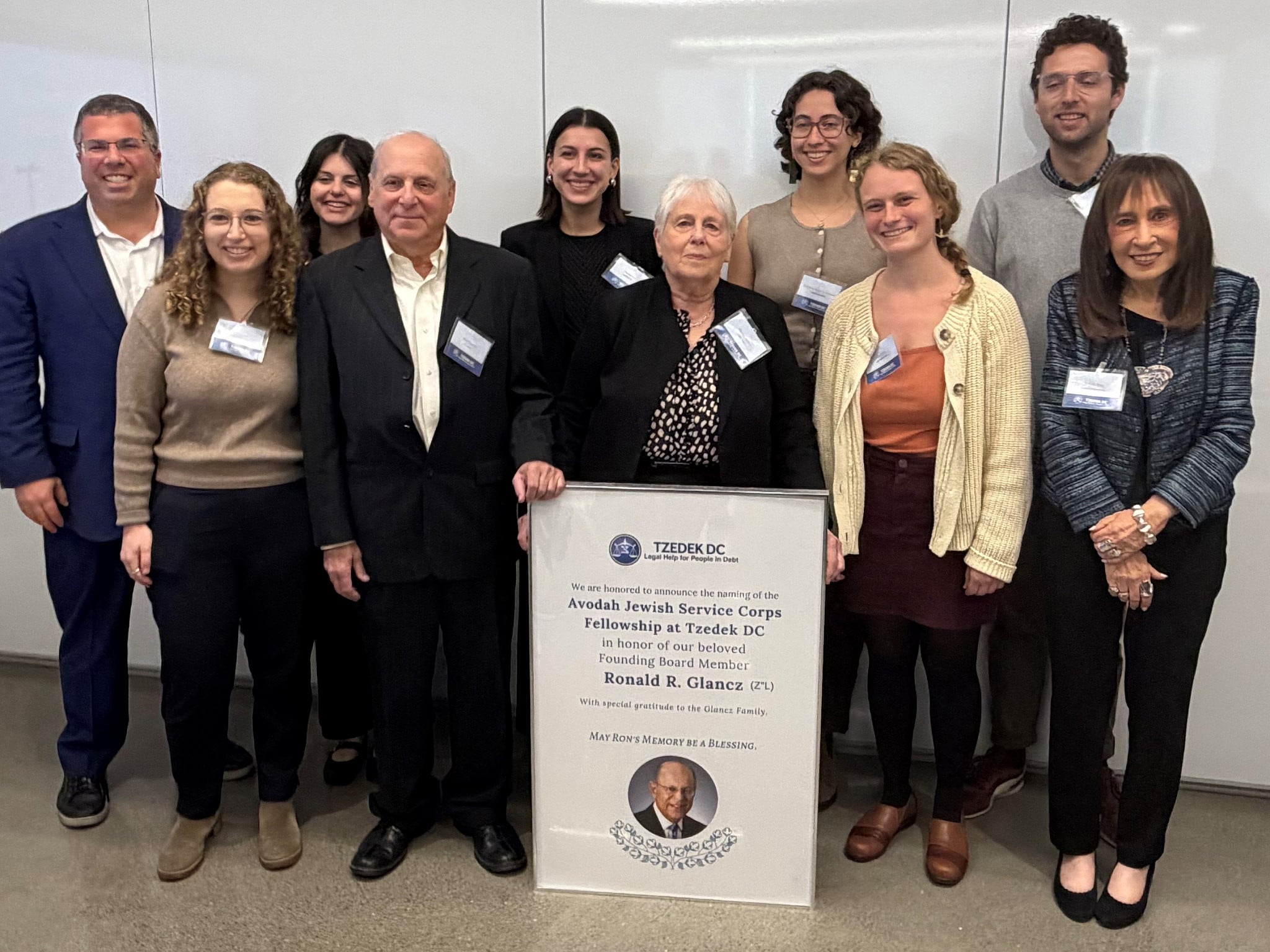
Margie Glancz (center) surrounded by her brother, Tzedek's Ariel Levinson-Waldman, Vivian Bass and numerous talented Ronald R. Glancz Avodah Jewish Service Corps Fellows. Photo by and courtesy of JLM.
In the Silicon Valley there are people who are searching to literally live forever. But the Glancz family and Tzedek DC have shown us real success – the way to make VALUES into a life that never really ends.
In Jewish tradition, we often speak of l’dor v’dor—from generation to generation. It’s not just a poetic phrase. It’s a blueprint for impact. It asks whether our values, our actions, and our commitments will carry forward long after we are gone.
By that measure, Ronald R. Glancz (z”l) – with the help of family, colleagues and friends – achieved something close to immortality.
Ron was known across the Washington region’s Jewish, legal, and civil rights communities as a man of deep integrity, rigorous ethics, and unwavering commitment to justice. Guided by the teaching “tzedek, tzedek tirdof”—justice, justice you shall pursue—he didn’t just believe in fairness. He built systems to deliver it.
One of those systems is Tzedek DC, an organization Ron helped bring to life and sustain. Today, it stands as a powerful response to a quiet but devastating crisis: the overwhelming number of low-income Washington area residents facing life-altering debt collection actions without legal help.
The consequences of that injustice are staggering. Families lose access to bank accounts. Driver’s licenses are suspended. Job opportunities disappear due to damaged credit. For many—disproportionately people of color—these legal issues can trigger a cascade toward unemployment, housing instability, or worse.
And yet, there is a striking truth: when people do have legal representation in these cases, they succeed more than 90% of the time.
That gap—between what is possible and what is accessible—is where Tzedek DC operates. And where Ron’s legacy lives.
Through free legal services, policy advocacy, and financial empowerment programs, Tzedek DC has already helped more than 6,000 families stabilize their lives—and driven systemic changes benefiting more than 300,000 DC residents. This is not abstract justice. It is justice measured in preserved homes, protected wages, and restored dignity.
But perhaps the most powerful expression of Ron’s legacy is the Ronald R. Glancz Avodah Jewish Service Corps Fellowship.
Each year, this fellowship brings a young leader—driven by values of tikkun olam, repairing the world—into the heart of Tzedek DC’s work. These fellows are not just learning the law. They are living it. They are sitting with clients facing impossible choices, helping them navigate complex systems, and ensuring that justice is not reserved for those who can afford it.
In doing so, they become the next generation of Ron’s values in action.
This is how legacy becomes living.
As Ron’s dear friend Vivian Bass reflected, he was “an incomparable moral compass” who believed deeply in bringing people together and tackling even the hardest problems. She recalled his steady advice in moments of tension: “Don’t fight fire with fire; instead fight fire with water.” That combination of principle and humanity—of strength and compassion—is exactly what these fellows now carry forward.
The Glancz Legacy Fund ensures that this work continues. It supports not only the fellowship, but also Tzedek DC’s Disabilities Community Project—an essential initiative providing tailored legal services to people with disabilities, who make up more than one in five of Tzedek DC’s clients. As someone who has advocated for disability inclusion, I know how critical this work is—and how rare it is to see it done so thoughtfully.
Ron understood something fundamental: justice must be accessible to everyone, or it is not justice at all.
His widow, the equally amazing Margie Glancz, captures that spirit beautifully. She said:
“The concept of Dor L’Dor was very important to Ron. He was proud to be Jewish and felt a responsibility to transmit his Jewish values to the next generation. Ron’s decision to mentor Ariel Levinson-Waldman (who leads Tzedek) and establish the group resulted in Ariel’s mentoring and support of the Avodah fellows to pursue justice and make the world a better place. A clear example of D’L Dor.
Ron volunteered to help establish Tzedek because Tzedek would be an organization with a name drawn from Torah, based on Jewish values, supported by the Jewish community while serving the whole community and building bridges.”
That is the essence of l’dor v’dor. Not just remembering, but continuing. Not just honoring, but building.
At a time when so many people feel overwhelmed by the scale of injustice in our world, the model Ron helped create offers something rare: a practical, proven way to make a difference. Train the next generation. Ground them in values. Give them the tools to act. And trust that they will carry the work forward.
Ron Glancz and his family showed us that immortality is not about being remembered.
It’s about ensuring that the work of justice never stops.
Related Topics
Related Posts