
Global Orchestration of anti-Israel Mobilisation
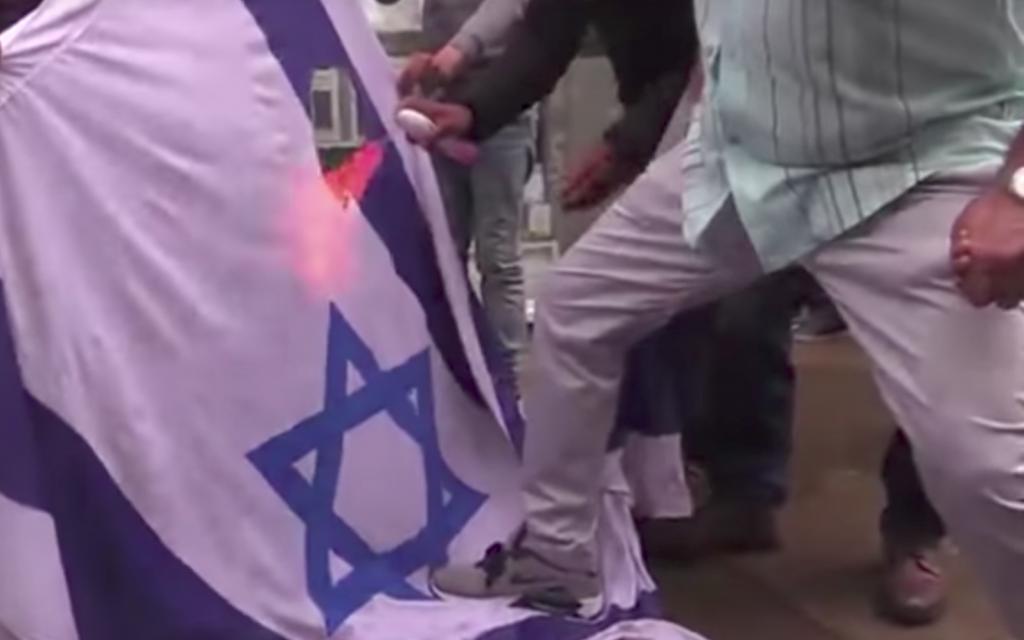
From October 7, 2023, Back to the Red/Green Alliance
If the Islamic Republic of Iran is the model of the red/green alliance fallout, the West has a mountain to climb if it is to survive. It cannot begin to climb that mountain if it doesn’t recognise Israel as the bulwark that leads the way forward despite extremist activist propaganda. Western leaders such as those of Canada, UK and Australia have failed by recognising and promoting a non-existent state in which Palestinianism can thrive ideologically, doing everything power allows to subsume any opposition to this dangerous folly. This failure will have dire consequences into the future.
The immediate and synchronised eruption of anti-Israel demonstrations across Western capitals after Hamas’s brutal invasion from Gaza into Israel on October 7, 2023, has raised questions about orchestration. It is improbable that crowds materialised overnight carrying matching placards, organised leaflets, tents and coordinated slogans. This points not to spontaneous outrage, but to pre-existing organisational infrastructure primed and waiting to mobilise.
James Lindsay explains that two things are required to influence society: Propaganda and a fertile soil.
Circa 2018 James Lindsay, Helen Pluckrose, and Peter Boghossian sent fake papers to various academic journals specialising in activism or “grievance studies.” Their idea was to expose to how easy it is to get “absurdities and morally fashionable political ideas published as legitimate academic research.”
Born into a Roman Catholic family, growing up amongst Protestants, James is an ex atheist now reportedly an agnostic who recognises Christianity.
Shaun King explains the blueprint for activism necessary for mobilisation requires four things to make change:
Highly energised people; organisation; a list of people who can help; available skills.
In 2020 the world saw the fruition of his work when BLM (Black Lives Matter) violence broke out across America.
Shaun King was then a pro Palestinian activist propagating Palestinianism alongside Linda Sarsour. For many years he was a christian pastor. He is now fully converted to Islam.
Many people perceive Palestinianism as simply another identity group whose purpose is to influence society in the given of the day. Greta Thunberg offers a clear example of this phenomenon. Initially, Thunberg rose to international prominence for her climate activism, becoming a celebrated figure recognised by world leaders as an ‘Enfant Pensable’. Speaking at major climate events and even the United Nations from late 2018, by October 2023 her public focus shifted when she posted a photo on social media, expressing solidarity with Palestinians. By 2025 Thunberg had fully aligned herself with the pro-Palestinian movement.
While the role of Iranian and Gulf money, particularly Qatari funding, is often highlighted with regard to Palestinianism, the deeper question lies in understanding who laid the social, ideological, and logistical groundwork enabling this level of “instantaneous” global coordination. Without organisational coordination funding alone is inept.
It is widely misunderstood that Palestinianism and its peoplehood represents merely another identity-based movement; in reality, it functions as a coherent ideology, weaponised against the West, drawing strength from its ability to merge disparate political and cultural grievances under the guise of solidarity. To answer this we must trace the genealogy of Palestinianism as a political concept, the collaboration between Marxist-Communist networks and Islamist movements, as well as the institutionalisation of anti-Israel activism through organisations such as the Palestine Solidarity Campaign (PSC), the Boycott, Divest, Sanctions (BDS) movement, and various affiliated and aligned bodies. Palestine Action is a case in point: proscribed in the UK in 2025, the Government failed to focus on the parent organisations, leaving space for factions and cells to re-emerge under new identities.
The modern idea of the Palestinians as a distinct national people has contested roots. Before 1964, Arab inhabitants of Mandatory Palestine were primarily identified as Arabs of Southern Syria, or more broadly as members of the Arab nation. It was with the establishment of the Palestine Liberation Organisation (PLO) under the aegis of the Arab League, heavily guided by Soviet KGB strategy, that Palestinianism emerged as a defined political identity in 1964. This was not simply historical happenstance: the Soviet Union understood that instead of encouraging Arab states to absorb the refugees following the 1948 war, weaponising them into a revolutionary vanguard against Israel gave Communism new leverage in the Middle East as well as a weapon in the cold war with the West.
The creation of Palestinianism was less about nationhood than about establishing a useful ideological instrument. It could bind together liberation theology, global anti-colonial rhetoric, and anti-Zionism into an ostensibly coherent narrative that conveniently framed Israel as a colonial implant and pariah state. This framework proved exportable to Western campuses and activist networks where it gradually entered the bloodstream of left-wing movements and the main stream media worldwide, most notably the BBC. Parallel to this Soviet construction of Palestinianism, Islamist movements, most prominently those inspired by Egypt’s Muslim Brotherhood, were gaining ground.
The influence of the Muslim Brotherhood must not be underestimated. Created in 1928 it has developed into the most insidious infiltration movement seeping into western society. Its manifesto appeared in the Holy Land Foundation trial in the US when affiliated organisations were named.
Likewise, the Islamic Republic of Iran’s revolution in 1979 demonstrated the potential for Islamic networks and Marxist revolutionaries to collaborate pragmatically. Initially, Communists and Islamists joined hands to overthrow the Shah, but as soon as Ayatollah Khomeini consolidated power, he eliminated his Communist allies. The lesson was unmistakable: the “red/green” alliance could achieve revolutionary ends, but Islamist ideology would not tolerate rivals in the long term.
Nevertheless, for tactical purposes, an alliance of convenience between Marxist-inspired anti-colonial movements (“red”) and Islamist or jihadist movements (“green”) persisted. Iran, Turkey, and Saudi Arabia, despite their geopolitical rivalries, have all at times used the Palestinian cause as a mobilising symbol for transnational jihad and Islamic solidarity, binding broader Muslim identity to the anti-Israel struggle.
This tactical union created a global ideological current: a world without borders rooted either in Communism (atheist internationalism / transnational progressivism) or Islamist theocracy (the global Ummah / Caliphate). Palestinianism became the shared bridge, a unifying grievance through which the red/green alliance could attack not only Israel as the only democracy in the Middle East, but the legitimacy of Western national democratic values in totality.
Following the 2001 UN Durban Conference on Racism, where Israel was erroneously singled out as an apartheid state, anti-Israel activism entered a new institutional phase. The Palestine Solidarity Campaign (PSC) in the UK became a central platform, organising boycotts and public demonstrations. Around the same time, the Boycott, Divestment, and Sanctions (BDS) movement emerged as the PSC’s global propaganda arm (Google PSC and up pops BDS). Originally a marginal initiative, over 25 years the BDS has built itself into a recognisable international brand, operating within a sophisticated campaigning infrastructure.
By the 2020s, BDS and PSC no longer needed to build demonstrations from scratch. They had already cultivated university activist networks, unions, media allies, and funding pipelines in line with Shaun King’s initiative in the US. When October 7 occurred, the machinery was ready to reactivate with astonishing speed. Coordinated materials, placards, hashtags, and press lines were rolled out worldwide within hours, reflecting years of latent organisational planning awaiting a trigger event. By evening on October 7, 2023 demonstrations calling for ceasefire, a free Palestine from the river to the sea, to globalise the intifada and gas the Jews erupted almost simultaneously in Times Square New York, central London and the Sydney Opera House.
These instantaneous eruptions of global anti-Israel demonstrations on the very day of the 7 October invasion of Israel in 2023 were not spontaneous. For decades the red/green alliance has been meticulously building this infrastructure via the campus groups, activist NGOs, digital propaganda, and transnational solidarity networks. Local authorities were tested for possible reactions, evidenced for example by the PSC drive-through the Jewish areas of North London in 2021 calling to rape Jewish daughters and f–k their mothers. The arrest of 4 failed to materialise in convictions despite clear evidence, giving the green light for future actions despite leaders’ protestations that antisemitism would not be tolerated.
When Hamas struck on that fateful day, the networks were activated in real time. Qatar may provide financing, Iran may nourish militancy, Western NGOs may provide grassroots legitimacy, but the unified appearance of movements across continents within hours is testament to a long-prepared ideological machine. Suddenly the call to “globalise the intifada” became a reality.
Placards, tents, chants, marches – none of this springs up ex nihilo. It is the result of 60 years of Soviet ideological engineering, 40 years of Islamist jihadist mobilisation, and 25 years of BDS/PSC institutional propaganda. The immediate global chorus after October 7 was the culmination of this effort, designed to invert the narrative: Israel’s defence became delegitimised, while Hamas’s aggression was reframed as resistance. The sudden appearance of protests across Western cities on October 7–8, 2023, hours after the most heinous attack on Jews since the European Pogroms 1919-1921, was only possible because activist organisations had long maintained standing networks prepared for such triggers.
Thus it is seen that the apparent “instant” demonstrations across the West were not borne of spontaneous moral outrage, but of dormant networks trained for rapid activation. The PSC in the UK, SJP in the US, the ECCP in Europe, and BDS worldwide make up a latticework holding together NGOs, unions, student groups, mosques, churches and activist hubs. Where funding flows from states like Qatar or Iran, providing the strategic finance for Hamas and its ideological allies, the actual mobilisation is carried out by these NGOs, lobbyists, and academic activists who are embedded in Western societies. They are the executors of Palestinianism as an ideological project and the red/green alliance its tactical enterprise.
The lesson is stark: anti-Israel demonstrations are the pre-planned responses of a transnational infrastructure that has patiently laid its groundwork over decades. Understanding these networks is essential to recognising how the red/green alliance continues to weaponise Palestinianism, to advance its vision of a borderless world order, whether under the banner of Communism or global Islamism.
If the Islamic Republic of Iran is the model of the red/green alliance fallout, the West has a mountain to climb if it is to survive. It cannot begin to climb that mountain if it doesn’t recognise Israel as the bulwark that leads the way forward through extremist activist propaganda. Western leaders such as those of Canada, UK and Australia have failed by recognising and promoting a non-existent state in which Palestinianism can thrive ideologically, doing everything power allows to subsume any opposition to this dangerous folly. This failure will have dire consequences into the future.