
Writer covering Israel–Africa, Jewish affairs, and Israel worldwide
Global Outrage: Now Closed for Non-Israel Related Business
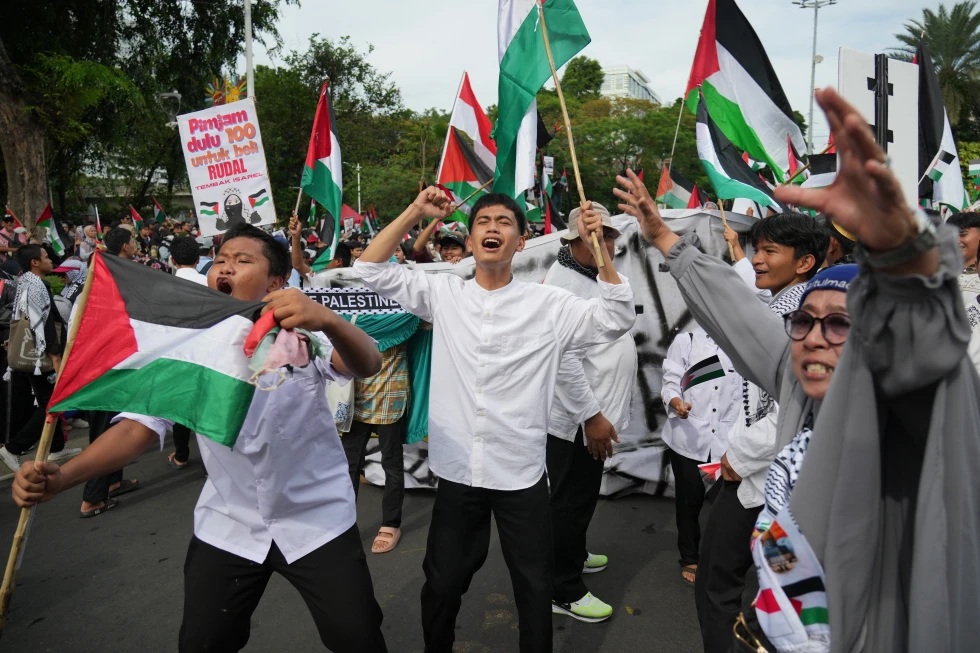
Protesters wave Palestinian flags as they shout slogans during a rally commemorating the second anniversary of the war in Gaza, outside the US Embassy in Jakarta, Indonesia, Tuesday, Oct. 7, 2025. (AP Photo/Achmad Ibrahim)
Bridges stay open, ships sail, civilians die—unless Israel is in the headline.
After Gaza: The World Discovers “Do Not Disturb”
So here we are. The Gaza ceasefire came, the hashtags faded, and suddenly the world’s conscience slipped into airplane mode. It’s almost as if “humanity” had one job—make noise—and the moment Israel was not involved, outage notifications turned off and the moral app crashed.
Meanwhile, in Iran, protests exploded into what may be one of the largest uprisings since 1979. Security forces responded with lethal force: estimates of the dead range into the tens of thousands, with some counts upwards of 36,500 killed in late December and January alone as civilians demanded basic dignity. Governments slam the door shut on reporting with internet blackouts and contested figures, producing a tapestry of numbers that only proves how many bodies are invisible until someone tweets a body bag emoji.
Did we see the world shut itself down? Did bridges close? Did activists chain themselves to anything bigger than their own outrage feeds? No. Outside of small protests in places like Berlin—brave, sincere, but nowhere near world-stopping—the global machinery of moral panic remained blissfully dormant. Even Tehran’s own foreign minister felt forced to issue the first official toll—thousands dead, according to state media—only to be treated like an afterthought in the daily churn of news.
Here’s the conundrum no one will publicly voice: civilians can be slaughtered in the tens of thousands, but if they aren’t within that very specific geopolitical frame, humanity’s notifications don’t buzz, and the outrage barometer stays at “Do Not Disturb.”
In a world where outrage is measured by how big the chaos looks on a TikTok grid, the Iran catastrophe wasn’t “Instagrammable” enough. And so the moral hellscape achieved the perfect silence after Gaza: the public conscience didn’t vanish. It merely went on silent mode.
Apparently, Ayatollahs Don’t Test Well With Activists
Here’s the part where we get to the punchline: it’s not that people aren’t dying, it’s that nobody’s crowning a meme for it. Iran’s streets have become an open wound since late December, with protests sparked by economic collapse and spiraling discontent rapidly morphing into a nationwide eruption against the clerical regime. Security forces responded with the deadliest crackdown in decades, leaving thousands dead and tens of thousands detained. Estimates vary wildly—from *at least 3,000 confirmed casualties to figures suggesting as many as 20,000 or more civilians killed—in part because the regime shut off the internet to conceal what was happening.
Human rights organizations describe unlawful use of lethal force, imprisonment of children, and a nationwide blackout once the protest toll exceeded what the state wanted seen. Security forces didn’t just fire on protesters; they throttled the channels that bring their suffering into light. And yet. Where were the flash mobs? Where were the celebrity hashtags embracing #IranLivesMatter? Thousands of deaths met a collective “meh.” A lone protest in Berlin drew maybe 8,000 people and some international political attention, but nothing close to an international emergency.
Look at it this way: if a state kills its own citizens and the only icons trending are stock photos of flame emojis, does solidarity even exist? Apparently not. The outrage machinery that roars the moment foreign policy collides with a particular Middle Eastern narrative did everything short of issue a yawn in this case. The Ayatollahs massacred protesters by the thousands—and yet, to large segments of the so-called global conscience, it barely tested as a B-side. When clicks matter more than corpses, the moral compass doesn’t just wobble—it flatlines.
Nigeria: 170 Bodies, No Bridge Closures
Let’s talk about what happened in Woro and Nuku, two villages in Nigeria’s Kwara State—which most of the world has successfully ignored, even as dozens of tweets about avocado toast keep clambering for attention.
On February 3, 2026, armed extremists carried out one of the deadliest attacks in Nigeria this year, storming the remote Kaiama Local Government Area villages of Woro and Nuku. Residents were rounded up, executed, houses burned, and shops razed in an assault that left at least 162 civilians dead, with some humanitarian groups and local sources saying the toll could be over 170. Dozens of women and children were reportedly abducted in the carnage.
This wasn’t a quick drive-by. Witnesses described militants arriving on motorbikes, sending a fake call to prayer to lure people, then firing on anyone who responded. Homes were torched, entire families wiped out, and survivors driven into the bush.
Local and regional authorities expressed horror: Nigeria’s president deployed army units under Operation Savannah Shield, governors condemned the assault as “cowardly and beastly,” and even the African Union issued a formal denunciation of the violence. But here’s the part that’s supposed to raise eyebrows: this didn’t cause international bridges to close. No iconic landmarks were blocked by demonstrators. No flotillas of outrage set sail. No global hashtags trended in solidarity. Just silence—deep, heavy, collective silence.
For context, imagine this: 170 human lives snuffed out, whole villages left abandoned, neighboring communities fleeing in terror—and the global activism apparatus keeps its voice as quiet as a library on Sunday morning. Even widespread social movements and student encampments have reported zero mobilization for these victims.
Yet if someone somewhere tweets a thumbnail of a journalist next to gunfire, a thousand algorithms go into overdrive.
So here’s the newfound rule of outrage economics: If a crisis doesn’t crash your commute, disrupt a familiar narrative, or involve a specific named conflict, it barely qualifies as news—much less a cause worth shutting a bridge for.
No Encampments for the Dead of Syria
If there’s a global rule about outrage, it’s this: it only gets traction if it’s loud, clickable, and ready for a poster frame. Otherwise? The moral machinery barely burps.
Take Aleppo, a city that has borne the brunt of over a decade of Syria’s civil war. In early January 2026, fighting flared again—this time between Syrian government forces and the Kurdish-led Syrian Democratic Forces (SDF), a conflict that reignited a humanitarian catastrophe in a city still trying to recover from years of carnage. Elements of the feud have displaced tens of thousands of civilians, with at least 30,000 people forced from their homes as clashes resumed in densely populated neighbourhoods like Ashrafieh and Sheikh Maqsoud. Curfews were imposed, entire districts became no-go zones, and families fled with nothing but the clothes on their backs.
International bodies have sounded alarms too. United Nations agencies officially reported that renewed shelling and combat resulted in multiple civilian casualties and triggered mass displacement, prompting calls for immediate de-escalation and a return to political dialogue.
Still, in the Western outrage economy? This barely registered. No mass encampments. No students chaining themselves to campus gates chanting for Aleppo. Social feeds buzzed with everything from celebrity gossip to the latest AI filter trend, while tens of thousands of real human beings—women, children, the elderly—sought refuge in overcrowded alleys and temporary shelters. A brief UN tweet here, a lip-service press release there—sure. But it’s telling that the world’s moral outrage seems to work like signal strength: full bars only when a particular narrative tag is involved.
If violence doesn’t have the right hashtag, the right villain, or the right PR cycle behind it, humanity just… sighs and scrolls on.
The Pattern Emerges: A User Guide to Modern Humanity
At this point, pretending these are isolated oversights requires Olympic-level innocence. What we’re seeing isn’t fatigue. It isn’t ignorance. It’s pattern recognition—and the pattern is embarrassingly consistent.
So, for clarity, let’s publish the manual everyone seems to be following.
Rule One: Civilian deaths matter—conditionally.
They must occur in the correct geography, involve the correct villain, and be framed inside the correct moral storyline. Random villagers in Nigeria? Too obscure. Protesters shot in Iran? Too inconvenient. Minorities displaced in Syria? Too old. Sudanese civilians massacred in El Fasher? Too African.
Rule Two: Outrage must be cinematic.
If there’s no drone footage, no English-language spokespeople, no emotionally legible villain, the algorithm loses interest. Tragedy without production value is just background noise.
Rule Three: Activism prefers familiar enemies.
Internal repression, or non-Western power struggles are exhausting. They require nuance. Israel, by contrast, comes pre-loaded with slogans, chants, and a ready-made protest playlist.
Rule Four: Western inconvenience is the gold standard of compassion.
If no bridges are blocked, no campuses occupied, and no shipping lanes disrupted, did solidarity even happen? The modern conscience measures itself not by lives saved—but by traffic delayed.
This isn’t moral concern; it’s moral branding. A performance art project where outrage is deployed selectively, strategically, and—above all—safely. The dead are weighed not by number, but by narrative utility. And once you see it, you can’t unsee it. The silence after Gaza wasn’t accidental. It was procedural. Humanity didn’t disappear—it simply reverted to its default setting: active only when Israel is involved, dormant everywhere else.
The tragedy isn’t just the hypocrisy. It’s that this system now passes for conscience.
Next comes the most revealing test of all: what happens when even the activists’ favorite tools fail to deploy.
No Israel, No Flotillas
Welcome to the modern logistics of outrage. Here, timing, location, and narrative framing determine whether a flotilla sets sail, a bridge closes, or a student sits chained to a gate. When the story doesn’t involve Israel, the machinery quietly jams.
Take Sudan, Nigeria, or Iran. Tens of thousands die, homes are razed, families vanish—but the activism supply chain falters. No international flotillas, no symbolic seizures of harbors, no viral campaigns demanding justice in real time. Even well-funded NGOs struggle to assemble a coherent response, because apparently, a tragedy without Israel isn’t a tragedy worth disrupting international shipping routes.
Contrast that with Gaza. In the weeks leading up to a ceasefire, the world witnesses swift mobilization: ships delayed, bridges shut, hashtags trending globally, celebrities pontificating from every timezone. Outrage is professional, instantaneous, and performative. Lives are measured not in their intrinsic value, but in how quickly they can fit into a preexisting activist blueprint. It’s almost mechanical. Step one: identify the villain. Step two: ensure the narrative is easily digestible. Step three: activate protests, flotillas, and media coverage. Miss a step, or change the villain? Well, you might as well have held your demonstration in a soundproof vault.
The lesson is simple, brutal, and uncomfortably clear: the global conscience is conditional. It’s a supply chain that only flows when the demand aligns with a particular geopolitical story. Otherwise, human catastrophe remains a background hum, politely ignored while the world continues to scroll, schedule, and sip lattes.
No Israel, no flotillas. No bridges shut. No hashtags. No spectacle. Just silence.
And that silence speaks louder than any press release ever could.
Until Then, Enjoy the Silence
And here we arrive at the final act: the truth no one will announce in press conferences or trending hashtags. Humanity hasn’t vanished. It hasn’t gone rogue. It’s simply gone selective, taking a long, luxurious vacation with all its slogans, hashtags, and performative outrage packed neatly in the luggage.
In Sudan, Nigeria, Syria, Iran—the dead pile up like unread notifications. No bridges closed, no ships diverted, no campuses occupied. The machinery that roars in the presence of a single conflict with Israel? Silent. The hashtags? Dormant. The chants? Echoing only in empty corridors of moral pretense. History shows us a pattern: humanity only wakes up when it’s convenient, visible, and narratively compatible. Everything else is ignored, filed under “background noise,” a footnote in the selective ledger of conscience. And as for those who genuinely care—well, the silence is deafening, and it’s instructive.
So, what can we hope for? That one day the conscience will return, fully operational, indiscriminate, and real. That outrage won’t need a bridge to close or a flotilla to sail to matter. That tragedy will matter even when it’s inconvenient, invisible, or inconveniently African, Middle Eastern, or otherwise.
Until then, enjoy the silence. Watch the news cycle scroll past, observe the hashtags remain dormant, and understand that the world’s moral compass isn’t broken—it’s just asleep, on selective snooze, and very particular about when it wakes.
Related Topics
Related Posts