
Gluten Free Moshiach – part 3
Read chapter 1: https://blogs.timesofisrael.com/gluten-free-moshiach-2/
The Chacham is Gone
The call came at 4:40, the hour when Jerusalem’s golden stone turns ash and almost everyone is asleep. Everybody, or almost everybody.Detective Ronit Peretz had been doing this for eleven years and still hated the pre-dawn calls. They always meant whatever was waiting for her had already been waiting a while.She arrived at the police station half an hour later, looking like she had lost a fight. Mismatched socks, a blazer thrown over a pajama top, and hair pulled back with such aggressive efficiency as if someone had styled it with the front of a speeding locomotive instead of a comb. A coffee thermos dangled from her fingers.
She was short, and the tall uniformed officers instinctively lowered their voices when they briefed her, as if volume might somehow compensate for the two feet of height they’re not using well.
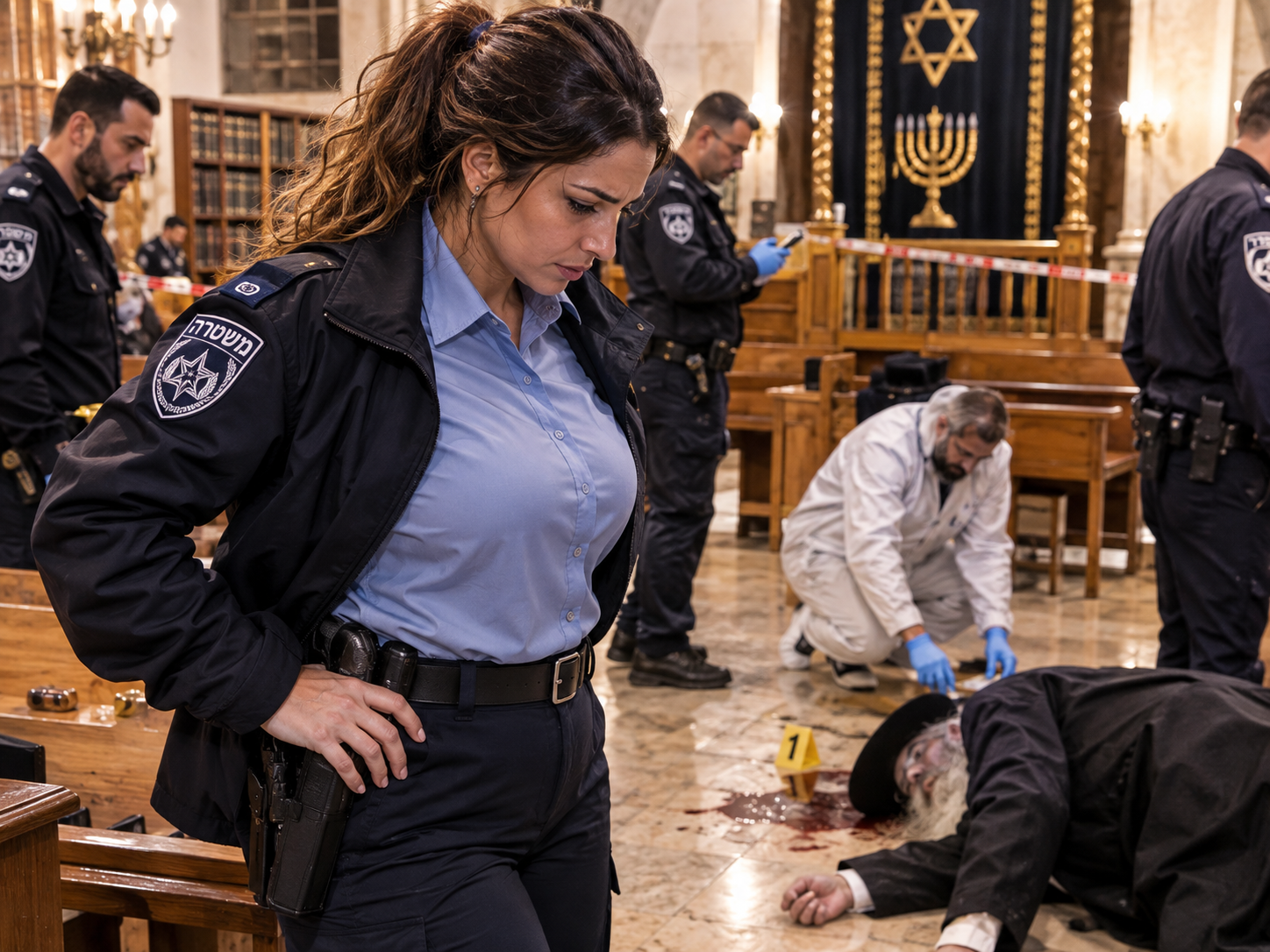
The address was a small shul in Nachlaot, with a hand-painted sign and a worn mezuzah. Yellow tape already strung across the entrance, two uniforms outside, one of them praying, lips moving, eyes on the distance. Inside, overturned siddurim, pages spread out across the floor. A strong smell of toddler’s sneakers after a birthday party filled the air as the police photographers documented the scene. Smoke flooded the tabernacle while the ner tamid still burned above the ark.
It had been a while since Ronit was in a synagogue since the Bar Mitzvah of her annoying young brother Doron in that little Iraqi temple in the Negev. It felt less like a religious milestone and more like a takeover. He stumbled through his haftarah, blamed the rabbi’s pronunciation, and still ended the day sure he had nailed it. Between the candy hailstorm and the buffet line, he cried twice, threw an elbow at her over the last kubaneh, and left the party believing, as always, that he was the victim of everyone else’s incompetence. For Ronit, that day in the synagogue had been a welcome break from the cramped Be’er Sheva apartment she grew up in the eighties with her four brothers ruled by volume and elbows, and absent parents. Since then, synagogues calmed her down.
Rabbi Yehezkel Ostrower’s body lay at the foot of the bimah. The seventy-three-year-old rabbi was found by Berel, a caretaker, a heavyset man who had suffered from insomnia for years and often couldn’t sleep at night.
He was not fallen, but positioned, tallit arranged with intention. His hands were folded in the priestly gesture, the split-fingered blessing, even though he was never a Cohen, by someone who knew the difference between a Cohen and a rabbi and decided it mattered and wanted the wrongness on display.
His throat had been cut in one deliberate stroke. It wasn’t a frantic attack, but a slow, almost ceremonial cut, as if the killer were a shochet, letting the blood pool slowly across the stone at the foot of the bimah. And yet it was the eyes that made Ronit intrigued: rolled back white, lids forced open with something like wax, so the old rabbi appeared to be staring, sightless and startled, at whatever had been standing over him in his final moment.
Ronit crouched, careful not to touch a thing. She let her gaze travel slowly around the room, committing every detail to memory. She had a photographic memory that unsettled people and she could recall the exact words of an argument three years gone, down to who had been standing where. It made her a formidable tomboy growing up, the girl who always remembered which brother started the fight and how, even when everyone else’s story had conveniently shifted. In college, dating Ashkenazi men for the first time felt like stepping into a quieter world, and one boyfriend, watching her recount a whole afternoon’s conversation word for word, told her flatly she should be a police detective.
A torn passage from the Tanakh had been placed on the rabbi’s chest. Though no Torah scholar, she recognized the reference immediately. Something from Zechariah. Something about a king who would come in humility, riding on a donkey.
“He was writing a sefer,” said the caretaker, still shaking. “About the geula. The redemption. He really believed it was close.”
“Close like a date on a calendar?”
“Close like a feeling.” Berel wiped his face. “He used to say he could feel it coming. Like he could feel the weather.”
Peretz stood, joints complaining, and looked again at the arrangement of the body, the care of it, the theater of it, a crime scene staged like a tableau. Nothing stolen. Nothing ransacked except what needed to look ransacked. A killer in a hurry did not leave you a verse.
“Whoever did this,” she said, mostly to herself, “isn’t hiding what he did. He’s announcing it.”
“Announcing what?” asked Motti, her partner, young enough, and green enough, that her gift did not just impress him, it quietly unsettled him, like watching someone read a language he had not known existed.
“That the rabbi wasn’t going to be the one,” she answered. “And that somebody’s decided he is.”
Ronit looked down at the rabbi, an old man who spent his life waiting for someone else to arrive and got, instead, someone convinced he did not need to wait any longer.
(to be continued)