
God Made the Promise. Let Him Pick Up the Tab.

I still remember the first time I read Hanoch Levin’s Ketchup, that bitter satirical revue from the 1970s that somehow grows more relevant every year instead of less. Levin, one of Israel’s sharpest playwrights and anti-war satirists, looks straight at the land promised to Abraham and to descendants, and refuses, flatly, to give his life for it.
He never dreamed of Hebron. Nablus does not keep him awake at night. Abraham, Isaac and Jacob are already resting in their graves, and he has no particular desire to dig his own beside them. Whatever God promised Abraham, Levin essentially says, God should settle the account Himself, on His own dime. He is not a grain of sand on anyone’s seashore, and he never signed up to make good on a deal God struck thousands of years before he was born.
I remember exactly which idea shook me: the sheer possibility of refusing to lay down your life for the land. For an Israeli, that comes close to blasphemy. My sacred cow was the line traditionally attributed to Joseph Trumpeldor: “It is good to die for our country.” Military service was not merely a duty; it was a privilege. Giving your life for your country was the ultimate sacrifice, almost the ultimate proof of belonging. That was simply the water I swam in. Nobody mentioned that “No, thank you” was an available option. Nobody told me I was allowed to admit that I have never dreamed of Hebron, that Nablus does not keep me awake at night, and that what actually worries me is getting through my one life in one piece. I have more than enough room between Metula and Eilat. I have no designs on the Nile and am not losing sleep over the Euphrates. I would mostly like to live here in peace, with myself, with my conscience and with my neighbors. And if I’m honest, I don’t even make it to synagogue. So why, exactly, am I supposed to hand over my life for a promise made in Genesis?
And then comes this week’s Torah portion, Nitzavim, with a verse I find even more unsettling. Moses gathers the people to renew the covenant and makes an extraordinary claim. This covenant, he says, is being made not only with those standing before him, but also “with those who are not here with us today.” (Deuteronomy 29:14) I read that sentence and want to raise my hand. Excuse me. That would be me. I wasn’t there. I didn’t sign anything. Neither did my children.
Hanoch Levin’s entire provocation rests on precisely that objection: God made a promise to Abraham; why should I be required to pay for it with my life? And Nitzavim offers an astonishing answer: because a covenant can reach people who were never in the room. In my head, an inheritance is a decent sum of money, Grandma’s antique jewelry, maybe an apartment. Nobody warned me that an inheritance could be more like gum stuck to the bottom of your shoe, a burden you cannot scrape off, an obligation you never agreed to and cannot quite escape. Nobody showed me the fine print.
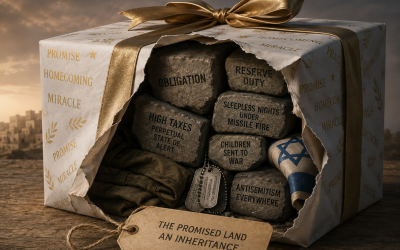
A gift can be politely declined. An inheritance arrives carrying the wishes of the dead. This one comes with generations looking over our shoulders. It arrives wrapped in the language of promise, homecoming and miracle, but beneath the wrapping lies the fine print: obligation, reserve duty, sleepless nights under Iranian missile fire, taxes that finance a country perpetually on alert, children sent off to the army, and the knowledge that being Israeli can make you a target of antisemitism even thousands of miles from home.
So I am asking- Can one refuse an inheritance one never agreed to accept?
Perhaps the blessing is not that we inherited a land worth dying for, but that we may yet learn how to make it a land worth living for.
Shabbat Shalom!