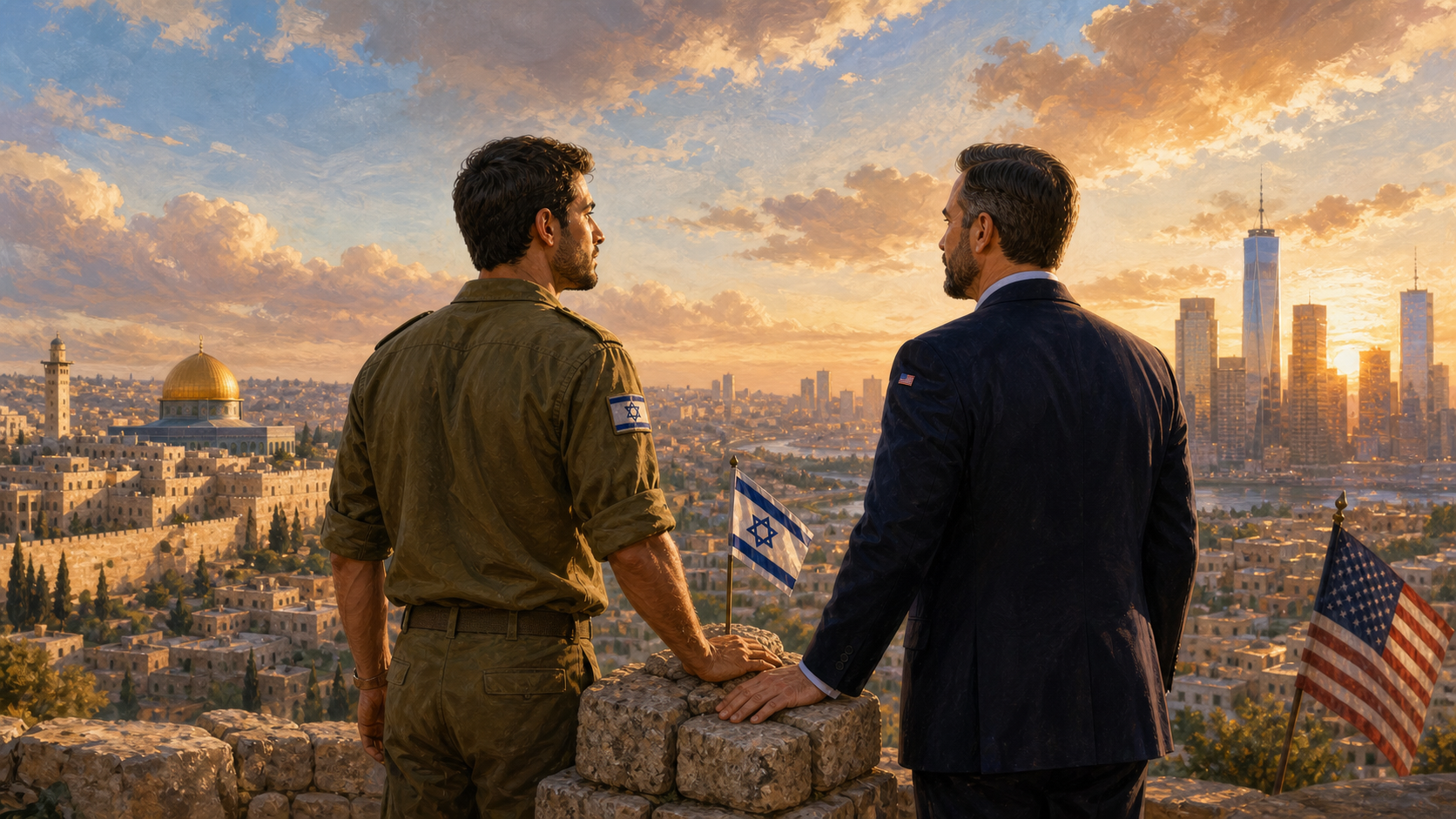
Grateful to America, Not Dependent on It
Israel can honor American friendship and President Trump’s past support while still insisting on its right to speak clearly about its own security.
As an Israeli, I have learned never to take international support for granted.
Israel welcomes allies, values friendship, and deeply appreciates the support it has received from the United States. Israelis should also continue to show respect and gratitude toward President Trump, following Prime Minister Netanyahu’s example. We should not forget the Abraham Accords, the extraordinary support President Trump has given Israel, or the fact that America joined a war Israel initiated and fought on the front lines.
That is precisely why the current debate should be handled with both firmness and dignity.
Some Israelis have responded to recent policy disagreements by attacking President Trump and members of his team. That is a mistake—not because allies should never disagree, but because Israel’s interests are better served by distinguishing policy criticism from personal denunciation.
Steve Witkoff has played an important role in efforts to secure the release of hostages. Jared Kushner was central to the Abraham Accords. Ivanka Trump has also shown genuine affection for Israel and the Jewish people.
Politics is not just a conversation on X. Words spoken impulsively by Israelis can quickly be exploited by antisemites, anti-Israel activists, hostile regimes, and influence networks that seek to weaken Israel. We should be wise enough not to hand them ammunition.
At the same time, friends must be able to speak honestly. That is why Congressman Randy Fine’s response to Vice President JD Vance was important.
Israel was not created by American generosity. It was created by Jewish sacrifice, courage, and blood. For roughly the first two decades of Israel’s existence, the United States did not provide meaningful military assistance. In 1948, Israelis fought with almost no weapons. My father’s generation fought with their bare hands, stubborn faith, and a determination that history would not end with Jewish helplessness.
In 1948, after Israel defeated the invading Egyptian army and entered Sinai, both Washington and Moscow pressured Israel to withdraw. In 1956, after Israel again captured Sinai following Egyptian aggression, America and the Soviet Union forced another withdrawal. Only after Israel’s stunning victory in 1967 did Washington fully understand that Israel was not a burden, but a strategic asset.
Since then, Israel has become one of the most effective showcases for American military technology. Israel fights with American systems, yes—but it is Israelis who do the fighting, Israelis who take the risks, and Israeli families who pay the human price.
That is why Vice President Vance should be respectfully reminded that a nation that fights and sacrifices at this level naturally expects to have a voice in negotiations affecting its survival. Whatever one thinks of Vice President Vance’s position, Israelis are entitled to voice concerns when diplomatic decisions affect their security.
Many Israelis are also deeply concerned by diplomatic efforts that appear to link Iran and Lebanon, treating the Iranian regime and Hezbollah as interconnected negotiating partners. To Israelis, this is not a technical diplomatic matter. It risks returning Lebanon—and its historic Christian community—to the grip of the Hezbollah-Iran axis.
This is a strategic concern. It is also a moral one.
American Jewry has an important role here. American Jews should speak clearly, confidently, and without apology. Not as partisans, and not as guests in someone else’s political argument, but as citizens and Jews who understand the cost of silence.
Israel does not need unconditional praise. No democracy does.
What Israel deserves is far simpler: to be treated as a sovereign ally whose leaders have both the right and the duty to speak when their people’s security is at stake.
That should not be controversial.
It should be self-evident.
Israel will remain grateful for America’s friendship. But friendship is strongest when it exists between partners, not dependents. Israel was built by a people willing to bear the burden of their own survival. That reality should guide every conversation between Jerusalem and Washington.