
Working to protect people and our shared planet.
Great TV: ‘Boston Blue’ & Its Shabbat Tradition
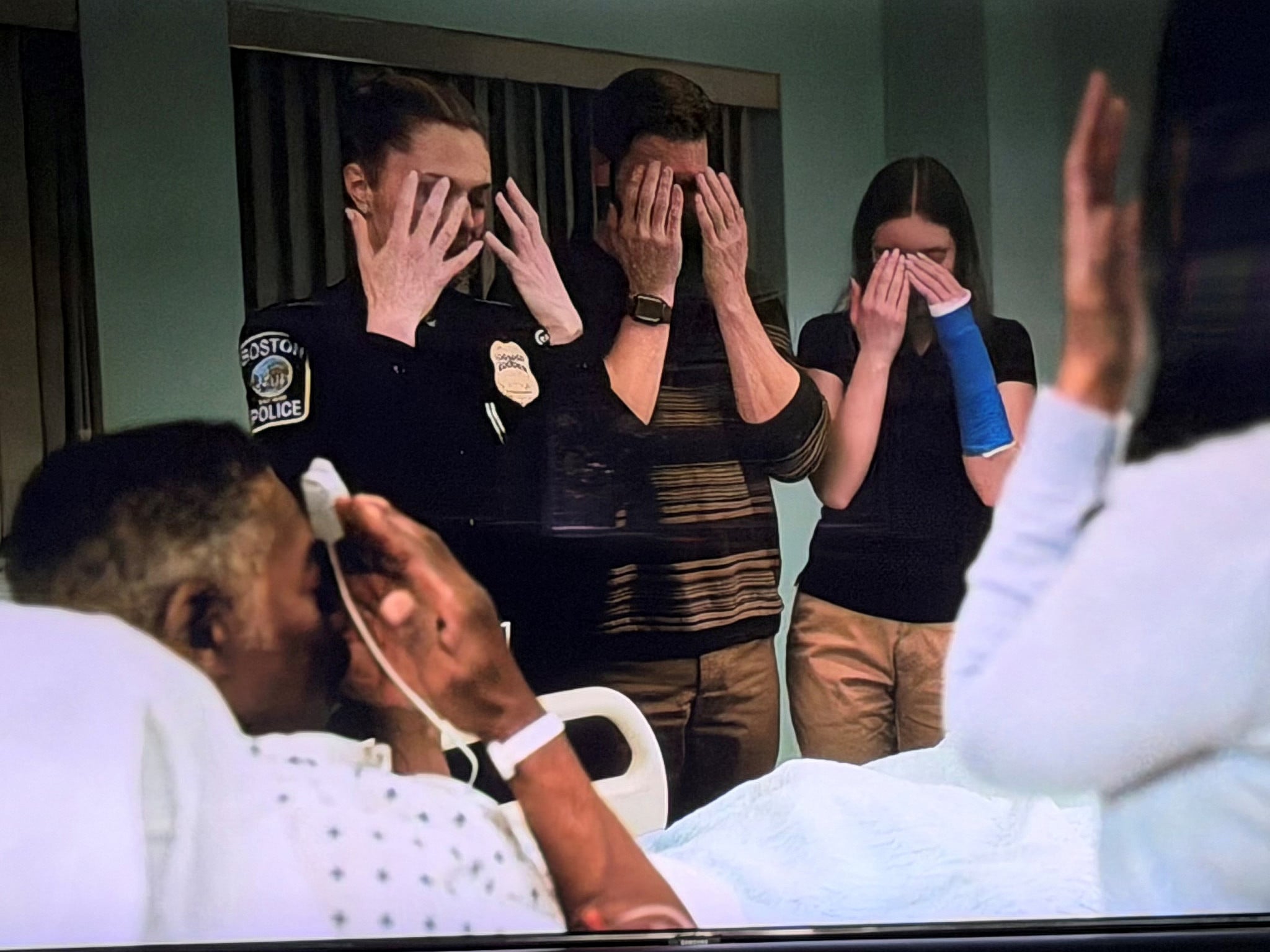
Screen shot from Boston Blue where they celebrate shabbat from a hospital room. Photo by and courtesy of JLM.
In a time of chaos and conflict in the world, I am a big fan of shows that take a problem and solve it in an hour.
It is probably good for my mental health. Real life rarely offers quick and neat endings. The problems we face—antisemitism, war, political division, loneliness, and global instability—rarely resolve in 45 minutes with calm music in the background. So, I find comfort in stories where people work together, pursue justice, and restore some sense of order.
That is one of the reasons why I have long loved police shows including Law & Order: SVU and NCIS. But of all the shows in this genre, the one I have always loved most is Blue Bloods.
It was never just about solving crimes.
At its heart, Blue Bloods is about family, values, faith, duty, and showing up for one another. The Reagan family dinners – which always included Catholic grace – were the emotional center of the show. Week after week, we watched people disagree strongly and still come together around a table with love and respect.
Now there is a new spin-off from Blue Bloods – a show carrying that same spirit forward: Boston Blue. Only this time it has the Jewish shabbat dinner table at its core. Indeed, diverse Jewish life is woven into the story in a way that feels authentic, grounded, and deeply human.
At the center of this creative vision is executive producer Brandon Sonnier and his producing partner Brandon Margolis, known together in Hollywood as “the two Brandons.” Sonnier was already a successful television producer working on projects like L.A.’s Finest when his life changed in an instant in 2019.
While filming a scene, a stunt vehicle struck a shipping container near the production area. Sonnier was severely injured and pinned underneath. His injuries were so extensive that doctors had to amputate part of his right leg.
As someone who has worked extensively with people with disabilities, I know that people handle acquired disabilities in a variety of ways. But what is striking is not only what he experienced physically, but how that experience reshaped his spiritual and family life.
On his first night home from the hospital after the amputation, Sonnier reportedly attended his family’s regular Friday night Shabbat dinner. His wife is Jewish, his children are being raised in a Jewish home, and the tradition of Shabbat was already part of their weekly rhythm. But that night carried a different weight. In that moment—surrounded by family, ritual, and rest—he made the decision to move forward with his long-delayed conversion to Judaism.
As he later described it, he had been living a Jewish life in practice, but had not taken formal steps. The accident, recovery, and return to that Shabbat table became a turning point.
That lived experience is now reflected directly in Boston Blue.
The show continues the legacy of Blue Bloods, including its iconic family dinners, but reimagines them through a modern, multicultural, interfaith Jewish lens. The series stars Donnie Wahlberg as Danny Reagan, now working in Boston alongside Detective Lena Silver, played by Sonequa Martin-Green.
The Silver family is a mixed-race, interfaith Jewish family whose weekly Shabbat dinner is the emotional anchor of the show. They light candles, bless challah, and gather across generations—arguing, laughing, and working through life together.
One episode titled “L’dor Vador”—“from generation to generation”—captures this beautifully. The phrase speaks to one of Judaism’s deepest values: the passing of tradition, identity, and responsibility from one generation to the next. The episode explores family legacy, moral choices, and the ties that bind people – Jews and Christians alike – even when they disagree. But what stands out most is not simply the use of Hebrew phrases on network television. It is the normalization of Jewish life itself.
In so many portrayals of Jews in media, we are either invisible, flattened into stereotypes, or defined only by trauma. Boston Blue does something different. It shows Jewish identity as lived, joyful, complex, and integrated into everyday family life.
That matters.
The Silver family is not presented as a monolith. They are interracial and interfaith, reflecting the reality of many modern families. A Baptist patriarch, Rev. Edwin Peters, sits alongside Jewish children and professionals in law enforcement and public service. They are not defined by difference, but by commitment—to family, to justice, and to each other.
As the show’s creators have noted, the goal was to reflect something real: families who do not always look the same, believe the same, or even agree, but who still come together at the table.
There is something profoundly powerful in that image right now.
We live in a time when division often feels like the dominant narrative. Boston Blue quietly pushes back by showing that shared meals, shared values, and shared responsibility still matter.
And for me personally, seeing Shabbat dinner portrayed not as something exotic or explained for outsiders, but as a natural part of family life, is deeply moving. Shabbat has been a central part of my life every week since I was born. To see that rhythm of candles, blessings, conversation, and connection reflected on screen in such a grounded way is meaningful in a way that is hard to overstate.
Television cannot solve the world’s problems in an hour.
But it can remind us of what holds families and communities together in the first place.
Boston Blue does exactly that.
Related Topics
Related Posts