The views expressed herein are solely mine.
Greenland Is the Arctic Crown the U.S. Must Secure
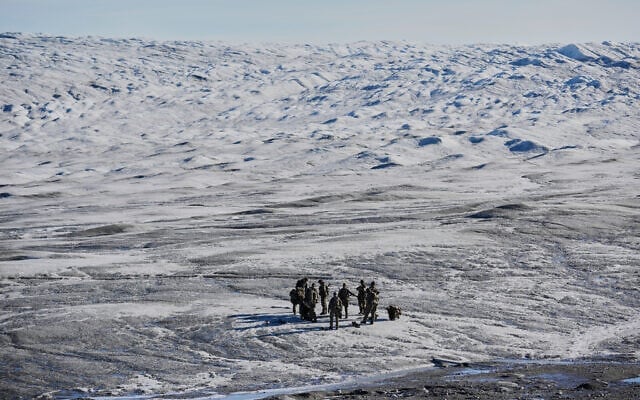
Danish military forces participate in an exercise with hundreds of troops from several European NATO members in Kangerlussuaq, Greenland, September 17, 2025. (AP/Ebrahim Noroozi, File)
Strip away the poetry and the case for American control of Greenland reduces to three elements that should terrify any serious strategist: minutes, megatons, and minerals.
In minutes, the math is brutal. Polar trajectories are the shortest paths between Eurasia and North America. A ballistic launch over the Arctic reaches U.S. airspace roughly 10–15 minutes faster than one flown on lower latitudes; hypersonic glide vehicles compress that window further, into single digits. That is not a theoretical problem. It is why the radar complex at Pituffik Space Base remains one of the most strategically valuable pieces of ground on the planet.
Simultaneously, high-latitude, fixed, hardened sensors detect what satellites often miss in cluttered polar geometry. Lose guaranteed control over Greenland and you do not lose territory—you lose reaction time. And in nuclear deterrence, reaction time is survivability.
On megatons, look at force posture rather than press releases.
Currently, Russia stations the majority of its sea-based nuclear deterrent in the Northern Fleet. Those submarines are designed to operate under Arctic ice, where detection is hardest and escalation control is highest.
Since the 2010s, Moscow has reactivated dozens of Arctic installations, extended runways to host long-range bombers, and layered air defenses along its northern coast to shield that bastion. This is not commercial development; it is a second-strike architecture.
Meanwhile, Greenland sits directly opposite that system. Leaving it anything less than firmly American is equivalent to conceding oversight of the most nuclearized maritime space on Earth.
This strategic logic is neither novel nor radical. The United States has repeatedly acted to secure decisive terrain before rivals could contest it.
Consequently, Alaska was purchased in 1867 not for prestige, but to deny imperial competitors access to the North Pacific and Arctic approaches—an acquisition later vindicated by its military, energy, and geographic value.
At the same time, the same calculus resurfaced in 1946, when Washington formally explored purchasing Greenland from Denmark after concluding that Arctic geography would be central to future deterrence and early warning.
In each case, early acquisition appeared excessive only until history rendered it indispensable.
On minerals, the data is even more damning.
Today, China controls roughly two-thirds of global rare-earth processing and an even larger share of downstream refining capacity critical to radar arrays, precision guidance, jet engines, and electric propulsion.
But Greenland is not a marginal player in this equation. Geological surveys estimate over 35–40 million metric tons of rare-earth oxides in Greenlandic deposits, including one of the world’s largest undeveloped REE sites, alongside hundreds of millions of pounds of uranium and substantial concentrations of zinc, niobium, tantalum, and graphite—materials the United States and Europe do not produce at scale.
Due to these qualities, Beijing has already tested entry points through mining bids and infrastructure-linked proposals. This is not about digging holes in ice; it is about who controls the upstream inputs of modern warfare. A missile that cannot be built is as useless as one that cannot be launched.
By contrast, shipping trends close the circle. The Arctic is warming at roughly four times the global average. Ice-free days are increasing, and transit through northern routes is no longer speculative.
Thence, Russia already treats the Northern Sea Route as a controlled corridor, charging fees, mandating escorts, and enforcing rules with military assets.
As traffic grows, the power to regulate becomes the power to coerce. Greenland anchors the North Atlantic gateway to that system. Thus, whoever controls Greenland influences surveillance, insurance risk, cable routes, and freedom of navigation between Europe and North America.
Reached this point, the governance fantasy collapses here. Bodies like the Arctic Council were built for scientific coordination, not strategic denial. The moment real competition arrived, consensus evaporated. Power filled the vacuum. That is how geopolitics always works, whether polite institutions approve it or not.
This is also why appeals to Greenlandic autonomy, while morally appealing, are strategically incomplete.
Although Denmark remains a close ally, it lacks the military scale, Arctic force posture, and economic leverage required to shield Greenland from coercive great-power competition. The issue is not intent, but capacity.
In an environment defined by nuclear bastions, supply-chain warfare, and Arctic militarization, sovereignty without power becomes exposure. Strategic terrain does not remain neutral by preference; it is shaped by the strongest external actor willing to commit.
This is why talk of “hands-off autonomy” is strategically illiterate. Strategic terrain does not remain neutral; it is absorbed by whoever moves first and commits hardest. The United States does not need Greenland for symbolism. It needs it to lock in early warning dominance, deny adversaries resource leverage, and prevent the Arctic from becoming a Russian-Chinese depth zone pointed at North America.
Delay is not caution; it is compounding risk. Every year without decisive American control tightens detection margins, deepens rival supply-chain footholds, and raises the cost of reversal.
In conclusion, Greenland is not an optional acquisition. It is the Arctic crown—and crowns are either secured early or fought over later, at far higher cost.
Related Topics
Related Posts