
Eyes everywhere
Infiltration and ‘Muqawama’: The Islamist war of attrition within Europe
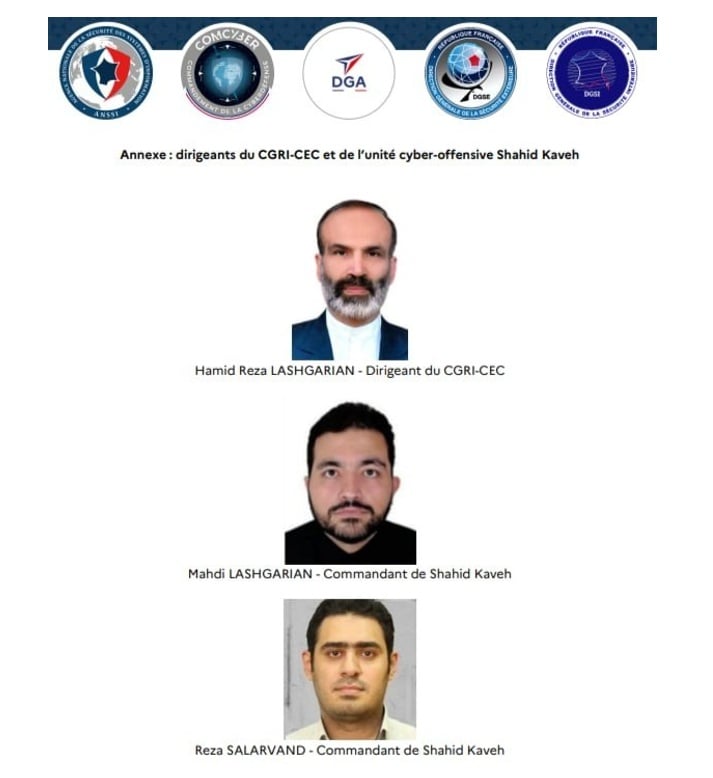
The three Iranian Shahid Kaveh suspects, as disclosed by the French Ministry of Interior (French Ministry of Interior Affairs, used in accordance with Clause 27a of the Copyright Law).
On November 11, French authorities disclosed the identities of three senior Iranian figures indicated as linked to the Shahid Kaveh cyber unit, attributed to Iran’s Islamic Revolutionary Guard Corps (IRGC). The individuals are Hamid Reza Lashgarian, named as head of the IRGC’s Cyber-Electronic Command, Mahdi Lashgarian and Reza Salarvand. Their identification follows an investigation into the cyberattack of 11–12 October 2026, which targeted refrigeration systems at approximately 700 French commercial sites, causing extensive food losses and fires. French intelligence agencies have published their names and photographs, while the Paris prosecutor’s office has sought international arrest warrants against them.
As of November 13, 2026, European counter-terrorism and intelligence agencies have significantly intensified operations against networks suspected of acting on behalf of the Iranian regime, particularly the Islamic Revolutionary Guard Corps (IRGC) and Iran’s Ministry of Intelligence and Security (MOIS). The latest developments include the investigation and disruption of an alleged Iran-linked network accused of orchestrating nearly 20 attacks and attempted attacks across Europe and the United States, targeting Jewish communities, Israeli interests and Western military installations. Particular attention has focused on the September 2026 suspected plot against RAF Fairford in the United Kingdom, which led to arrests and, on 10 November, a major US indictment against three alleged operatives linked to the IRGC and Iran-backed Kataib Hezbollah.
British authorities have also pursued individuals accused of conducting surveillance on Iranian opposition journalists and Jewish institutions, while investigations have exposed the alleged use of organized-crime networks, local criminal intermediaries and AI-generated propaganda to facilitate attacks while concealing Tehran’s involvement.
It is also important to recall the EU’s February 2026 designation of the IRGC as a terrorist organization, which enabled the freezing of its assets and the prohibition of financial support within the Union. Collectively, these developments signal a more coordinated European effort to identify, disrupt and prosecute Iranian intelligence-linked networks, counter foreign-sponsored terrorism and protect dissidents and vulnerable communities across the continent.
Furthermore, the European Parliament adopted a resolution on October 8, 2026, calling for a coordinated EU strategy to counter what it describes as “Islamist entryism” and the growing influence of Muslim Brotherhood networks across Europe. The resolution calls for tighter scrutiny of organizations suspected of links to the Brotherhood, greater transparency and monitoring of their funding, and restrictions on their access to EU institutions and public funds. It also urges the EU Council to assess whether individuals and entities linked to the movement meet the legal criteria for inclusion on the EU terrorist list.
It must also be recalled that Italian investigators recently uncovered an alleged Islamist pro-Palestinian orchestrating group behind the October 17 riots in the center of Milan, when shops were attacked and looted. Moreover, it should not be forgotten that a trial is currently underway in Italy concerning a Hamas network, led by the Palestinian leader Mohammed Hannoun, that is accused of raising funds for the terrorist organization.
The “Mukawama Doctrine”
Back in 2006, Israeli journalist and Middle East expert Ehud Yaari wrote an interesting article, entitled “The Muqawama Doctrine”, published by The Washington Institute for Near East Policy, where he outlined how the doctrine is characterized by an approach to “constant combat,” or “persistent warfare”. Precisely, a continuous confrontation pursuing strategic endurance rather than conventional military victory. It therefore reflects an understanding of “resistance not simply as a response to occupation or external intervention”, but as an enduring project through which Islamist movements seek to hit, abase, and crumble from within specific socio-political targets.
In fact, the Islamist concept of Muqawama, meaning “resistance”, represents an ideological and political doctrine that extends beyond conventional understandings of armed resistance or national liberation. Within certain Islamist movements, particularly those associated with Iran’s regional network and groups such as Hezbollah and Hamas, Muqawama is understood as a sustained struggle against perceived external enemies and political adversaries, combining ideological, religious, military and societal dimensions. Rather than being limited to a specific military confrontation or territorial objective, the doctrine emphasizes the continuation of resistance over time, even in circumstances of considerable military asymmetry. It is rooted in the belief that armed struggle constitutes a religious and ideological obligation, while temporary ceasefires (hudnas) may be accepted as tactical pauses rather than recognition of an adversary’s legitimacy or a permanent political settlement. Furthermore, Muqawama is also conceived as a comprehensive alternative political and social framework in which Islamist movements assume responsibilities beyond armed resistance, establishing educational, healthcare, charitable and economic institutions to consolidate their influence within society (in this case, Europe).
It is therefore possible that the current wave of hacking attacks targeting the UK and Eu-member states such as France, Italy, Belgium, Germany and Ireland are part of a broader Iranian-Islamist hybrid terror campaign aimed at creating chaos, political destabilization, while also testing the authorities’ responses.
Related Posts