
Writer covering Israel–Africa, Jewish affairs, and Israel worldwide
Haaretz: Paid for Irony, Promoted for Contradiction
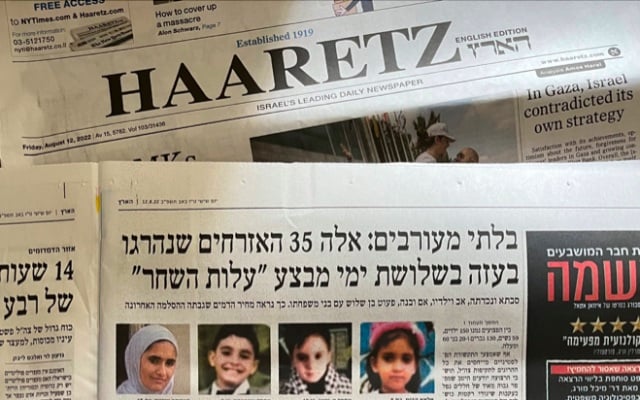
Haaretz
You ever notice the people asking for your feelings are the same ones who’ve been making your life harder? Yeah, that’s today’s menu at Haaretz.
Irony, Paid for and Promoted
I am not someone who wakes up eager to criticize Israeli institutions. For a long while, I have read Haaretz—disagreeing, sometimes wincing, sometimes tolerating. Like many readers, I treated it as part of Israel’s argumentative ecosystem: abrasive, self-assured, occasionally illuminating, often exasperating, but ultimately something to be engaged rather than dismissed. That posture became impossible to maintain after encountering a paid Facebook promotion from Haaretz announcing that it was “reversing the conversation.”
Here, the promotion opens by explaining that, for years, for years, Haaretz journalists have spoken to readers through Q&As and online briefings. “This time,” the paper declares, “we want to hear how the rise in antisemitism has been experienced where you live.” What follows is a carefully constructed questionnaire, inviting respondents to describe how antisemitism has affected their sense of safety, belonging, daily routines, work, campus life, public spaces, and Jewish communal engagement. Submissions may be anonymous. Names may be withheld. Trauma, carefully collected, is promised careful handling.
On its face, the exercise appears earnest—almost pastoral. Haaretz, a newspaper that has spent years publishing material widely cited, circulated, and weaponized in hostile anti-Israel discourse, now positions itself as a listener, a recorder, a curator of Jewish vulnerability. The same outlet that routinely frames Israel as uniquely culpable, morally suspect, or structurally malignant now asks Jewish readers to explain how antisemitism has reshaped their lives—as though these narratives exist in separate universes.
This is not a question of bad faith outreach. It is a question of editorial self-awareness. One cannot spend years normalizing suspicion toward Jewish sovereignty, amplifying language that migrates seamlessly into activist hostility, and then express surprise at the social climate in which Jews feel less safe, less welcome, and more exposed. When Haaretz asks whether daily routines have changed, whether belonging has eroded, whether Jewish life has been reshaped by fear, it is asking questions whose answers circulate in an ecosystem it has helped cultivate.
At that point, irony is no longer accidental. It is paid for, promoted, and placed carefully into readers’ feeds—an invitation to describe wounds while refusing to interrogate the narratives that keep reopening them.
Beyond Left and Right
Claiming Haaretz is simply “left-wing” is a generous shorthand — but it also obscures what that label has come to mean in practice, and why the term “left” no longer captures the newspaper’s distinct editorial culture. Within Israel’s media landscape, most major print outlets occupy identifiable slots on the political spectrum. There are centrist titles, right-leaning tabloids, religious-nationalist broadsheets, and liberal voices with varying degrees of critical outlooks. Among them, Haaretz stands out as the most consistent left-leaning national daily.
This self-description as liberal and center-left tends to underplay how the paper’s tone and issue selection diverge from other “left-wing” outlets in Israel and abroad. Where many progressive newspapers might balance critique with context, Haaretz routinely foregrounds narratives that depict Israel not just as flawed, but as an aggressor in almost every dimension of its national policy. Its editorial line consistently opposes ongoing territorial control and champions what it calls peace initiatives, while aligning narrative emphasis with ideas and language that critics — inside and outside Israel — read as far beyond mere policy critique.
To ground that abstraction in observable output, a snapshot of Haaretz’ Israel-News section reveals frequent themes such as:
-
Coverage framed around claims that the government’s conduct undermines democracy or deviates toward authoritarianism.
-
Analyses pointing to international “trouble ahead” for Israel, tied to global diplomacy and public opinion.
-
Opinion and reporting on Israeli actions in Gaza and the West Bank, often deeming such actions as crimes.
-
Coverage of polls or social trends as “brutal” indictments of mainstream Israeli sentiment rather than explored sociologically.
Individually, these headlines and analyses reside within the broader bounds of legitimate journalism. Taken together, they compose a pattern of selection and framing that is markedly distant from how most Israeli outlets present similar events. Where most newspapers would contextualize criticism within a broader national consensus, Haaretz’ framing often emphasizes rupture and exception, consistently privileging narratives of decline, international isolation, and moral failure.
Contrast this with other Israeli newspapers. Outlets such as Yedioth Ahronoth are broadly centrist, balancing social coverage with mainstream defense perspectives; others lean right, prioritizing strength in security narratives and state sovereignty. Haaretz remains unique in its relentless editorial focus on portraying Israel as the instigator of its own worst outcomes, rather than as a state navigating complex security dilemmas like any other democracy. Calling Haaretz “left-wing” is accurate only in the broadest, academic sense. In practice, its editorial culture often transcends ordinary partisan critique and gravitates toward a persistent narrative posture where Israeli conduct is framed as uniquely suspect or morally suspect — and that frame has consequences far beyond simple ideological disagreement.
The Enemy Granted Context, Israelis Granted None
Consider Haaretz’s treatment of narratively charged figures outside of Israel. A recent opinion piece doesn’t just explain Palestinian suffering — it tells Palestinians why they should not forget and should not forgive.³ From the headline alone, the subject’s internal logic is accepted; the paper does not interrogate whether those motivations are strategically or morally sound — only how they are justified from within the speaker’s worldview.
Compare that to how Israeli motivations are treated elsewhere on the site. Complexity is often replaced by implied culpability. Where one side’s motivations are rendered with nuance and interiority, the other side’s motives are frequently reduced to moral error or pathological stubbornness. This asymmetry isn’t occasional — it’s patterned. Taken together, these tendencies reveal a newsroom that doesn’t merely report on conflict — it frames conflict in ways that recurrently privilege suspicion toward Israel, predictive guilt, and institutional critique, while offering contextual layers to Israel’s adversaries that are more complete and more psychologically immersive.
This pattern is not about isolated headlines. It is about which narratives receive context and which receive containment. And it’s why critics, observers, and global audiences increasingly see in Haaretz a style of coverage that feels less like journalism and more like editorial projection.
The Narrative Breaks Character
Every publication has a voice. Most never abandon it. What made the Haaretz Facebook promotion so revealing was not merely its content, but the momentary collapse of narrative consistency it exposed. For years, Haaretz has spoken about Israel and Jews in a register of suspicion, moral indictment, and structural blame. Its reporting posture has been confident, declarative, often prosecutorial. It has not presented itself as uncertain, conflicted, or searching. And then, suddenly, it asked to listen.
“This time, we’re reversing the conversation.”
The phrase is unintentionally candid. Because what Haaretz did in that moment was not reverse a conversation—it broke character. The newspaper that rarely grants Israelis interiority, context, or emotional complexity now invited Jews worldwide to describe fear, isolation, and vulnerability. The same institution that treats Jewish sovereignty as a recurring moral problem asked Jews whether their sense of safety and belonging had eroded. It was an abrupt pivot from accuser to confidant.
And it did not land as empathy. It landed as dissonance.
There is something profoundly jarring about an outlet that relentlessly interrogates Israel’s legitimacy now soliciting Jewish testimony about antisemitism without acknowledging the narrative environment it helps sustain. The questions themselves—about safety, daily routines, public hostility, retreat into communal life—are legitimate. But coming from Haaretz, they read less like inquiry and more like unintentional self-indictment. Because one cannot ask Jews whether they feel less safe in public spaces while consistently publishing material that portrays Jewish power as uniquely dangerous. One cannot express concern over campus hostility while supplying the intellectual scaffolding that fuels it. One cannot document Jewish fear while refusing to examine how that fear is normalized, justified, and reframed as moral consequence in global discourse.
This was not a moment of hypocrisy so much as a moment of exposure. The mask slipped—not because Haaretz suddenly revealed malice, but because it revealed a total absence of connective awareness. The newspaper appeared genuinely puzzled by an atmosphere its own editorial posture helps thicken. In that sense, the promotion was not just ironic. It was diagnostic. It showed a newsroom capable of studying antisemitism as an external phenomenon while remaining curiously uninterested in how its own narratives travel, mutate, and return—stripped of nuance, weaponized by activists, and aimed squarely at Jewish life beyond Israel’s borders.
The day the narrative broke character was the day the contradiction became impossible to ignore. Not because Haaretz asked the wrong questions—but because it refused to ask the one that mattered most: what role have we played in creating the world our readers are now afraid to describe?
Words Do Not Remain on the Page
One of the central illusions of modern media is that words are harmless until someone acts on them. That illusion collapses when narratives escape the newsroom and enter the bloodstream of global discourse. Haaretz’s editorial patterns — repeatedly amplifying claims that cast Israel in the worst possible light, accepting unverified or hostile reports without robust scrutiny, and reframing military operations as moral pathology — do not remain confined to its own readership. They travel. They are quoted, shared, and repurposed by critics, activists, and foreign media alike.
A review published by JNS highlights this dynamic with stark clarity: over just a few days, Haaretz repeated claims that Israel was guilty of genocide due to water shortages in Gaza, accepted dubious characterizations of legal neighborhoods as “settlements,” and framed the elimination of armed terrorists as civilian killings worthy of public scolding. Whether or not individual readers agree with those articles, the effect of this repeated framing is to distort the context in which Israeli actions are understood internationally. This is not a fringe phenomenon. It is the same pattern that led multiple government ministries and agencies in Israel to cut official ties with Haaretz after controversial statements by its publisher — remarks about apartheid, sanctions, and terrorist “freedom fighters” that struck many as unmoored from the realities of the conflict and its legal complexities.
Critics do not merely argue that Haaretz has political opinions — they argue that its selection of narrative frames matters because it shapes what millions of people believe happened, not just what was reported. Stories with emotive visuals, headings focused on moral crisis rather than strategic context, or reliance on hostile sources are the ones that tend to go viral. This is how one sided frames quickly detach from qualifiers and footnotes, and become the narratives people remember — even when they’re laden with error or omission. In such a landscape, headlines and tags become more influential than the facts they claim to describe. A report that foregrounds accusations of genocide becomes proof of cruelty in the public imagination, regardless of subsequent corrections or disputes over data. An emotionally charged depiction of “starvation” or “intentional harm” becomes the meme, while the complex interplay of blockade logistics, combat realities, and humanitarian access gets buried in footnotes.
This is the collision point between journalism and narrative warfare: words outlive context. They are picked up by activists, reposted on social platforms with no qualification, and invoked by commentators whose own agendas have nothing to do with nuance. The result is a feedback loop where the stories about the reporting carry more weight than the reporting itself. Haaretz may see itself as rigorous, self-critical, or morally urgent — but its frames do not remain contained. Once released into the global rumor mill, they become part of the very ecosystem of hostility, misunderstanding, and conviction that its recent promotion claims to want to understand.
And that contradiction is not incidental. It is consequential.
A Modest Editorial Suggestion
After years of watching Haaretz position itself as the arbiter of moral judgment, one might hope for a rare pivot: a look inward. If the newspaper truly wishes to understand antisemitism—or even its own role in shaping perceptions—there is a single, unavoidable starting point: the mirror. Before cataloguing Jewish fear in distant communities, before asking readers to describe diminished belonging or disrupted routines, Haaretz could first ask itself:
-
How have our narratives contributed to the global framing of Israel as a rogue actor?
-
How often have our headlines and opinion pieces been cited as proof of Israel’s moral failings, without context?
-
When we criticize Israeli policy, are we offering guidance, or are we simply reinforcing a world narrative that places Israel perpetually on trial?
This is not a call for censorship, nor a plea for journalistic restraint in principle. It is a call for moral coherence. One cannot plausibly ask communities to describe the anxiety that stems from antisemitism while simultaneously supplying rhetorical ammunition to those same forces. A modest editorial suggestion is therefore also a radical one: begin with accountability. Not for headlines’ sake, not for optics, not for reputation, but because truth requires context and consistency. If Haaretz wishes to continue operating as a newspaper, it might first learn the uncomfortable art of acknowledging its own fingerprints on the very crises it claims to observe.
Anything less is performative concern—a press release in human form, polite but hollow, asking the world to describe pain it has often helped narrate. At the end of the day, Haaretz wants to be the therapist asking how fear reshapes Jewish life… while it’s been the one sneaking into the session, spilling coffee on the carpet, and then wondering why everyone’s on edge. Sometimes, asking questions ain’t empathy—it’s just messy irony.
Related Topics