Hadassah Volunteer, Hadassah Medical Organization, Hadassah Writers' Circle
Hadassah Hospital Hospice Diaries: Neta
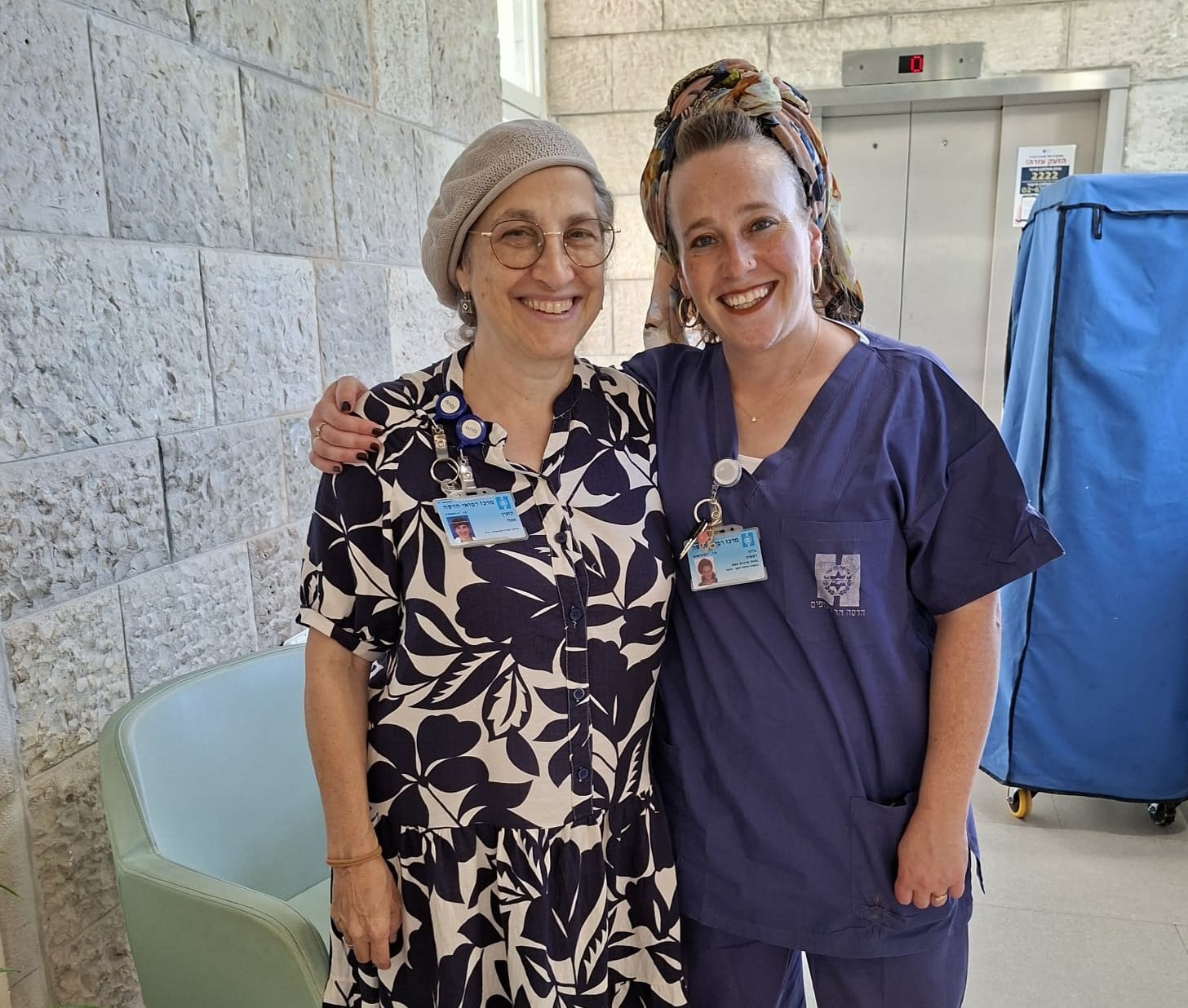
Social Worker Anna Kochin and Head Nurse Reshit Bazer at Hadassah Hospital Hospice at Mount Scopus. Photo courtesy of the author.
This is the third blog in an ongoing series on volunteering at the Ina and Jack Kay Hospice at Hadassah Hospital Mount Scopus.
“Every exit is also an entrance. When you walk out of something you do not walk into nothing unless that is what you choose. You walk into something else.”
– Why Me? Coping with Grief, Loss, and Change by Pesach Krauss and Morrie Goldfischer
The story of how hospice and palliative care came about is interesting. In 1948, a 29-year-old English nurse and medical social worker named Cicely Saunders was caring for a dying Warsaw Ghetto survivor named David Tasma. Every day, she would visit him. In England at the time – and everywhere else in the world – a dying hospital patient would normally be put in the back wards and sedated with morphine until the end.
One day, David told her that he wished there was a home where terminal people could go, where their pain would be controlled but they would still be able to communicate and end their days with dignity.
As he never married nor had children, David left Cicely all the money he had –a total of 500 pounds. Cicely spent the next 19 years building the place that David had envisioned. On July 24, 1967, St. Christopher’s Hospice opened in South London.
The second time I volunteered at the Hadassah Hospice on Har Hatzofim (Mount Scopus), the nurses told me that I should meet Neta. She was lying in her bed on the garden patio that Hadassah built for Hospice patients and their families. It is the only place where people can smoke. (And, if you are a smoker –even one who has quit – at the end of your life, you don’t worry about cigarettes killing you. You smoke tobacco and whatever else helps you cope with your pain.)
I went outside to meet Neta. Even in her weak state, you could tell that she was a force to be reckoned with! There she was trying to roll her marijuana cigarette, which I learned is a process – one that involves careful attention so as not to waste any of the precious contents.
I introduced myself and she told me her name. Her pain was substantial, but it was important to her that, in controlling it, she could still carry on a conversation. Neta told me how she was planning a מסיבת סיום –an “Ending Party.” She used the same Hebrew words that we use for a high school or university graduation party.
She had invited family and friends and ordered food and drink to be delivered to the Hospice the next evening. The party was to be held outside on the garden patio, with its view of the desert. Although Neta had been born in Europe, she loved living in the desert!
Neta had traveled to many different countries in her life and spoke many languages. She easily moved from Hebrew to Arabic to English. She was sharp and bold and believed in honesty. I mentioned to her that truth wasn’t always the best policy (i.e., I used to tell my Yeshiva boys if your wife asks you if she looks fat, don’t ever say yes. Tell her she is a beautiful woman!). Neta would have none of that: “If I’m fat, I want to know and I want to be told, period.” She waved her forefinger at me as she emphasized the point.
“I don’t know why I am still here,” Neta said in one of our conversations. “Maybe I still have something left to do.” I agreed with her; she did. There was her “Ending party” for one thing. And she still had things to teach me!
One time I was helping her with her “cigarette,” trying to get it into her mouth. She responded, “If you help people too much, they will always be dependent on you. Let me try to do this myself.” I probably could have used that valuable piece of advice when raising my own children.
Another time (we only had three visits together), the doctor came by to check on Neta. In hospice, a lot of the care is about pain control and he wanted to make sure that her pain was under control. She was smoking away and her smoke was blowing towards me. He asked if her “cigarettes” were helping her. “Very much,” she answered. Then I piped up and said, “I think that they are also helping me!” I’ve never smoked any kind of cigarette in my life before, but I don’t think that all second-hand smoke is necessarily detrimental!
Neta told me that if there is anything that I wanted to do in my life, I should do it. “Don’t have regrets about the things you haven’t done.” She was grateful for her life and how she had lived it. Of course, she fought to have a longer life, but that was not meant to be.
The third time I met with Neta, she was very weak and sedated with a lot of pain medication. Her ending party had taken place and, though she couldn’t really tell me about it, I’m sure it was very special. She had invited me to come, but I felt that the party was for her family and the many friends she had made over her lifetime.
When it was time for me to leave, I stroked Neta’s forehead and her cheek and held her hand. “Neta,” I said, “If I don’t see you next week, we will meet on the other side.”
Lining the corridor leading from the delivery room to the hospice are extra baby baskets on one side, with a view of the lawn and trees on the other. I believe that the people whom I grew to love at Hadassah’s hospice (even in the short time I spent with them before they passed away) will line that corridor when it is my turn, helping me to pass to the “other side.”
–
The author does not speak on behalf of Hadassah and the views expressed herein are the author’s own and not necessarily those of Hadassah.
Karen is a member of the Hadassah Writers’ Circle, a dynamic and diverse writing group for leaders and members to express their thoughts and feelings about all the things Hadassah does to make the world a better place. It’s where they celebrate their personal Hadassah journeys and share their Jewish values, family traditions and interpretations of Jewish texts. Hadassah members are proud of their Zionist mission and their role as keepers of the flame of Jewish values, traditions and beliefs as well as advocating for women’s empowerment and health equity for all. Since 2019, the Hadassah Writers’ Circle has published nearly 800 columns in The Times of Israel Blogs and other Jewish media outlets. Interested in writing? Please contact hwc@hadassah.org.
Related Topics
Related Posts