Hadassah Volunteer, Hadassah Medical Organization, Hadassah Writers' Circle
Hadassah’s Research on Antibiotic Resistant Bacteria is Lifechanging
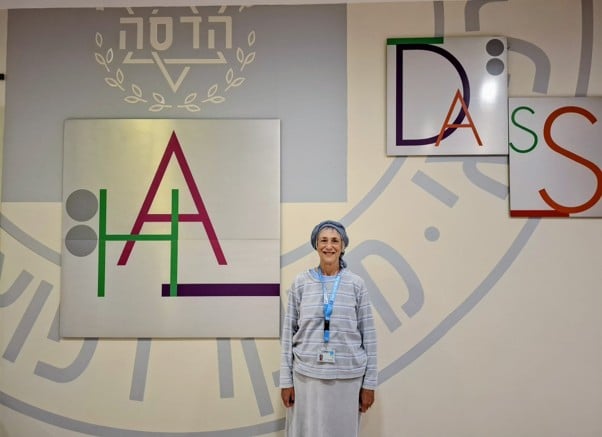
The author at Hadassah Hospital Ein Kerem. Photo courtesy of the author.
I had my first hip replacement surgery in 1980 in America. It was a miraculous procedure that enabled me to walk normally, after walking for a year on an undiagnosed broken femur that eventually collapsed. I was even able to return to the tennis court.
Shortly after my surgery, my doctor discovered an infection. The surgeons opened the area, cleaned out the infection and put me on a six-week course of intravenous antibiotics. This intervention saved my hip replacement for six years.
But then the infection returned. This time, the surgeons removed the infected prosthesis, put me in traction to keep a space available for a new hip and, once again, gave me a six-week course of intravenous antibiotics.
I received a second hip, but it also became infected. It was removed and again I was connected to intravenous antibiotics for six weeks. Although there were several surgeons who were willing to put in a third hip prosthesis, one wise doctor explained to me that I probably had a drug-resistant bacteria hiding in my hip joint, ready to re-emerge after another foreign body was inserted into it.
At age 30, I made the decision to forgo the surgery and live with what is a significant handicap – no hip joint and one leg nine centimeters shorter than the other.
For 37 years, the infection in my bone lay dormant. I didn’t return to the tennis court but, instead, I became a swimmer. “There are many dreams you can fulfill in your life, even without a hip,” my knowledgeable and compassionate family doctor told me at the time. He was correct. I married, became a mother and a grandmother. I had an amazing and meaningful career as a teacher, both in America and in Israel, we made Aliyah in 2000, I completed my doctorate in education and became an author of children’s books.
In 2025, that dormant infection decided to “wake-up” and pursue me with a vengeance. I ended up in the hospital with sepsis and, as I write these words, I am grateful that my life was saved.
After two surgeries, months of intravenous antibiotics followed by months of oral antibiotics that I continue to take, I have been waiting for the next “cure” or treatment for my infection.
Then my brother sent me an article on phage therapy. It explained: “Phages are viruses that solely infect and attack bacteria. They attach to bacterial cell walls and inject their genome (the genetic instructions found in the virus’s DNA or RNA) into the cell. These instructions interfere with the bacteria’s ability to function, halting the bacterial infection. The infection is unable to reproduce and instead produces additional phages, which potentially destroy the specific bacteria even if it tries to re-emerge.”
The use of phages to control infection is over a century old. Phages were identified in 1915 by British bacteriologist Frederick Twort and by French microbiologist Félix d’Hérelle in 1917.
Phages are found wherever bacteria thrive. For example, in sewers and in rivers that catch waste runoff from pipes. It was immediately recognized by many scientists to be a treatment for the eradication of pathogenic (anything that causes disease) bacterial infections.
Although used in Russia, Georgia, Poland and later the Soviet Union to treat infections. Throughout the 1940s, several U.S. pharmaceutical companies produced phage preparations to treat various infections, including those of the upper respiratory tract and abscesses.
With the discovery of penicillin and other antibiotics, phage therapy fell into disuse. However, with the emergence of antibiotic-resistant bacteria, phage therapy is again gaining recognition as a viable solution for eradicating them.
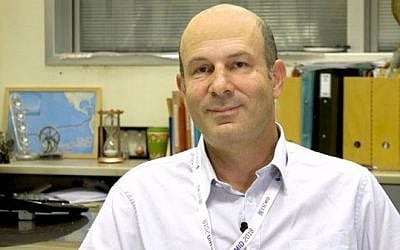
Thirty minutes from my home in Israel, some of the most innovative research in phage therapy is now being conducted at the Hadassah Medical Organization (HMO) in Jerusalem by Professor Ran Nir-Paz and Professor Ronen Hazan. Nir-Paz, a professor of microbiology and medicine in Hadassah’s Department of Clinical Microbiology and Infectious Diseases, is the cofounder of the Israeli Phage Therapy Center at Hadassah and chairs the Study Group for Non-Traditional Antibacterial Therapy of the European Society of Clinical Microbiology and Infectious Diseases.
Professor Ronen Hazan, a professor at the Institute of Biomedical Research of the Hadassah-Hebrew University, is co-founder of the Phage Therapy Center and brings his expertise in phage discovery (“phage hunting”) and phage susceptibility testing. Together, the two established a local phage laboratory to enable Israeli patients to access phage therapy.
As Professor Nir-Paz explains, “Establishing a phage lab in Israel became essential because the availability of phages of adequate quality was limited. Professor Hazan and I decided to develop local methodologies for phage purification on an academic scale, enabling the production of high-quality phages for patients in need. We recruited a scientist with expertise in pharmaceutical production processes and began developing our own standard operating procedures (SOPs) and protocols.”
When asked how successful phage therapy has shown to be, Professor Nir-Paz responds, “It is difficult to precisely determine the overall success rate of phage therapy because there are currently no large, controlled clinical trials evaluating phage efficacy. However, programs in Belgium, Australia, France and in Israel at HMO indicate that, in patients who have failed all other available medical treatments, phage therapy combined with antibiotics can achieve cure rates of approximately 70-80 percent. For this reason, HMO offers phage therapy as a potential option under compassionate use frameworks and in the context of clinical trial protocols for patients who have not responded to conventional treatments.”
Professor Nir-Paz has met with me on several occasions and is monitoring my situation. I am currently on high doses of suppressive oral antibiotics and hope to become a candidate for phage therapy soon.
The research that is conducted in HMO’s phage therapy lab will have far reaching benefits for thousands of patients in Israel, the Middle East and the world. This therapy will change the quality of my life as it will for others who have antibiotic-resistant bacterial infections!
Imagine a world in which we can eradicate these infections! Antibiotics held out this promise to cure infections but have fallen short against the bacteria that have become resistant to them. In addition, many antibiotics have adverse effects on those taking them. Phage therapy offers a real alternative to these resistant microorganisms. It offers hope to those of us who are fighting and suffering with these infections and the Hadassah Medical Center is on the frontlines of this battle!
For more information on Hadassah’s research on Phage Therapy go to the following link.
The author does not speak on behalf of Hadassah and the views expressed herein are the author’s own and not necessarily those of Hadassah.
Karen is a member of the Hadassah Writers’ Circle, a dynamic and diverse writing group for leaders and members to express their thoughts and feelings about all the things Hadassah does to make the world a better place. It’s where they celebrate their personal Hadassah journeys and share their Jewish values, family traditions and interpretations of Jewish texts. Hadassah members are proud of their Zionist mission and their role as keepers of the flame of Jewish values, traditions and beliefs as well as advocating for women’s empowerment and health equity for all. Since 2019, the Hadassah Writers’ Circle has published nearly 800 columns in The Times of Israel Blogs and other Jewish media outlets. Interested in writing? Please contact hwc@hadassah.org.
Related Topics
Related Posts