
Veteran software engineer returning to his freelance reporting roots to chronicle the modern tech ecosystem.
HaKatze: Velocity.io
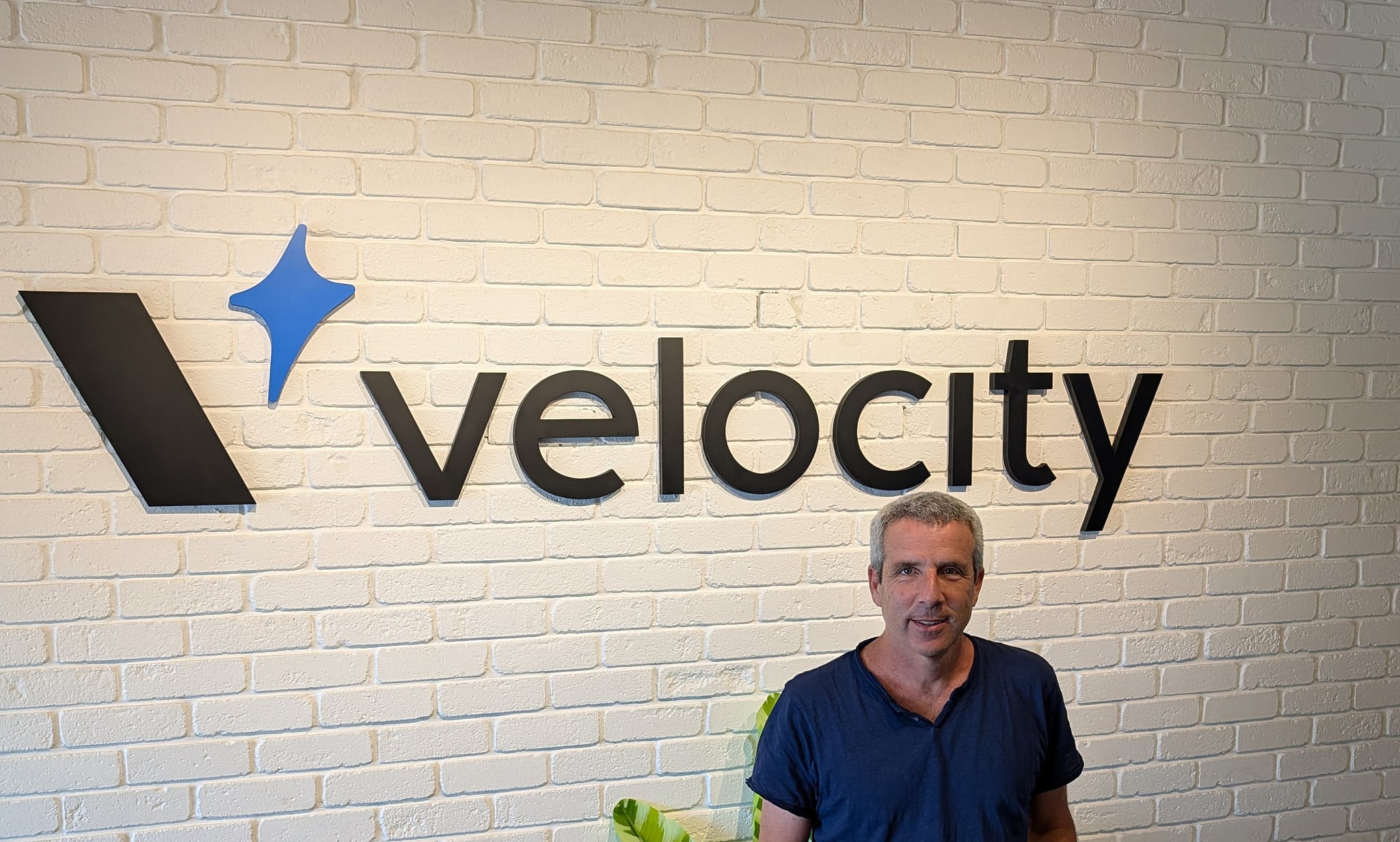
Guy Kirschbaum, founding VP engineering @ Velocity.io, pictured in the Velocity offices.
On the ninth floor of the Hagag building on Tel Aviv’s Ha’arba’ah Street, the office of Velocity.io is surprisingly quiet.
Only a sprinkle of desks and meeting rooms take up their sleek minimalist offices. A few years ago, a software operation handling this volume would have required forty or fifty engineers, layers of middle management, and endless sprint-planning ceremonies. Today, Velocity operates on a flat grid with zero engineering managers and an intentional hiring freeze.
At the door to greet me is Guy Kirschbaum. With a career spanning late-’90s startups, the dot-com crash, and enterprise leadership roles at SAP and Unity, Guy has seen enough tech cycles to separate ephemeral hype from tectonic shifts.
[I] felt a fundamental shift happening… There’s a cultural shift here, a serious revolution with such high acceleration that has completely flipped how we think about processes… We find solutions in minutes, not days or months.
Guy left the predictability of corporate tech specifically to build at his new company’s namesake: velocity. What he is witnessing isn’t just an upgrade in developer tooling: it is the wholesale disruption of the Software Development Life Cycle (SDLC).
The Pancake-Flat Organization
Tech giants have chased organizational efficiency for decades. Jeff Bezos famously instituted Amazon’s “two-pizza teams” to insulate builders from corporate drag, while Mark Zuckerberg spent 2023 evangelizing a “Year of Efficiency,” declaring that “every layer of a hierarchy adds latency and risk aversion.”
Velocity is running that experiment to its logical extreme: an engineering organization stripped entirely of management tiers.
We intentionally stopped hiring… AI brought a reluctance to get into personnel management as long as it can be avoided… Today we produce the output of 40 engineers from the old world. It’s better to grow horizontally, giving individuals more power and ability to make an impact, than to bring in more engineers.
In this new model, the traditional siloed developer is extinct. An engineer is no longer hired simply to write a mobile SDK; they are expected to manage a personal legion of AI agents across frontend, backend, databases, and product specs. The developer has transitioned from a factory-line coder to a general manager.
“Keys to the Mercedes”: Democratization vs. Guardrails
The disruption, however, extends far beyond the engineering pit. Because modern generative tools allow natural language to dictate software architecture, non-technical employees have abruptly crossed the threshold into engineering.
Our office manager came to me and asked how she connects a Slack webhook into her HR app. An employee I never expected to talk to me in those terms has become an engineer… but it requires setting the right guardrails.
Yet, this democratization introduces immediate operational friction. When anyone can build software, the question shifts to whether they should. Beyond wasted time, giving untrained personnel the power to push automated code to production invites massive risk. A poorly prompted script from a sales rep or an office manager can easily bypass standard security protocols, leak private data, or cripple infrastructure.
Guy points to a recent discussion with a Sales Development Representative (SDR) who spent days building a custom automated lead-generation tool from scratch.
I saw that he was spending all day building features. I told him, ‘Stop, there is a tool that does this for $100 a month, let’s just buy it….It’s like giving a Mercedes to a new driver: you don’t give your daughter a Mercedes just to drive around the block, you buy her a scooter. You have to fit the solution to the problem.
Furthermore, unbounded AI access carries hard balance-sheet consequences. Suddenly, every developer’s cost goes up by 30%, so you have to ensure there is an ROI. To justify developer token spend, output expectations cannot simply climb incrementally: they must compound exponentially.
The Human Bottleneck and the “Zero-Bug” Tradeoff
If AI can generate code, open tickets, and reproduce scenarios automatically, why not automate the entire pipeline from end to end? For Guy, trusting the machine with total autonomy is still premature.
If you give AI absolute freedom, it will generate a ton of noise for you… AI can be petty, or throw a 5-kilo sledgehammer at a P99 edge-case problem. Sometimes I prefer to live with a bug than to complicate my architecture tenfold. The machine still doesn’t know how to make those soft decisions.
Because of this, Velocity intentionally keeps a human checkpoint at every Pull Request (PR), even if it introduces friction.
Every place I insert a human into the process becomes a bottleneck. The question is whether this bottleneck is justified.
To manage this speed without drowning in technical debt, the company operates an unofficial Zero-Bug Policy. Velocity maintains no dusty backlog of low-priority Jira tickets sitting unresolved for two years. If a bug impacts production, it is resolved immediately at maximum priority; if an issue does not warrant immediate intervention, it isn’t classified as a bug: it is deliberately discarded to prevent operational drag and debt.
Always Be Experimenting (ABE)
In a software landscape shifting month to month, Velocity does not enforce a rigid, top-down standard for development environments. Some team members rely on Cursor, others lean on Claude, while others assemble multi-model open-source pipelines.
In my management style, I don’t know everything. I try very hard to have champions on the team who have a free hand to experiment all the time. We don’t have a single standard… The multi-variable environment brings a lot of value.
For Guy, the definitive skill of the next-generation technologist is no longer syntax mastery: it is the speed of evaluation and adaptability.
A developer today must be able to evaluate tools rapidly. It’s a prerequisite. And anyone who has this power but jumps without opening their parachute in time, meaning they make irresponsible decisions, won’t be here for long.
Related Topics