
Vayetzei: Noticing Angels
The world is changing at breakneck speed. It is getting harder and harder to predict what life will look like in a few weeks from now, let alone a few years. I often find this overwhelming. How can we possibly plan for, navigate, and be adaptable to such fast-paced changing circumstances?
This week’s Torah portion, Vayetzei, has offered me helpful guidance for this question. This weekly reading picks up after Jacob effectively steals his father’s blessing from his brother Esau. He flees his home in fear of his brother’s revenge, and sets off (the name of the parshah, Vayetzei, means “and he left”) for his uncle’s home, hundreds of miles away.
The rest of the portion is all about the uncertainty and changing experiences he navigates during his self-imposed exile. He falls in love with his cousin, Rachel, and agrees to work for his uncle, Laban, for seven years to earn her hand in marriage. But Laban tricks him (the poetic justice is not lost on classical commentaries) and marries him to Rachel’s older sister Leah instead. So Jacob has to pivot. He agrees to work another seven years for Rachel, whom he marries a week later. Eventually, his relationship with Laban deteriorates, and God tells him it is time to return to his homeland. Jacob sets out again, now with wives, children, and a family of his own.
That decision to return home is how the Torah portion ends. It opens with “And Jacob left.” Its second-to-last verse begins: “And Jacob went on his way.” The whole parshah is an extended meditation on what it means to be on a journey through uncertainty, which in many ways describes all of life.
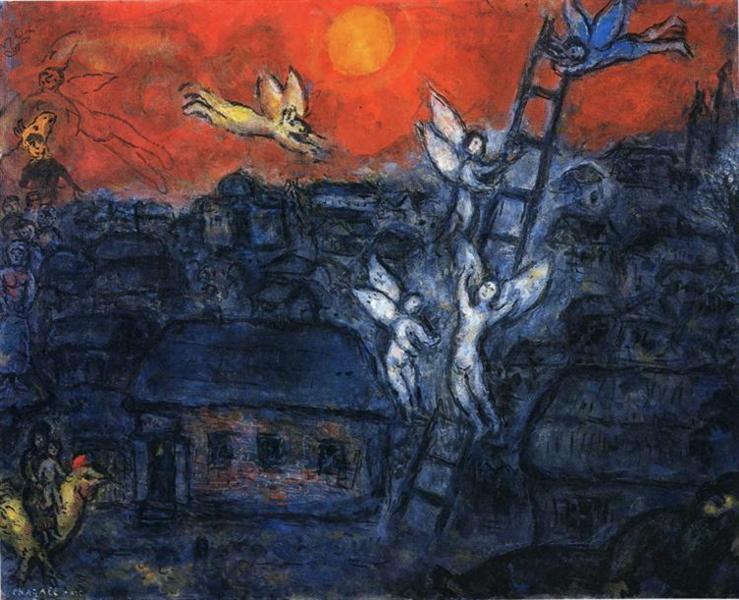
And Jacob, like all biblical characters, offers a model to learn from, both from his successes and from his failures. The one that really caught my attention this year is that when Jacob sets out on journeys at the beginning and end of the Torah portion, both times he encounters angels. The first time, he is dreaming, and he sees a ladder reaching to the heavens with angels going up and down. The second time, he is simply walking on his way when he meets some angels. Put differently, Jacob’s entire journey is accompanied by angels.
At first glance, this might be incredibly unrelatable. When I was a kid, I would go to the fire escape in my bedroom on Friday nights to greet the Shabbat angel. But it has been a long time since I felt the presence of disembodied angels. I can imagine that feeling very helpful. It also feels very out of reach.
But Maimonides (1138–1204), one of the most influential Jewish thinkers of all time, offered a different perspective. These are his words, not mine:
“This, too, is how all the biblical passages speak, for you will not find a single action that God performs except through an ‘angel.’ Know that the word ‘angel’ means ‘messenger,’ and therefore anyone who carries out a mission is an ‘angel.’ Thus, Scripture describes even the movements of animals, despite their lack of rational thought, as being brought about through an ‘angel’…”
Building on Maimonides’ framing: What if we approached every being we encounter as a potential “angel,” a messenger who might have something to teach us along our journey?
And if everyone you encounter could be an angel for you, then you could also be an angel for them. This means that the messages we have to offer each other are dynamic and being formed in real time. We are able to navigate a changing world, a journey through the unknown, much better when we realize we are not in it alone, and that the people around us may have something essential to teach us, just as we may have something foundational to offer them.
The mystical Jewish tradition takes this point one step farther. The Zohar, the foundational text of Jewish mysticism and Kabbalah, asks how Jacob recognized the angels the second time, and answers that they were the same ones he had seen in his dream. But there are critical differences: the first time he saw them at night, in a dream; the second time, in broad daylight. The verses themselves add a subtle difference. The first time, Jacob encounters a place that gives rise to his vision; the second time, the angels encounter him.
What happened over those twenty years that changed his ability to see them? I think there is something here about the relationship between our dreams and our ability to notice what is in front of us.
Dreams are important. They help us imagine the people, possibilities, and futures we wish were part of our lives. But sometimes we become so attached to what we have imagined, to our projections of who or what we wish were by our side, that we fail to notice the actual people and possibilities that are there.
Often it takes many bumps and bruises to begin noticing the things we encounter. Jacob goes through twenty years of hard work, love, family, deception, and uncertainty. Perhaps through all these experiences, he develops the capacity to recognize in the world around him what he had once seen only in a dream. The angels hadn’t necessarily changed. His ability to notice them had.
And that, I think, is part of what allows us to adapt when everything around us is changing. We need dreams to help us imagine where we want to go. But we also need the capacity to notice and respond to what we couldn’t have anticipated. The people, experiences, and possibilities that appear along the way might not look anything like what we had imagined. But they may have precisely what we need to help us navigate the journey.
There’s one final detail I love. The very next verse after our portion ends, the first of next week’s Torah portion, tells us that Jacob sends angels ahead to greet his brother Esau before they see each other for the first time in about two decades. Maimonides actually cites this verse as an example of human messengers.
Jacob begins by dreaming of angels. He ends by recognizing them. And then he sends angels of his own.
I know I’ve gone through periods in my life where I never noticed the angels at all even though they were right in front of my eyes. It took Jacob twenty years, but his story can hopefully inspire us to notice even sooner. To keep dreaming of what’s possible, to recognize the angels already around us, and to remember that we can be those angels for one another.