Writing on Jewish identity, Israel, and American politics
Hamam Al Hammami: The man entrusted with their lives
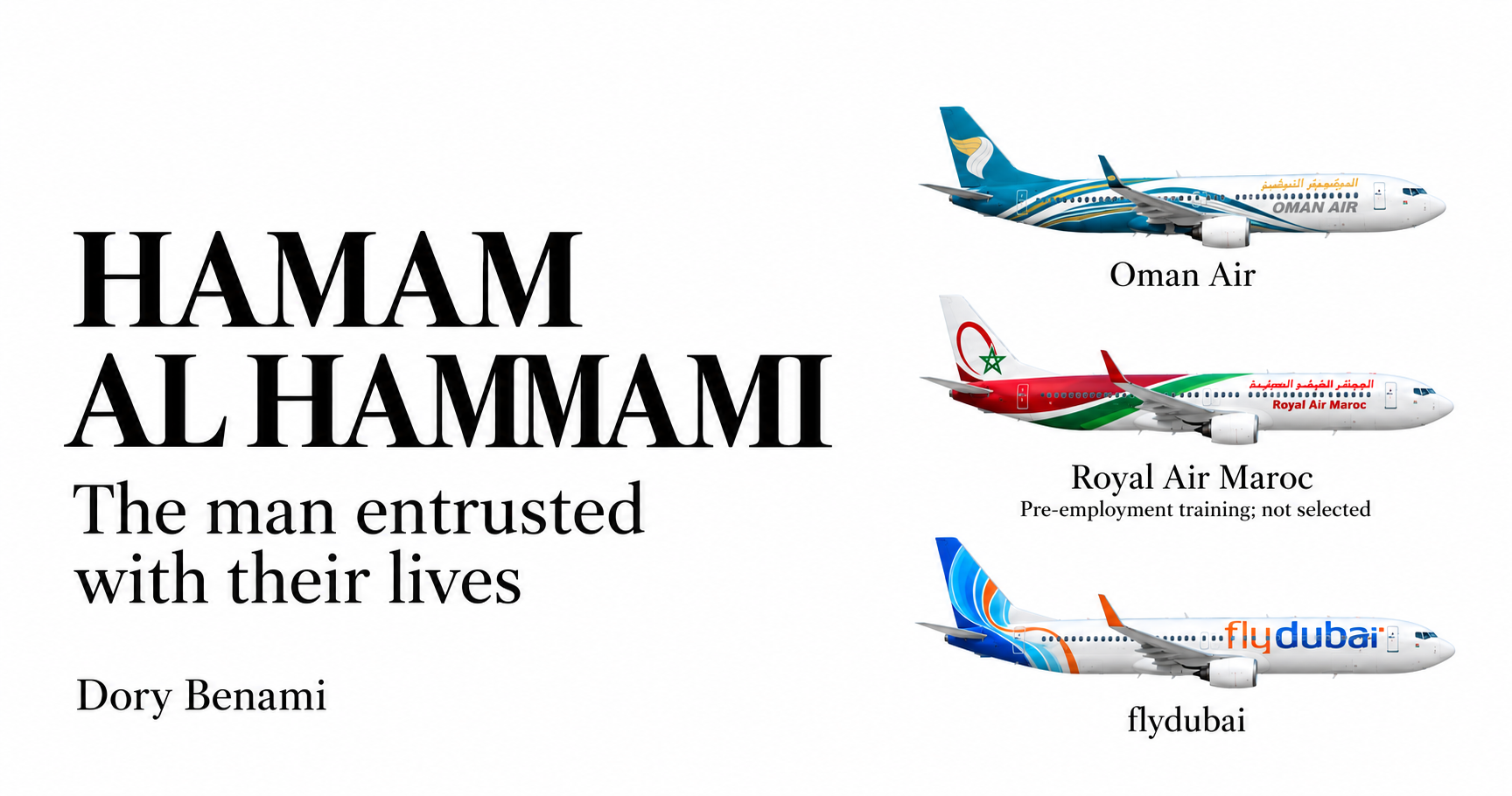
On September 30, flydubai Flight FZ1073 departed Dubai for Tel Aviv. At 05:21 UTC, according to Flightradar24’s published timeline, it began a steep descent. It subsequently transmitted emergency codes for both general emergency and unlawful interference. Passengers and crew intervened after an attack in the cockpit, according to public accounts. The aircraft landed safely in Tabuk, Saudi Arabia.
On October 3, the UAE’s attorney general said the copilot had attempted to carry out a terrorist attack. According to the official account, he attacked the captain with the aircraft’s emergency crash axe and tried to seize the controls. Authorities are examining the motive, planning and possible connections.
ABC News identified the suspect as Hamam Al Hammami, a 29-year-old Omani national. Reports identify the wounded captain as Smit Machchhar, an Indian national, and describe the passengers as predominantly Israeli.
CNN reports that Al Hammami was born in the UAE to an Omani father and a Syrian mother and spent several years living in the UAE. He completed a 3-year distance-learning degree in aviation management through Buckinghamshire New University in 2023. The university confirmed that he received no pilot training there.
His employment history raises questions that deserve answers.
ABC News, citing senior intelligence and law-enforcement officials, reported that extremist material was found in his possession while he was an Oman Air copilot trainee in 2024. Those officials said he was suspended from flying and continued in an administrative role. CNN separately reported that sources said he was removed from flight training over concerns about extremist views.
He later became a first officer at flydubai.
A LinkedIn profile bearing his name reportedly listed 7 years at Oman Air, ending in February 2025, followed by Royal Air Maroc from June 2025 to January 2026. Royal Air Maroc told AP that he completed 3 months of pre-employment training in 2025 but was not selected. The profile’s dates should not be mistaken for confirmation that he served as one of the Moroccan airline’s pilots.
CNN also reported that social accounts linked to him contained a video combining footage of Israeli aircraft with images of al-Qaeda figures. That material deserves examination alongside the reported concerns at Oman Air. It does not establish that al-Qaeda recruited or directed him.
He had acquired qualifications, professional training and access to a commercial cockpit. Flydubai currently advertises a first officer package equivalent to approximately $158,181 annually, including average flying pay. That figure describes the opportunity associated with the position, rather than his individual contract.
How did someone reportedly flagged over extremism come to be entrusted with those passengers? Did earlier concerns fail to reach the next employer? Did screening fail to uncover them? The evidence raises those questions without yet assigning responsibility.
I want his life studied. His posts, employment records, screening and contacts could help explain how this happened and prevent another attack. His parents’ backgrounds cannot substitute for evidence about his own decisions.
I also want us to examine how we talk about the people he endangered.
I studied law. I understand why reporting uses “allegedly.” Defendants have rights, anonymous sources require scrutiny, and accusations need evidence. Those distinctions matter here.
I want that discipline applied consistently. In my view, too much commentary about Israel presents genocide, apartheid and deliberate murder as settled conclusions while skipping disputed evidence and the distinction between an allegation and a legal finding. Serious legal characterizations require serious arguments.
But the passengers’ right to survive requires no argument about Israel’s government. Nobody aboard that aircraft should have needed to defend a military operation, a prime minister or a national identity before deserving sympathy.
That is what makes the hostility in the comments so exhausting.
We write to inform, encourage or help one another understand something frightening. Then we open the responses and encounter contempt, collective blame and people treating Jewish fear as amusing. Some I answer. Some I block or report. Sometimes I stop reading because I cannot face another evening of it.
This week, someone wrote directly to me that “Israel deserves to die,” demanded “a pound of flesh” and said the world would not help because “you deserve it.”
Then he lectured me about humanity.
Those are his words. They illustrate what I mean when I say the hostility follows us beyond an argument about policy. A stranger has decided that people like me deserve what is coming to us.
A comment section does not represent the whole world. Still, repeated hostility affects the people receiving it. You begin to wonder whether identifying yourself will cost you friendships or work, whether speaking is worth the abuse, and whether anyone will stand beside you when the threat becomes real.
Those questions follow us into politics. We want leaders who recognize violence against Jews and defend our safety without making it contingent on their foreign-policy preferences.
That brings me to Abdul El-Sayed, Michigan’s Democratic Senate nominee, facing voters on November 3.
After the March attack on Temple Israel, he condemned the attack but also said, “Hurt people hurt people,” referring to the attacker’s relatives killed in an Israeli airstrike. He later apologized, and I credit that apology. His original response nevertheless troubled me because it shifted attention toward the attacker’s grievances when Jewish families needed reassurance.
That record is why I am asking him to speak clearly about this attack. Abdul, will you condemn it and say you are glad those passengers survived? You are asking voters to trust your judgment in the United States Senate. How you respond to violence against Jews belongs in that assessment. I expect that concern from anyone seeking public office.
ABC News reports that sources said Al Hammami indicated he intended to crash the aircraft in Israel. Such an attempt would have put his own life at risk along with everyone else’s. What kind of ideology makes strangers’ deaths worth sacrificing your own future?
Investigators should pursue that question. The rest of us should remember the people whose futures were almost taken.
I am a Jewish father. I read this story and picture boarding a plane with my daughter: fastening her seat belt, finding something to occupy her, trusting the people in the cockpit. Someone qualified is flying. We will land. Our family will be waiting.
The people aboard Flight FZ1073 were entitled to that ordinary trust. Instead, a wounded captain, passengers and others aboard had to fight to get them home.
My daughter is 2. She knows nothing about the labels people attach to Jews or Israelis. She knows that airplanes go somewhere, that her parents keep her safe, and that people who love her will be happy to see her when she arrives. I want her to grow up trusting those things.
We want to take our children somewhere and bring them home. We want to live without someone deciding that our deaths would serve a sacred duty or a political cause.
And when we survive, we want the world to be glad.
Sources: Flightradar24’s published timeline; Reuters on the UAE attorney general’s statement; ABC News on the reported warnings, education and intended crash; AP on his employment history; The Times of Israel on his background and social accounts; flydubai’s advertised compensation; JTA on El-Sayed’s remarks and apology.
Related Topics
Related Posts