Hamas and the Tunnel
Hamas and the Tunnel: A Philology of Ambiguity in Media and University Discourse
Tracking antisemitism is not an obsession. It is שמירת הלשון (shmirat ha-lashon) — guarding the tongue — a refusal to let language collapse into shortcuts when it is meant to carry ethical weight.
In an age in which words can regulate reality almost as effectively as actions, “Hamas” and “tunnel” are not merely terms. They often function as admissibility devices: switches that regulate what counts as legitimate speech, legitimate emotion, and legitimate attention. In this piece I highlight a simple mechanism: two ordinary words can become cognitive shortcuts. “Hamas” and “tunnel” frequently replace an account of what is happening with a ready-made moral verdict or a ready-made “analytic” conclusion. The effect is predictable: complexity disappears and easy certainty takes its place.
The Word-Device: “Hamas” as an Admissibility Switch
Public discourse often pretends not to notice: “Hamas” is not only a name; it is a device. In media and universities it operates as an admissibility switch, triggering immediate moral modes, shortening analysis, and polarizing roles into clean binaries. The result is consent to a shortcut, with little room left for mechanisms, reproduction scales, survival modes, or coercive ecologies.
Philologically, the ambiguity sharpens across languages. In English, “Hamas” is typically unambiguous: the name of a concrete organization. In Hebrew, a shadow appears: the root חמס (ḥamas) carries connotations of violence and wrongdoing, even when the modern group is spelled חמאס (ḥamas). That proximity enables a slippage from reference to moral essence: “violence” becomes a metaphysical thing, rather than a political actor with mechanisms and constraints. Living operations are frozen into tokens; semantics is elevated over mechanism.
The Prop: “Tunnel” as Reversible Agency
“The tunnel” is the other prop. In media it is cinematic: hiding, asymmetry, threat, an entire storyboard without specification. In universities it is upgraded into “network,” “infrastructure,” or “subterranean governance,” often simulating complexity through terminology.
Philology, however, exposes a distinctive feature: tunnels reverse agency with minimal syntactic effort. It is not only “someone is in a tunnel,” but “the tunnel holds someone,” “the tunnel leads someone,” “the tunnel produces someone.” A small shift in grammar and the direction of action blurs. This is ambiguity-fuel of the highest grade. It also matches a pattern visible in public debate: certain frames render threats “non-eventful” until catastrophe retroactively authorizes the frame.
Coupling the Two: Two Layers of Reduction
Together, “Hamas + tunnel” generates a double reduction.
The media layer: an absolute moral token (“Hamas”) plus a visual shortcut (“tunnel”) produces rapid consent.
The university layer: a “discourse-problem” (“Hamas”) plus an infrastructure-metaphor (“tunnel”) produces theoretical fog, where jargon substitutes for parameters.
Both layers evade hard questions: mechanisms, scales, boundary conditions. “Hamas” can function at once as a military apparatus, a governance apparatus, a political brand, and a product of a coercive ecology, yet discourse often totalizes it into essence. In audit terms this is the classic escalation: partial capture (semantic policing) is promoted into a system-level shortcut, and the token becomes the explanation.
Ambiguity peaks in formulas such as “I am actually Hamas,” which can then be sheltered as “staging unease.” In English, this can purchase the prestige of radicality; in Hebrew, it risks literal identification, moral essence (I am violence), or illegibility. Language distributes speaking costs asymmetrically: prestige travels upstream, responsibility is pushed downstream.
Honesty Test: From Affect to Analysis
A simple test cuts through the fog. What exactly do you mean by “Hamas” and by “tunnel”? At what scale are you speaking? Who is the agent in your sentence? If the answers shift with language, audience, or institutional setting, the text is not doing analysis; it is managing affect. When accountability changes by register, what you have is double-entry responsibility, not complexity.
This ambiguity is not accidental. Media are rewarded for shortcut, because shortcut travels. Academia is sometimes rewarded for fog, because fog can be prolonged. Neither point cancels anyone’s suffering; it names how language can strip people of “who” status in the name of a clean shortcut. That is precisely why the Hebrew phrase matters here: שמירת הלשון is not piety, it is an ethic of refusing linguistic laziness where the stakes are human.
If “Hamas” is to function as a reference point for understanding, it must be recovered from two reductions at once: the moral absolute and the theoretical fog. And the tunnel must be recovered from the cinematic frame and the infrastructure-metaphor. Only then does ambiguity become inquiry rather than trick.
The Non-Obvious: Pro-Palestinian Discourse and Structural Antisemitism
Pro-Palestinian commitments and antisemitism are not merely “confused” from time to time. They can couple through discursive shortcuts, even when intentions differ. This is not a diagnosis of motives. It is a claim about matrices: older antisemitic patterns can migrate into newer moral vocabularies, including the language of human rights.
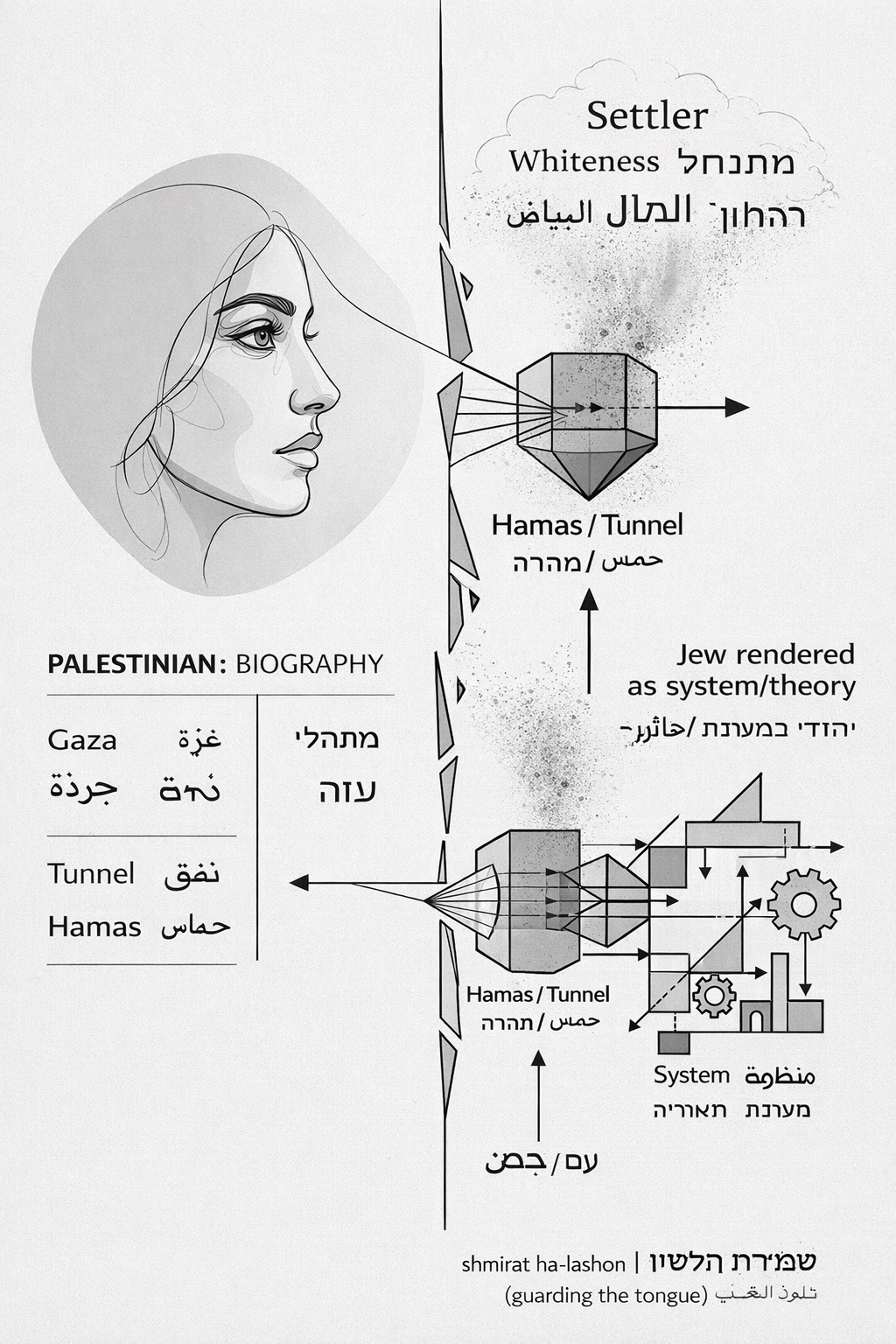
The simplest shortcut looks like this: Palestinians appear as “a people” (faces, suffering), while Jews appear as “a system” (structures, guilt). Empathy attaches to one; mechanism attaches to the other. Once that split enters a sentence, antisemitism does not need to arrive as insult. It is enough that Jews are reduced to functions: colonial, imperial, financial, epistemic. The Jew loses the status of who and is recast as what.
“Hamas/tunnel” reinforces this distribution. In mainstream media Hamas is often absolutized to close conversation. In some pro-Palestinian environments the move reverses: Hamas is dissolved into the background while prison, siege, or tunnel imagery is foregrounded as the carrier of empathy. Sincere compassion can therefore coexist with an antisemitic matrix at the level of agency distribution.
In university settings the coupling can be more polished. Antisemitism may appear as total theory rather than as hate. Jews become “whiteness,” “settler colonialism,” “capital,” “the West,” “epistemic violence”: functions, not subjects. The language of resistance becomes totalizing, and Jewish existentiality is erased without anyone needing to express animus. Antisemitism in white gloves.
Put asymmetrically and plainly: pro-Palestinian sensitivity to suffering can be genuine and morally motivated. Antisemitism emerges when that sensitivity is plugged into a totalizing theory that converts Jews from who into what. It is a shift from empathy to mechanism.
Detector: Four Philological Questions
A formal definition of antisemitism is not required for this detector. Four questions suffice, philological and existential at once.
Does the Jew appear as a person or as a function of a system?
Is Jewish suffering treated as suffering, or as mere “consequence”?
Is Hamas named as an agent of actions, or dissolved when inconvenient?
Is “resistance” used in a way that automatically legalizes everything, without boundary conditions?
If the answers tilt toward function, consequence, dissolution, and automatic legalization, solidarity is being routed into structural antisemitism without anyone needing to say the word.
A line of dry humor helps the reader retain the point: there are discourses in which Palestinians have biographies, while Jews have theories. That is exactly where the trouble begins.
Yochanan Schimmelpfennig