
Eyes everywhere
Hamas is not willing to disarm and it was clear from the start
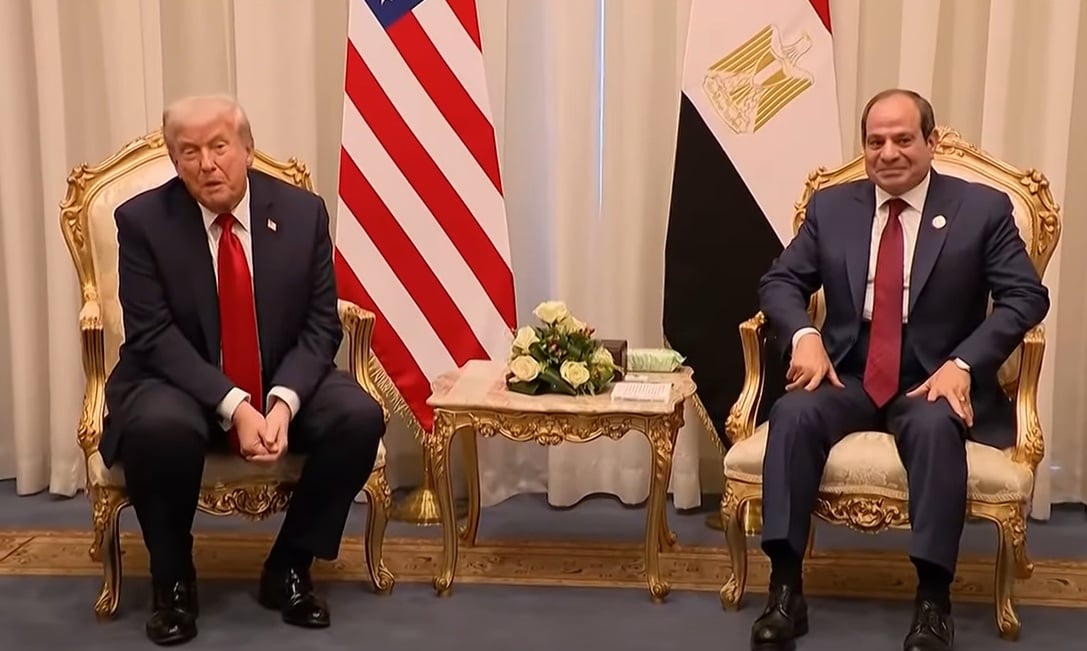
US President Donald Trump meeting Egyptian President Abdelfattah al-Sisi on October 13, 2025 (YouTube DWS screenshot; used in accordance with Clause 27a of the Copyright Law)
The so-called “phase one” of Trump’s peace plan is on its way to being completed. The twenty living hostages who remained in Hamas hands have finally been released, and, hopefully, the bodies of the 28 deceased will soon be returned to Israel for proper burial.
In the meantime, Israel released 1968 terrorists who were being held in the prisons of Ketziot and Ofer, belonging not only to Hamas but also to Fatah, the Palestinian Islamic Jihad (PIJ), and the Popular Front for the Liberation of Palestine (PFLP).
These terrorists will most likely take up arms again and kill more Israelis, just like in previous agreements with numbers disproportionately favorable to terrorists, such as the 2011 deal that led to the release of 1,027 in exchange for the soldier Gilad Shalit. Among the released prisoners was Yahya Sinwar, the mastermind behind the massacre of October 7, 2023.
It is therefore unclear how the release of nearly two thousand terrorists can contribute to a “peace plan”, especially considering the bloodshed caused by previous exchanges.
Meanwhile, Hamas has at least 7,000 terrorists at its disposal in the Gaza Strip, many of whom have been mobilized to execute “collaborators” of Israel as soon as the ceasefire went into effect. A move that certainly doesn’t reflect the attitude of someone intending to give up power.
However, there is another aspect, with extremely vague connotations, on which it is essential to focus: the alleged disarmament of Hamas.
US President Donald Trump stated that the issue of Hamas surrendering its weapons would be addressed in the second phase of the peace plan. On the night of October 8th, US special envoy Steve Witkoff and Jared Kushner met directly with senior Hamas official Khalil al-Khaya and other Hamas leaders in Sharm el-Sheikh to seal the hostage release and ceasefire deal.
As reported by Axios, Hamas leaders feared Israel would resume the war once the hostages were freed, and needed direct assurances that Trump wouldn’t let that happen. It is unclear what type of reassurances and guarantees were provided by Witkoff and Kushner. The hostages were the only guarantee Hamas had for its survival. If they released them, did they also receive other guarantees in exchange that perhaps we are not aware of?
Interestingly enough, on October 12th, Hamas political bureau member, Hossam Badran, told AFP that disarmament is totally ruled out and not negotiable:
“It is important to note that Hamas’s weapons are not the only ones. Today we are talking about weapons that are the weapons of the entire Palestinian people, and weapons in the Palestinian case are a natural thing and a part of history, the present, and the future.”
Badran also said that Hamas is ready to resume the fighting if needed:
“We hope that we will not return to (war), but our Palestinian people and the resistance force will undoubtedly confront and use all their capabilities to repel this aggression if this battle is imposed.”
If Hamas is saying that it will not give up its weapons and is ready to resume war, it means that the terrorist organization is not planning to leave power anytime soon, and it is most likely just trying to take time and find its way through the turmoil once again. The objective? Maintaining power and fighting against Israel.
Moreover, to whom should Hamas hand over its weapons? Who will be running the international coalition for disarmament? Trump’s proposed framework generically calls for the complete demilitarization, with the destruction of all military infrastructure under international supervision and the permanent decommissioning of weapons.
However, Washington already stated that there won’t be any US boots on the ground in Gaza. At the same time, it would be unthinkable to see Hamas handing over weapons to Turkish or Qatari soldiers, considering that these two nations are the terror group’s main supporters, together with the Iranian regime. As to Egypt, it’s worth highlighting how Cairo turned a blind eye to Hamas’s illicit trafficking between Sinai and Gaza, including the passage of weapons that later proved crucial to the pogrom of October 7, 2023.
Israel will not fully withdraw until Hamas lays down its weapons, or, at least, that’s what we should all hope for; otherwise, it would turn into a capitulation. On the other hand, Hamas will not lay down its weapons until Israel fully withdraws. This potential situation has only one outcome: more war.
Furthermore, anyone who knows Hamas is well aware that its goal is the destruction of Israel, and it will never give up fighting because the foundation of its creed is suicidal fanaticism. Hamas leaders said they will repeat an October 7-style massacre, and they mean it. Hamas is not a political actor; it is a terrorist organization, and as such, it should have been dealt with. As to Qatar, it should have never been allowed to take the role of “mediator” since it acted as Hamas’ diplomatic arm. The next stage of the “peace plan” will bring everyone back to the hard reality.
Related Topics
Related Posts