
Leadership With Heart
What If Israel Lost the War for Hearts and Minds?
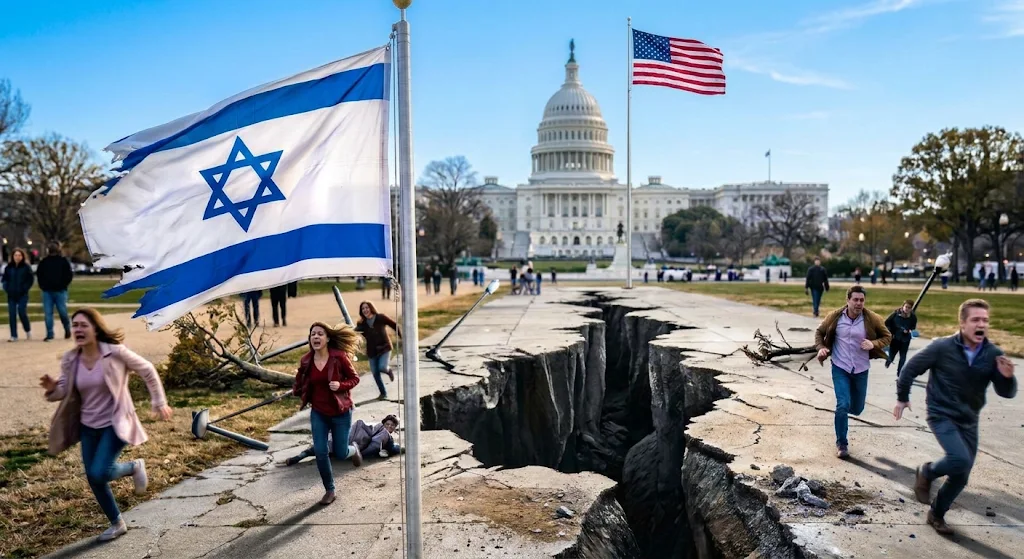
AI generated image
An expert on antisemitism recently warned that recognizing the threat and allowing ourselves to become deeply concerned about it could lead us toward paranoia.
What troubled me was the direction of the warning.
We do not need paranoia. We need the willingness to follow a threat through to its consequences—even when those consequences disturb us.
Here is the consequence we must confront: Israel could defeat the enemies attacking it today and still lose the political struggle that determines whether it can defend itself tomorrow.
Imagine that future.
Another war has begun. Israel needs replacement munitions, aircraft components and emergency assistance. Its enemies are still firing. Families are still in shelters.
The request reaches Washington.
The answer is no.
Not because the weapons are unavailable. Not because Israel cannot pay. The administration has decided that supplying Israel would perpetuate an injustice.
Congress supports the refusal. European governments coordinate restrictions. When Israel approaches other suppliers, Washington urges them not to fill the gap.
Then comes a second announcement.
The United States will provide military assistance and security guarantees to a Palestinian government. Its security, officials explain, requires protection from Israeli intervention.
The instruments once used to help Israel remain strong are now being used to constrain it—and strengthen the other side.
That is the future this essay asks us to examine. Not because it is already settled, but because preventing it requires understanding how it could become politically possible.
First, Reverse the Moral Story
Before a government reverses an alliance, a public must be persuaded that the reversal is justified.
The most effective propaganda does not merely dispute particular facts. It changes the framework through which facts are understood.
In that framework, Israeli strength becomes evidence of Israeli guilt. Palestinian suffering becomes proof that Palestinian actors bear no responsibility. Attacks on Israelis disappear behind explanations; Israeli responses become the beginning of the story.
The victim and perpetrator are reversed by deciding whose actions require explanation and whose existence requires justification.
“Genocide.” “Apartheid.” “Colonizers.” “Baby killers.”
These are not interchangeable terms. Some describe specific legal allegations; others are instruments of demonization. Each factual or legal claim must be examined on its evidence. But propaganda has no interest in preserving those distinctions. Its purpose is to collapse them into a single verdict: Israel is inherently criminal.
Once that verdict is accepted, the policy implications follow.
Helping Israel defend itself becomes complicity.
Protecting its military advantage becomes enabling oppression.
Resisting its isolation becomes obstructing justice.
The argument is no longer that Israel should change a policy. It is that the world should stop helping Israel remain strong.
That is where the battle over public understanding becomes a battle over national survival.
The Audience for That Reversal Already Exists
Pew Research Center’s May 2026 survey found that only 43 percent of Democrats and Democratic-leaning independents viewed Israeli people favorably. Among those under 35, the figure was 29 percent. These were attitudes toward Israeli people—not simply their government.
Nor can Israel assume that Republican support will renew itself automatically. Among Republicans and Republican-leaning independents aged 50 and older, 79 percent viewed Israeli people favorably. Among those under 35, only 43 percent did. Favorable views of the Israeli government fell from 68 percent in the older group to 28 percent in the younger.
Those numbers do not predict every future vote. They show that inherited assumptions about Israel’s place in American political life are not secure.
Today’s younger voters can become tomorrow’s legislators, congressional staff members and executive officials.
The strategic question is not whether every unfavorable opinion becomes a hostile policy.
It is what happens when enough policymakers come to believe that weakening Israel is the morally responsible thing to do.
Then, Reverse the Machinery
American support for Israel is not merely a sentiment. It has been translated into money, weapons and law.
The 2016 military-assistance memorandum established a framework of $38 billion over fiscal years 2019–2028: $3.3 billion annually in Foreign Military Financing and $500 million annually for missile defense, subject to congressional appropriations. That framework has helped turn a political commitment into military capability.
American law also protects Israel’s qualitative military edge. Specified certifications for proposed arms transfers to other Middle Eastern countries must determine that those transfers will not adversely affect that edge. The purpose is to preserve Israel’s ability to counter credible conventional threats despite its geographic and demographic disadvantages.
Economic policy has reflected support as well. In 2019, the House adopted a resolution opposing the BDS movement and efforts to delegitimize Israel. Some states have enacted contracting restrictions directed at boycotts of Israel, although their scope and constitutionality have been contested. These state measures are distinct from federal laws against participation in certain foreign boycotts.
These arrangements are not one permanent guarantee. They are separate political and legal decisions.
That is precisely the vulnerability.
A funding commitment depends on appropriations. An export approval depends on an executive decision. A statutory protection can be amended. A state contracting rule can be repealed.
What one political generation builds, another can dismantle.
The warning is not simply that assistance might shrink. It is that the governing purpose could reverse.
Instead of asking how to preserve Israel’s capacity to defend itself, officials could ask how to reduce that capacity until Israel accepts their demands.
What the Reversal Would Look Like
First comes the vote.
A congressional majority concludes that military assistance rewards Israeli wrongdoing. Conditions multiply. Emergency requests become political confrontations. Programs once defended as essential to an ally’s security are recast as subsidies for oppression.
Then comes the weapons decision.
Israel offers to purchase what it previously received through assistance. The answer remains no. The issue is no longer who pays. It is whether Israel should possess the capability at all.
Then comes the diplomatic decision.
Washington stops trying to narrow resolutions Israel considers dangerous. Eventually, it supports measures intended to compel Israeli compliance.
There is a limited but concrete precedent for withholding diplomatic protection. In December 2016, the United States abstained on Security Council Resolution 2334 concerning Israeli settlements, allowing it to pass by 14 votes to none. That was not a decision to abandon Israel. It demonstrated that withholding protection is an available choice.
In the future described here, that choice becomes a sustained strategy.
Then comes the economic decision.
Anti-boycott measures are repealed. Public bodies adopt divestment requirements. Governments impose restrictions on selected transactions, technologies or industries. Companies discover that maintaining an Israeli relationship creates compliance costs and political exposure.
Each measure would require its own authority and decision. But their cumulative purpose could be unmistakable: make Israel’s refusal progressively more expensive.
Finally comes implementation.
An approved shipment does not leave the warehouse. An export license is denied. A bank refuses a restricted transaction. A government supplier terminates a covered contract.
This is how a slogan becomes a material constraint.
Not when it is shouted at a demonstration.
When an official signs the order and an institution carries it out.
Then, Strengthen the Other Side
Now imagine the same governments building a security relationship with a Palestinian state.
Recognition brings embassies. Agreements bring funding. Security commitments bring training, equipment and political protection.
None of that must be hostile to Israel. A Palestinian government genuinely committed to coexistence could be part of a durable peace.
But recognition does not itself establish coexistence. A promise does not enforce itself. A security guarantee can protect an arrangement whose dangers remain unresolved.
Imagine Western governments extending those guarantees without securing credible acceptance of Israel’s enduring existence.
Israel warns that the proposed arrangements leave it exposed.
Its objections are dismissed as resistance to Palestinian freedom.
Israel insists on retaining military advantages.
Those advantages are described as the obstacle to equality.
Israel acts against what it considers an emerging threat.
Its former partners warn that it is violating the security of a state under their protection.
The alliance has not merely weakened. Its practical function has changed.
The weapons, votes and guarantees once intended to preserve Israel’s freedom of action now protect another government against it.
There is no need to imagine American aircraft attacking Israel to understand the severity of that reversal.
A government can become an instrument of coercion without firing a shot.
The Demand Would Not Stop at a Weapons Shipment
Imagine the ultimatum during wartime.
Accept the prescribed withdrawal or lose further cooperation.
Accept the security arrangement or face additional restrictions.
Accept the settlement or bear the economic consequences.
A territorial compromise is not the same as dismantling Israel. Difficult negotiations are not inherently existential threats.
The decisive question is whether the proposed outcome preserves a defensible Jewish state—or treats Jewish sovereignty as the injustice to be removed.
If the second premise takes hold, every remaining Israeli strength becomes another obstacle to overcome.
Its military advantage. Its diplomatic relationships. Its economic resilience.
What once reassured its friends becomes what its opponents insist must be dismantled.
This is the logical danger of losing the moral argument about Israel’s right to exist: the means of defending that existence become morally suspect as well.
The Reversal Reaches Jews Outside Israel
The same premise can travel from a state to the people associated with it.
If Israel is treated as inherently criminal, attachment to Israel becomes evidence against the person expressing it.
Consider David Schwimmer’s advertising campaign for the clothing retailer Quince. The advertisement referenced the red sweater from Friends. Yet some social media users called for boycotting the company because Schwimmer is a Zionist and has publicly supported Israel. The Jewish Chronicle reported objections to the company featuring a “Zio.”
That reporting does not establish a successful boycott or the loss of Schwimmer’s contract. It establishes the pressure being attempted: make employing him costly because of his association with Israel.
The mechanism belongs in this argument because it follows the same progression.
First, declare the association unacceptable.
Then, demand consequences from institutions.
Then, make maintaining the relationship require a defense.
The stakes differ enormously between an advertising campaign and a weapons agreement. The political method can nevertheless resemble itself: turn association with Israel from an ordinary relationship into an accusation.
And the danger to people is not confined to professional pressure.
In June 2025, participants in a Boulder gathering supporting Israeli hostages were attacked with Molotov cocktails. The perpetrator later pleaded guilty to federal hate-crime charges and admitted targeting victims because of their actual or perceived Israeli national origin and Jewish religion. Karen Sorin Diamond died from her injuries.
That is not evidence that every critic of Israel intends violence. It is evidence that anti-Israeli and anti-Jewish targeting can converge in lethal action.
When Gal Gadot warned this month about how rapidly and openly hatred of Jews was spreading, the concern was not abstract. When President Trump compared American antisemitism to “Germany in 1938,” his historical analogy was an assessment, not a finding that the situations are equivalent. Neither remark should substitute for evidence. Neither should be dismissed as proof that concern itself has become excessive.
The question is what institutions will protect—and what they will learn to excuse.
We Cannot Leave This Battlefield Undefended
Our soldiers can destroy a weapons depot. They cannot, by themselves, preserve an American congressional majority.
They can defeat a terrorist formation. They cannot ensure that the next generation understands why Israel has the right to defend itself.
They can win today’s battle while others lose the political conditions of tomorrow’s security.
That is why public understanding is not a cosmetic concern. It is not merely reputation management. It is part of the environment in which arms are supplied, laws are maintained and alliances survive.
Israel must prepare for disrupted assistance while working to prevent it. Jewish institutions must build sustained education and relationships across party lines. Advocates must answer falsehoods with evidence, distinguish legitimate criticism from delegitimization and defend Palestinian rights without surrendering Jewish rights.
Accuracy is not an apology. It is what makes the warning credible.
Unity is not uniformity. It is agreement that Jewish safety and Jewish sovereignty cannot become expendable because defending them grows politically difficult.
Above all, we need Hashem. Faith must deepen our responsibility, not become reassurance that someone else will carry it.
“Never Again” Is an Obligation
For enemies who seek the physical destruction of Jews, the objective is genocide. Other actors need not share that intention to help create vulnerabilities those enemies can exploit.
That is the convergence we must prevent: a Jewish state stripped of essential support while Jews elsewhere find their belonging increasingly conditional.
It is not inevitable.
But its prevention will not happen automatically.
“Never Again” does not mean that history has made another catastrophe impossible. It means that we have accepted responsibility for recognizing danger and acting against it.
We must win the tactical battles. We must also win the long struggle over whether Jewish life, Jewish freedom and Jewish sovereignty deserve protection.
We cannot wait until the weapons request is refused, the protective law is repealed and the former ally is organizing pressure against us.
It can happen again. Our responsibility is to stand together and prevent it.
That is what we must mean by Never Again.
Related Topics
Related Posts