The views expressed herein are solely mine.
Hamas’s Empire of Fear Is Crumbling from Within
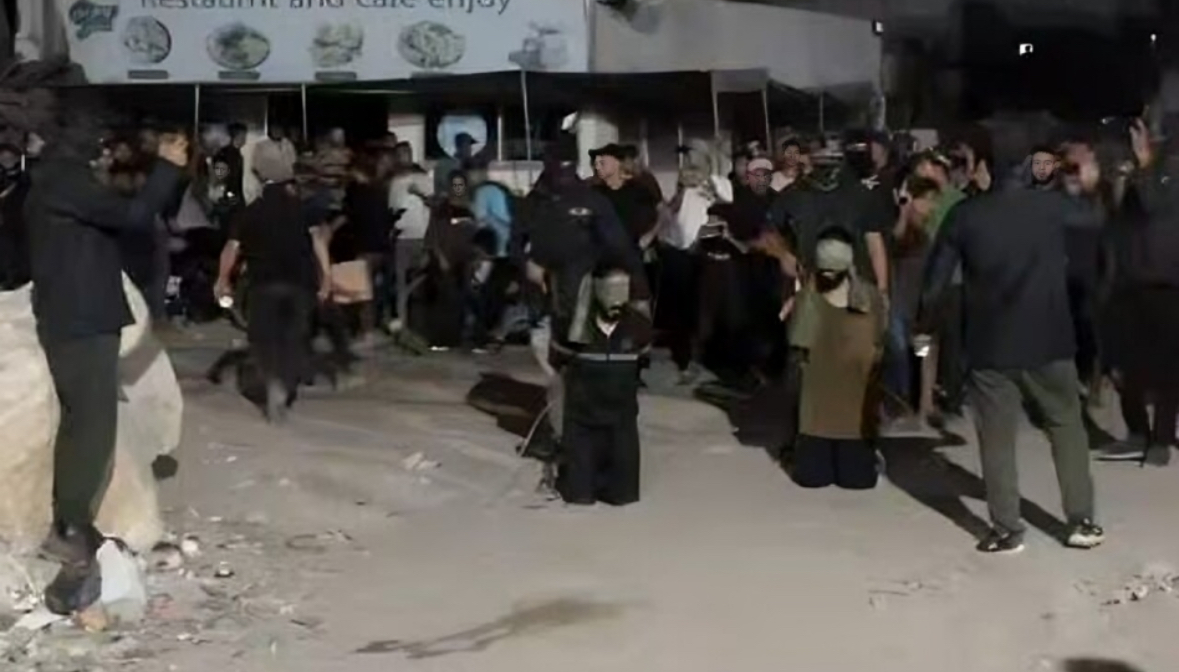
Palestinians accused of collaberation with Israel are seen blindfolded moments before their execution by Hamas gunmen in a Gaza street, September 22, 2025 (Social media)
The so-called “Trump Peace Plan” ceasefire did not bring peace to Gaza—it exposed the rot inside it.
Beneath Hamas’s collapsing empire, 12 armed clans now fight for the spoils of power, money, and revenge.
Gaza is not being rebuilt by the construction companies that have made Hamas’s leaders abroad rich or the companies that, according to Steve Witkoff, “have been working on this” (a really weird statement which confirms that “some” interests have been waiting to get involved in the Gaza reconstruction process to get rich); it is being carved apart by the very people Hamas once ruled through terror.
For nearly two decades, Hamas ruled like a mafia, hiding behind “resistance.” It taxed the tunnels, executed rivals, and built a police state with its ‘Radea’ enforcers.
Now the mask is off.
Around a dozen militias—tribal, criminal, Islamist—have risen across the Strip. They count barely 1,500 fighters against Hamas’s 20,000, yet they represent what Hamas fears most: rebellion from below.
In Rafah, the Abu Shabab forces—former smugglers now rumored to have quiet Israeli backing—control the gateways to Egypt.
The Doghmush clan, Gaza’s real mafia, runs extortion and kidnappings. Even Hamas negotiates with them because it cannot destroy them.
Why? Because the Army of Islam (Jaysh al-Islam) in Gaza—the Salafi-jihadist group that has pledged allegiance to Al-Qaeda’s global network—is led and largely composed of members of the Doghmush clan.
Therefore, a direct war between two Sunni Arab entities fighting for the establishment of a ‘caliphate in the Levant’ is the most irrational thing.
Meanwhile, the Bakr clan’s fishing fleets smuggle goods and dissent along the coast.
In Khan Yunis, the Abu Amra militia taxes neighborhoods while the Abu Jame family profits off aid convoys.
Others like the Abu Taha and Abu Eid networks control tunnels and local security. Together they form a loose but growing ecosystem of rebellion.
This is Gaza after tyranny: a web of tribes where loyalty is sold by the hour.
Meanwhile, Hamas’s unity is dying fast.
The West dreams of “reconstruction,” but you cannot rebuild a house that is burning from the inside.
As we have mentioned, Israel now only controls 53% of the Gaza Strip and must decide what comes next.
Certainly, its worst mistake would be to abandon these anti-Hamas clans again; in fact, when Israel pulled back protection, Hamas’s Radea police hunted them down and made Gaza run red.
Thus, to truly weaken Hamas, Israel must quietly rebuild bridges—offering local elders security, micro-aid, and protection in exchange for order, intelligence, and zero rocket fire.
Rotate alliances, reward results, and never crown new warlords. Controlled chaos beats Hamas’s dictatorship every time.
Nevertheless, here is the red line to watch: Israel cannot hand Gaza’s “phase two” to Qatar and Turkey.
Doha has bankrolled Hamas for years and has fostered the expansion of the Muslim Brotherhood in Gaza and the West Bank.
Ankara—which is in an endless crusade to reestablish the Ottoman Empire from Hatay to Alexandria—gives passports to operatives and uses Gaza as leverage against the West.
Hence, putting them in charge of reconstruction is not peacebuilding—it is relapse by design. They won’t deradicalize Gaza; they will repurpose it.
If the goal is stability, let Egypt, Saudi Arabia, the United Arab Emirates, and avant-garde Palestinian technocrats like Mohammed Dahlan—not Islamist patrons—manage aid under international audit.
Without a doubt, this is the moment to build clinics and schools through locals who want to live, not die for jihad.
Because the real war in Gaza is no longer Israel versus Hamas—it is Hamas versus the people it enslaved.
And in that war, Israel has only one mission: make sure fear finally turns on its master.
Related Topics