Grant Arthur Gochin

Handing Putin the pretext to annex Lithuania

(Courtesy of author)

Putin’s pretext for invading Ukraine was to “save” that country from “Nazis.” He claimed that a significant portion of Ukrainians revere Nazi Germany, which in 1941 drove the Soviets out of Ukraine. This support, Putin argues, poses a strategic threat to Russia.

Putin’s appetite for conquest is not limited to Ukraine, Georgia, and Transnistria. He would like to annex any territory with inhabitants who appear to venerate the Nazis, and Lithuanians now have given him precisely the evidence he needs to prove his case.

On June 21, 2024, Lithuanians mounted a plaque honoring Kazys Škirpa, who was the architect of the mass-murder of Jews in Lithuania, a model which the Nazis later adopted.
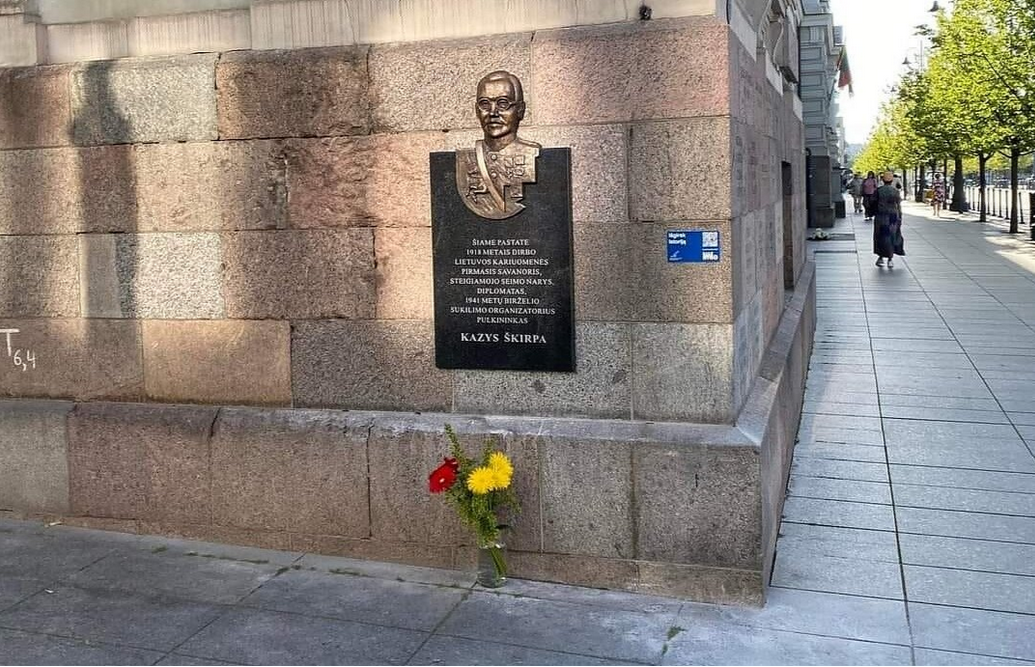
Screenshot from: https://www.lrt.lt/naujienos/lietuvoje/2/2302933/lietuvos-zydu-bendruomene-del-atminimo-lentos-skirpai-zada-kreiptis-tarptautiniu-mastu#lg=2302933&slide=1802662

In November 1940, Kazys Škirpa, a Lithuanian diplomat in Berlin, began organizing and directing the actions of a network of underground cells known as the Lithuanian Activist Front (“LAF”). The cells were directed to join the Nazis as soon as Germany began its invasion of Soviet-controlled territory. Škirpa, however, also made clear to the cells that the Nazi invasion must be used as an opportunity to eliminate Lithuania’s Jews.

In June 1941, Nazi Germany invaded Lithuania. The LAF quickly took control of the country and within a few days the Nazis turned administrative control of the country – known to the Nazis as the Litauen General Region – over to the Lithuanians.

The paramilitary LAF members were organized into militarized “police battalions,” which in fact were death squads. Within 12 weeks the squads had brutally – and publicly – slaughtered nearly all of Lithuania’s Jews. At the beginning of December 1941, Nazi officer Karl Jäger sent a report to Berlin that detailed the efficiency and enthusiasm of the Lithuanian death squads.

Significantly, while the Holocaust was unfolding in Lithuania, Nazi Germany itself had no plan for the mass-murder of Jews. There were no mass murders in western Poland, which Germany had occupied since September 1939, through the end of 1941. Ironically, a Jew who escaped Škirpa’s orgies of murder and reached Nazi-controlled towns in Poland were not subjected to mass-murder at that time.

The Nazis knew how well Škirpa’s plan had succeeded in Litauen, and the fact that the public spectacles aroused little public opposition. Still, it took several months for the Nazis themselves to emulate Škirpa’s model. On January 20, 1942, at the “Wannsee Conference,” Nazi Germany adopted a plan for the mass-murder of Jews.

For these reasons, many historians rightfully think of Lithuania as the true starting point for the mass murders of the Holocaust – and of Škirpa as the architect.

And now, by publicly honoring Škirpa, Lithuanians have given Putin clear proof that many in their country still venerate Nazi collaborators.
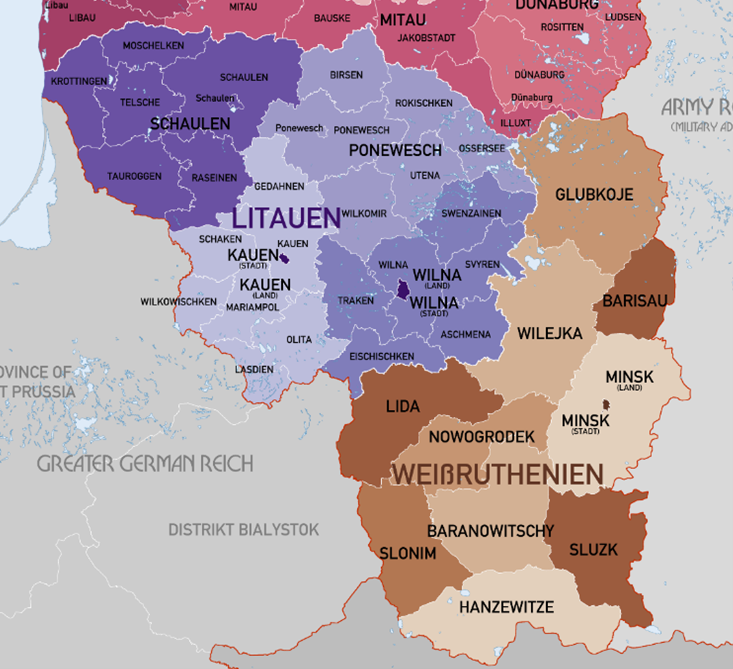
A Portion of the Area Occupied By Germany in the Fall of 1941
The purple area was “Litauen” – The area administered by the Lithuanians
The brown area was Nazi-controlled portions of Poland.

About the Author
Grant Arthur Gochin is a diplomat, author, researcher, and wealth advisor whose public work focuses on historical accountability, Jewish continuity, antisemitism, and recognition doctrine. He serves as Honorary Consul for the Republic of Togo and as Emeritus Dean and a Member at Large of the Executive Committee of the Los Angeles Consular Corps. From 2018 to 2020, he served as Special Envoy for Diaspora Affairs with the African Union Mission to the United States. Gochin also serves, in a voluntary, unremunerated and non-executive capacity, as Advisor on Recognition Doctrine and Sovereignty to the Mthwakazi Republic Party, Office of the President. His work there concerns international recognition, sovereignty, state continuity, comparative precedent and remedial self-determination. Unless expressly stated otherwise, his published views are his own and do not represent the positions of any government or institution with which he is or has been associated. His philanthropic work in Togo led to his investiture as Chief of the Village of Babade. For several decades, Gochin has researched Holocaust history, Jewish heritage and historical memory in Lithuania. He served as Chair of the Maceva Project, working on the documentation, preservation and restoration of abandoned and neglected Jewish cemeteries. His archival research, litigation and public advocacy have focused particularly on the treatment of Holocaust perpetrators and collaborators in Lithuanian state memory and on documented instances of Holocaust distortion by state institutions. He is the author of Malice, Murder and Manipulation (2013), which traces the destruction of his family in Lithuania and examines subsequent historical distortion. His writing regularly addresses antisemitism, Holocaust memory, governmental misinformation, Israel’s legitimacy and security, and the political use of historical narratives. Gochin is a PhD candidate in Holocaust and Genocide Studies at Gratz College. His research examines institutional responses to documented claims concerning Holocaust memory, historical accountability and post-genocide historical revisionism. Professionally, Gochin is a Certified Financial Planner™ and wealth advisor based in California. He holds an MBA earned with academic honors and leads Grant Arthur & Associates Wealth Services. He lives in Los Angeles with his husband, son, and dog, Kelev. www.grantgochin.com
Related Topics
Related Posts
Sign in or Register
Please use the following structure: example@domain.com
Or Continue with
By registering you agree to the terms and conditions
Register to continue
Or Continue with
Log in to continue
Sign in or Register
Or Continue with
check your email
Check your email
We sent an email to you at .
It has a link that will sign you in.