Hands up if you think you’re normal!
No, really. We Israelis, we should put our hands down…
I made aliyah six and a half years ago. Life in England was beautiful, and boring. I wanted a new adventure. I wanted to live in a kibbutz, as I’d wanted when I first visited Israel, aged 16. And I wanted to help work for peace.
Three weeks after arriving in the land of milk and honey (not the best description for a vegan, but I’ll let it go), Corona struck. I’ll try to describe to you my shocked state of mind at the time. I thought we had brought the virus. I thought we had made it happen. I believed, at the start, it wasn’t anywhere else, because in England they were still in denial, and behind us by a good couple of months. In fact, I still don’t know all the virus jargon in English. I only learnt it in Hebrew.
What followed was a couple of years of on-and-off education, lessons on Zoom, no school, some school, community projects, learning online, chaos and unpredictability.
In my six years in the country, I don’t think school has once begun when it was supposed to, either due to Corona, teacher strikes, or missile strikes. People here act like all strikes are equally inconvenient, but I’ll get to that later.
Then, Corona dwindled almost to nothing. There were vaccines, and all sorts of preventative measures. It looked like life was set to go back to “normal,” although whatever that was in Israel, I didn’t know. I’d never experienced it.
I thought other people had.
I was wrong.
There were a few months of fighting to save democracy, and then, suddenly, but apparently quite predictably, October 7 happened, and life could never be “normal” again. That simple. Pre-Shoah. Post-Shoah.
People’s hearts are broken. People’s lives are taken. People’s hopes are torn from them. All in a few hours of one day. And the wars just keep on coming. Wars that last days, weeks, months, years; it’s all the same to us. We have an app on our phone, know what to do when the siren goes off, are pre-warned, have the public shelter down the road just about in running distance, have our safe room down the road, where we can sleep sometimes, or all the time, if we want, even if it means living away from home…
Learning is stopped. Then online again. Then back in school, for a week or two, a month, a few months, until the whole cycle starts again.
One day, a few weeks ago, we had war for a day. For just one day, missiles were flying above us in the sky and we sat in our shelter and listened to the constant sirens, one after the other, for hours. And then suddenly, the all clear. We’re all back in school the next day. Like nothing has happened.
Really. I go back into school and the teachers are just teaching again. The kids are learning again. No one says a word about it until I finally turn to the school’s advisor and ask, “We did have a war with Iran yesterday, didn’t we?” And she laughs and agrees with me it was a bit bizarre that no one was talking about it.
It’s what happened after October 7, too. Once we finally did go back to school. No one really talked about it until I had the chutzpah to suggest we should start working for peace – that in wartime, peace work is absolutely vital. The overwhelming response at the time (January ’24) was that we needed to win the war, and THEN work for peace.
Yes. That’s how wars keep happening. You wait until you win it, and then peace happens. Until the next war that happens, because the other side wants to win.
Only, there’s no winners in war. It took the death of two of our graduates, fighting in Gaza, before our “left-wing” students started waking up to the possibility that the war might be going on for too long, that it might be built on a foundation of hatred and revenge, that it might not be the answer.
And still, each year, of course, the Year 12 students leave and go into the army, and life carries on “as normal.”
This year, I said goodbye to my students, who I have looked after as a mother/sister/friend for the last four years. I have watched them grow into young adults with beautiful, kind-hearted souls, and I am proud of them.
On the day I had to let them go, I knew that for some at least, those not going off to a year’s voluntary service, the army awaited them in just a few weeks’ time.
One of my students, for example, who loves the outdoors, doesn’t like large groups of people, hates gossip, loves philosophical questions and is curious about the world, and most of all, has the biggest heart, he will be driving a tank in approximately three weeks’ time.
I said goodbye to him over a glass of wine.
I don’t think I even cried.
I said goodbye to 73 of my students, my class and the whole year-group, some of whom I might never see again, except in their pictures on the internet, to show how proudly they served their country before they were killed.
And then we will remember them, too, on Remembrance Day, for there are more and more to remember each year, and the graves will keep piling up, literally – dead bodies are now being filed away in buildings made of drawers in the cemetery, as there is not enough room for the graves – as we keep sending our young people (some of whom have not yet even had a relationship, or been abroad) to fight our wars. Our wars, because we are the ones who vote for the government that creates/instigates/manoeuvers us into the wars in the first place. Some of these soldiers are too young to have ever even voted.
They are fighting history’s wars for all the older adults who continue to place them into their “normal,” for ever and ever…
Amen.
Few question it. A few shaking of heads, a few sighs, and a few comments as to what a shame it has to be like this…
A peace organization here and there…
But generally everything continues as normal. As it always has since the declaration of the country, 78 years ago. One lifetime ago. How many lifetimes have been stolen because our status quo is war?
So much war in just six years. So much death, hatred, violence. Every Saturday night at demonstrations. Sometimes huge rallies in the middle of the week. Peace events, conferences. Being screamed at by neighbors. Losing a house in our kibbutz because of our peace work. Receiving hate messages. A hearing at work, for wearing a knitted hat with a Palestinian flag and a Star of David….
Enough.
We wanted to feel normal again. We wanted to feel.
We put all our belongings in storage. We lent our cats to friends. We bought a boat in England, and brought our dog.
This year, our new normal will be living on our canalboat.
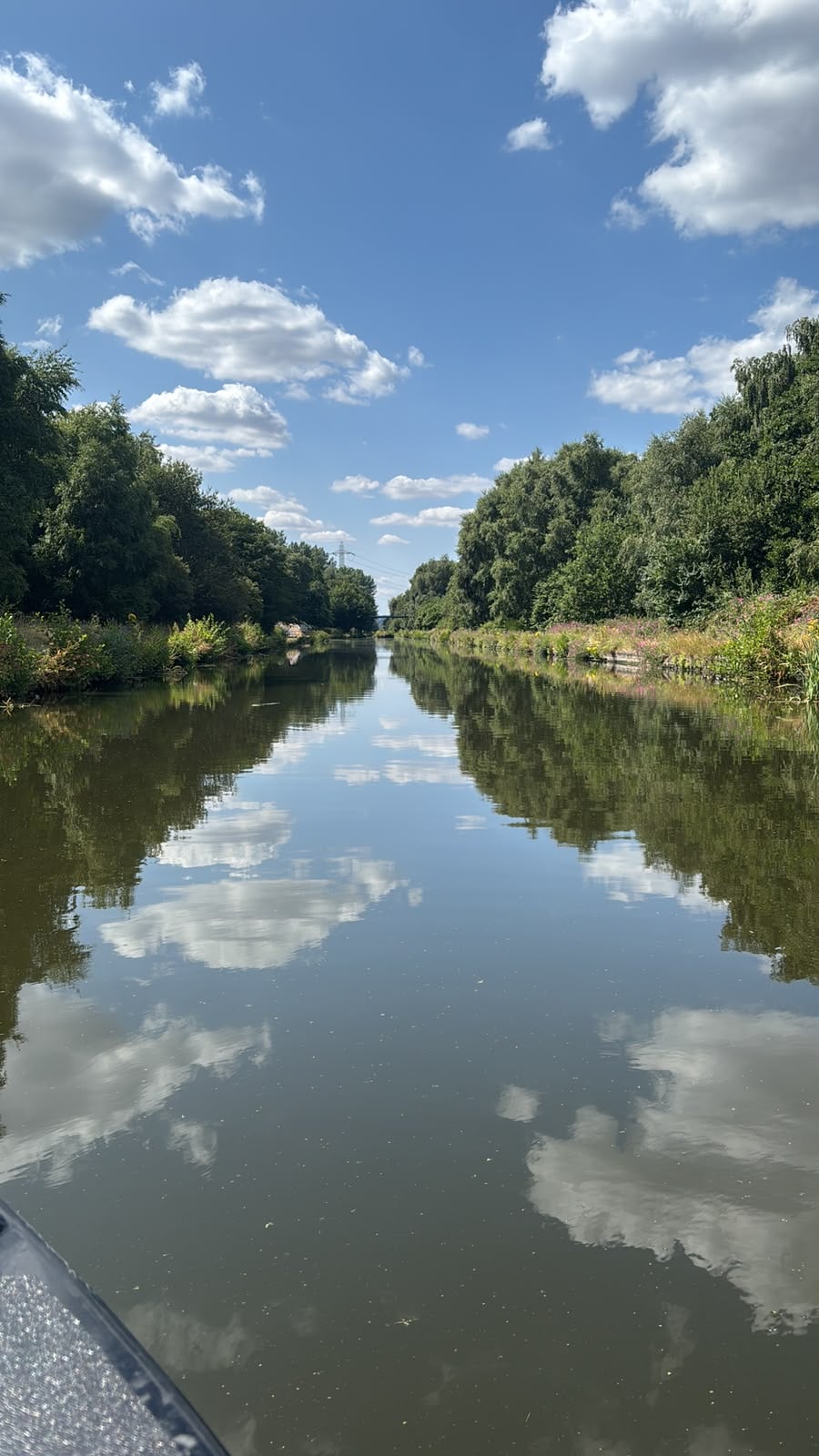
For two weeks I’ve listened to the quiet glide of the boat on the water and the faint hum of the engine. Mallards and their ducklings. Coots and their little chicks. Swans and cygnets, geese and goslings. Heron after heron, so used to us travelers on the water, they barely get out of the way as we slowly float past.
Magpies. Robins. Squirrels. Rabbits.
Pints of bitter. Vegan roast dinners. Conversations about nothing. Anyone and everyone happy to talk to us about nothing and everything. And even happy to know we are from Israel and to hear about our peace work.
This is England. This is the place I’ve heard my Israeli colleagues and friends joke and worry about for the past six years. The “cold” place, where the people are “cold,” the food is “awful” (English food – what is that?) and the sky is grey.
Well, I hate to break it to my lovely colleagues and friends, but the sky is blue here, the food is delicious and the life is boringly normal. Normally boring. Not one jot of racism, or negative comment.
No one is running around screaming about war. There are no sirens. We do not have to check where our closest shelter is. We do not even have to worry about what we say and to whom we say it.
I’m taking time to breathe, before I go back home. For Israel is my home, despite it being as far away from normal as one can get.
But England, she is my home too, and right now, I thank God for her every single day.