Historian, Librarian, Educator, and Artist
Hanukkah in Jerusalem: Light without Apology
When Jewish Time Occupies Jewish Space
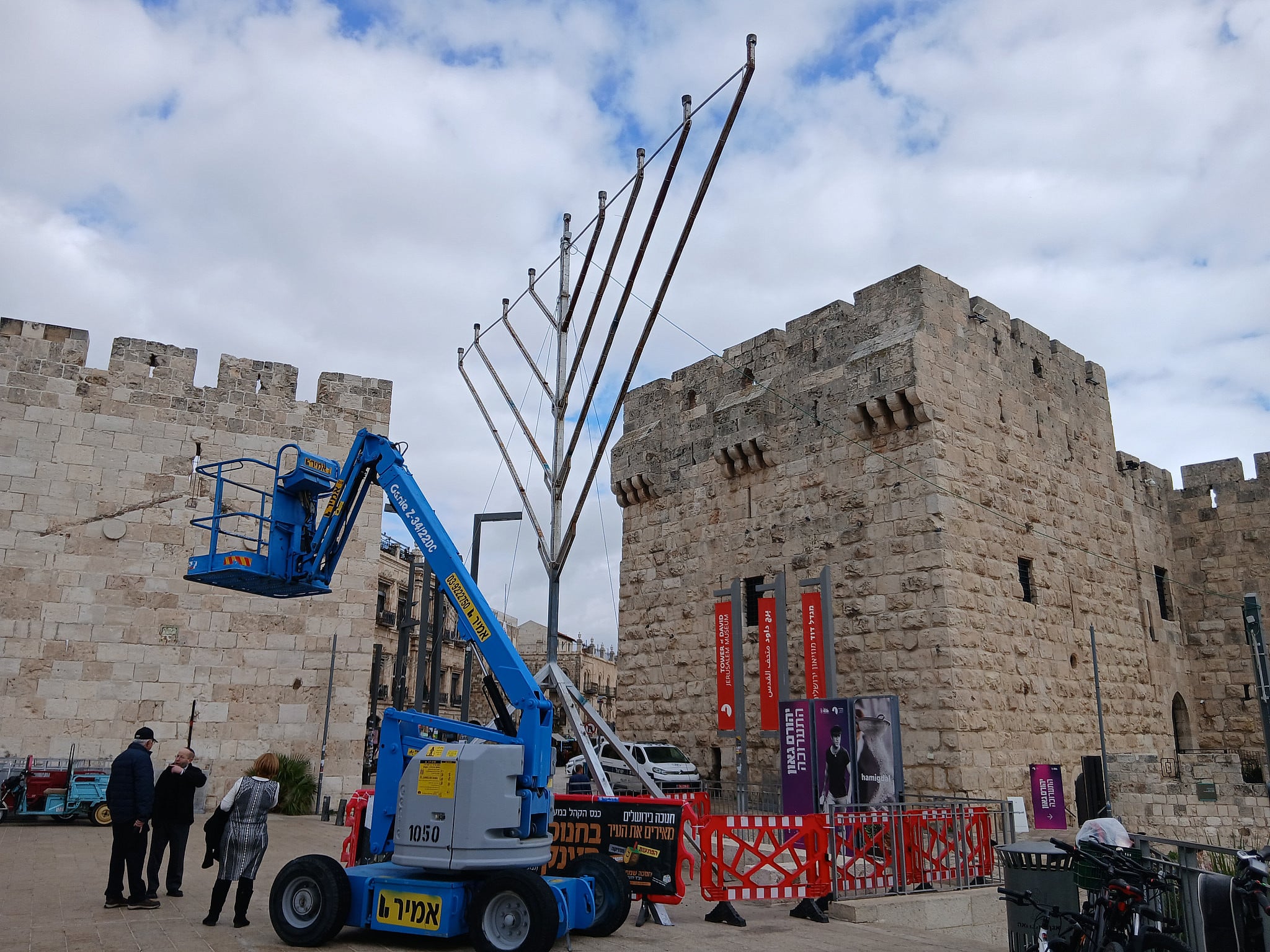
Preparing the menorah at Jaffa Gate, Jerusalem—a quiet act of continuity in a city where Jewish history occupies public space. (Photo: Bonnie K. Goodman)
A Holiday That Occupies Space
Hanukkah in Jerusalem does not announce itself with fanfare. It simply occupies space. Menorahs appear where Jewish life unfolds naturally: in apartment windows overlooking narrow streets, in shared courtyards, on balconies stacked one above the other, in synagogue entrances, at the Western Wall, and in public squares such as Jaffa Gate. The lights are not ornamental. They are functional, ritual objects performing a commandment rooted in history.
For Jews accustomed to celebrating Hanukkah as a minority, this difference is striking. In much of the Diaspora, Hanukkah has become the most publicly visible Jewish holiday precisely because it competes—visually and culturally—with Christmas. Its prominence is reactive. In Jerusalem, Hanukkah does not compete with anything. It does not need to.
Here, the menorah is not a symbol of coexistence or seasonal cheer. It is a marker of continuity. Jewish time unfolds in a Jewish city according to a Jewish calendar, without translation.
Pirsumei Nisa: Visibility as Obligation
Hanukkah is the only Jewish holiday whose defining commandment is explicitly public. The obligation of pirsumei nisa, publicizing the miracle, requires that the light be placed where it can be seen by others. The Talmud instructs that the Hanukkah lamp should ideally be positioned at the entrance of one’s home, facing outward toward the public domain (Babylonian Talmud, Shabbat 21b, open access via Sefaria).
This is not incidental. The rabbis understood that the meaning of Hanukkah depends on visibility. A miracle unacknowledged is incomplete. Jewish survival itself, the texts suggest, depends not only on continuity but on presence.
Maimonides makes this point with unusual force. In Mishneh Torah, he rules that even a person who lacks food must sell personal belongings or accept charity in order to light the Hanukkah lamp, because publicizing the miracle takes precedence (Hilchot Hanukkah 4:12, Sefaria). Few other ritual commandments are framed with such urgency.
This emphasis reflects the historical core of the holiday. Hanukkah does not commemorate escape from persecution. It marks resistance to erasure.
Not Just a Military Victory
The story of Hanukkah is often simplified into a narrative of military triumph, but the classical sources insist on something more complex. The Books of Maccabees describe a struggle not only against Seleucid rule but also against forced cultural and religious transformation. The danger was not only death but also disappearance.
When the Temple was rededicated, the act was not merely ceremonial. It was a declaration that Jewish worship, law, and collective identity would continue on Jewish terms. The lighting of the menorah became the enduring ritual expression of that refusal.
The Babylonian Talmud famously asks, “What is Hanukkah?” and answers not with a description of battles, but with the story of the oil that lasted eight days (Shabbat 21b, Sefaria). The rabbis deliberately reframed the holiday away from power and toward continuity. Light, not force, became the central metaphor.
That choice resonates powerfully now.
Jerusalem and the End of Apology
Celebrating Hanukkah in Jerusalem removes a familiar layer of negotiation. Jewish symbols here do not require explanation. Hebrew prayers are not private acts carried out behind security doors. Jewish history does not need contextual disclaimers.
This does not mean that Jerusalem is free of conflict. It is not. But Jewish presence here does not depend on conditional acceptance. The menorah at the Western Wall is not a political statement; it is the natural extension of a people returning to its ritual center. The large menorah lit at Jaffa Gate does not ask whether it belongs. It assumes it does.
For Jews who have spent their lives explaining, defending, or softening their identity for the comfort of others, this attitude matters deeply.
Hanukkah in a Time of Unprecedented Hostility
This year, Hanukkah arrives after a rupture. The Hamas attacks of October 7 and their aftermath unleashed a wave of antisemitism across the diaspora that has touched nearly every Jewish institution and community. Jewish students have faced harassment on university campuses. Synagogues have increased security. Jewish cultural events have been canceled or quietly scaled back. In some places, Jews have removed visible markers of identity out of fear.
Alongside these events has come an aggressive campaign to delegitimize Israel itself, often collapsing Jewish identity, Zionism, and collective guilt into a single target. For many Jews, the line between political criticism and antisemitism has not merely blurred; it has disappeared.
Against this backdrop, the public nature of Hanukkah feels newly charged. A holiday that insists on visibility now confronts a world increasingly hostile to Jewish presence.
The Irony of Visibility
In the diaspora, Jews are often told that visibility is provocative. Jewish symbols often incite tensions. That discretion is prudent. Hanukkah challenges this logic directly. The mitzvah assumes that withdrawal is not a viable long-term strategy.
The rabbis were not naïve. They lived under imperial rule. They understood danger. Yet they insisted that Jewish survival required being seen—carefully, wisely, but unmistakably.
Jerusalem embodies this insistence. Here, Jewish visibility is not an act of defiance staged for others. It is the baseline condition of daily life.
The Meaning of Sovereignty for Jewish Time
One of the quiet revolutions of Jewish sovereignty is the restoration of Jewish time to public space. In Jerusalem, Hanukkah is not compressed into evenings after work or weekends around majority culture. It unfolds across the city, night after night, according to its own rhythm.
As the historian Gil Troy recently noted, “Yossi Beilin once observed that Israel ‘may not be the most secure place for Jews, but it is the most secure place for being Jewish,’ a distinction that becomes tangible during Hanukkah in Jerusalem, where Jewish ritual occupies public space without translation or apology.”
This alignment of calendar, geography, and collective memory is rare in Jewish history. For centuries, Jewish time existed in pockets—homes, synagogues, texts—while public space belonged to others. Hanukkah, with its insistence on outward-facing light, always strained against that limitation.
In Jerusalem, that tension dissolves.
The Miracle We Are Still Asked to Create
Hanukkah does not promise redemption. The miracle it commemorates is modest and temporary. One small vessel of oil burns longer than expected—long enough to continue, not long enough to forget vulnerability.
Perhaps the contemporary Hanukkah miracle we are still responsible for is not divine intervention but moral clarity. The refusal to internalize hatred. The refusal to surrender Jewish legitimacy to historical distortion. The refusal to apologize for survival.
The Maccabees did not fight to be admired. They fought to remain themselves.
Light as Responsibility, Not Fantasy
It is tempting, especially now, to romanticize Jerusalem’s Hanukkah lights as proof of safety or resolution. They are neither. They do not erase fear, grief, or uncertainty. They exist alongside them.
That is precisely the point. Hanukkah does not deny darkness. It teaches persistence within it.
A City That Does Not Dim Its Lights
In Jerusalem, the menorahs do not flicker timidly. They are placed where they can be seen because that is what the tradition demands. They do not explain Jewish history to passersby. They do not translate themselves into universal language. They simply burn.
The lights do not promise that hatred will disappear. They insist, quietly and steadily, that Jewish presence will not.
Sources
“Shabbat 21b.” Babylonian Talmud, trans. via Sefaria,
https://www.sefaria.org/Shabbat.21b.
Maimonides. Mishneh Torah, Laws of Hanukkah 4:12. Sefaria,
https://www.sefaria.org/Mishneh_Torah%2C_Hanukkah.4.12.
Troy, Gil. “Hanukkah and the Meaning of Jewish Visibility in a Time of Rising Antisemitism.” The Jerusalem Post, Opinion, 2024,
https://www.jpost.com/opinion/article-879731.
Related Topics
Related Posts