Expert on Israel-U.S. relations, world Jewry and The Middle East.
Hanukkah Is a Story of Resistance. Ours Still Is
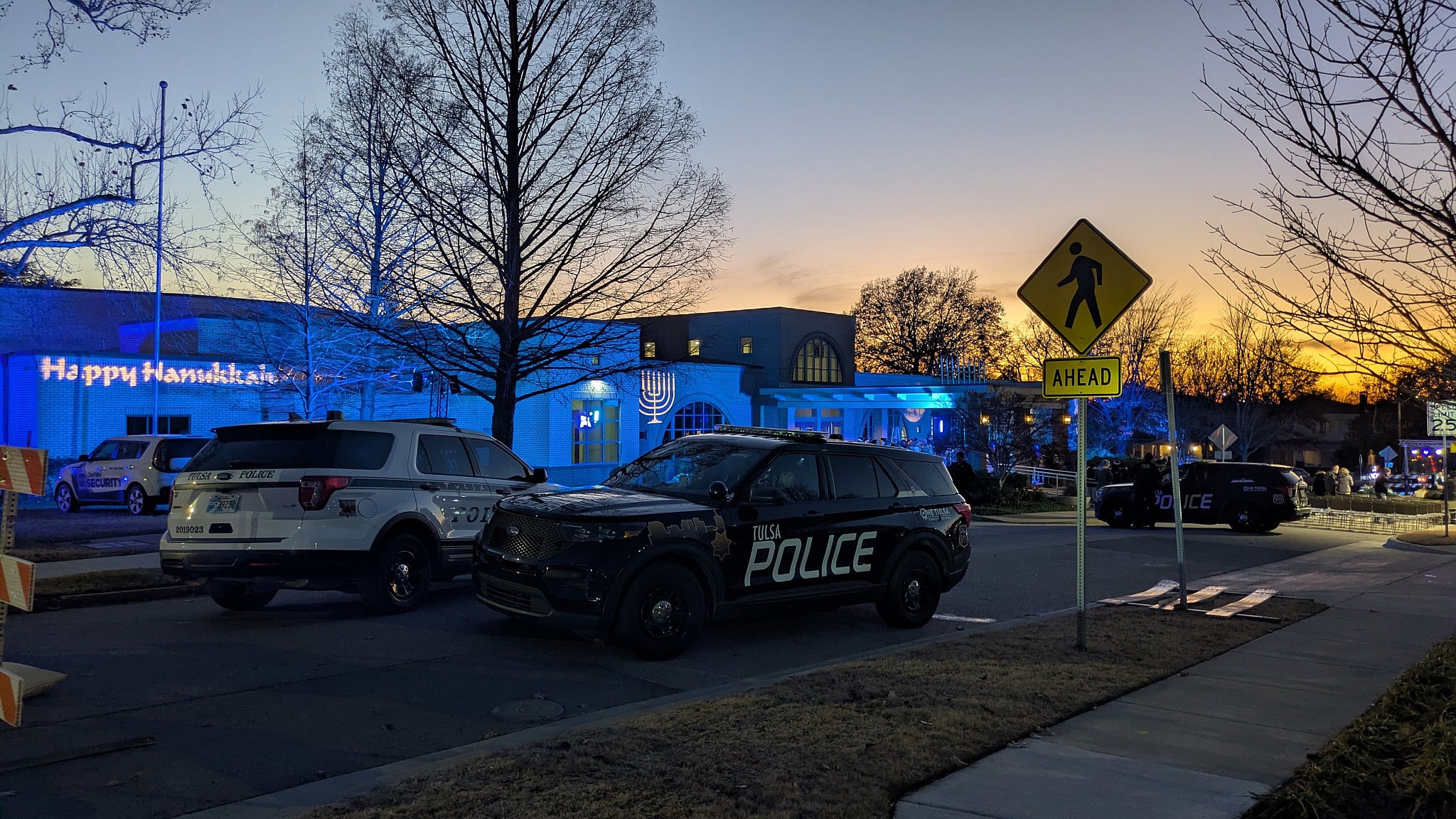
Hanukkah celebration at Congregation B'nai Emunah in Tulsa, Oklahoma. December 14, 2025. Credit: Barak Sella
Three police cruisers, two private security vehicles, and metal barricades blocking the street. That’s what the Jewish community in the middle of Oklahoma needed to set up in order to celebrate the first night of Hanukkah in safety.
The increased security was no doubt a response to the terrorist attack in Australia and a slew of other warnings. But it’s important to emphasize, this is not a new reality.
Regular security at Jewish communities in the Diaspora is our way of life, not just since October 7. What has changed is the cost and scale. In just the last two years, the cost of Jewish communal security in the United States has more than doubled. Today, American Jewish communities spend an estimated $765 million annually on security, around 14% of the average Jewish organization’s operating budget. For comparison, most American churches spend roughly 3%, if that.
So what’s new in what I’m saying here? For centuries, especially before WWII, Jews faced antisemitism not just from neighbors, but from governments themselves. Anti-Jewish laws were not solely a Nazi invention; they existed in nearly every country where Jews lived. The U.S. was a rare exception, with one notable blip: General Grant’s Civil War-era order expelling Jews from Tennessee, which President Lincoln overturned within two weeks.
After the Holocaust, Western governments adopted a new world order, and the equation flipped: antisemitism was no longer promoted by the state. On the contrary. The government became the protector of Jews against antisemitism coming from the population. Jews welcomed this new equation and, in turn, invested in the institutions of democratic-liberal order and their institutions. They joined parliaments, became judges, invested in academia, and donated not only to synagogues but to libraries, museums, schools, and more. Here in Tulsa, where I have been visiting for the last week as part of the Elson Israel Fellowship Program, you see it everywhere. In every public building, Jewish family names are at the top of the donor list.
But over the past two years, that equation has started to crack. Governments are failing in their role amid the wave of antisemitism. The slow response of the police in Australia to the Bondi Beach attack, alongside what seems like a lack of seriousness by Australian intelligence regarding threats of attacks on Jews, should seriously alarm us all. No, the government isn’t attacking us. But can we count on it to protect us?
Here, in middle America, there’s still a kind of sanity of the old order. The small Jewish community of Tulsa gathers with safety and great joy. The police protect us. You can openly say you’re from Israel in any store or bar. People will wish you a happy Hanukkah with a genuine smile.
But the doubt is already seeping in.
That’s why it’s important to remember what Hanukkah really commemorates. The theme of “light overcoming darkness” is a nice, digestible universal metaphor, but the “Festival of Lights” is primarily a story of sovereignty and Jewish self-determination. About our willingness to risk our lives to live as Jews, proudly. About the obligation to live full lives and not give up the core of our identity. About resisting the erasure of who we are. Faced with the choice between death and assimilation, the Maccabees chose life — and resistance.
Even today, everywhere Jews live, we’ve chosen to gather together, to remember the murdered in Bondi Beach, and to celebrate. To celebrate our existence. To celebrate our independence. And if we need five more patrol cars, we’ll bring them. We hope our governments will continue to protect us. But we also know this: we will never outsource the safety of the Jewish future to anyone else.
Chag sameach, nonetheless.
Related Topics
Related Posts