
Why the Overwhelming Majority of American Jews Identify as Democrats
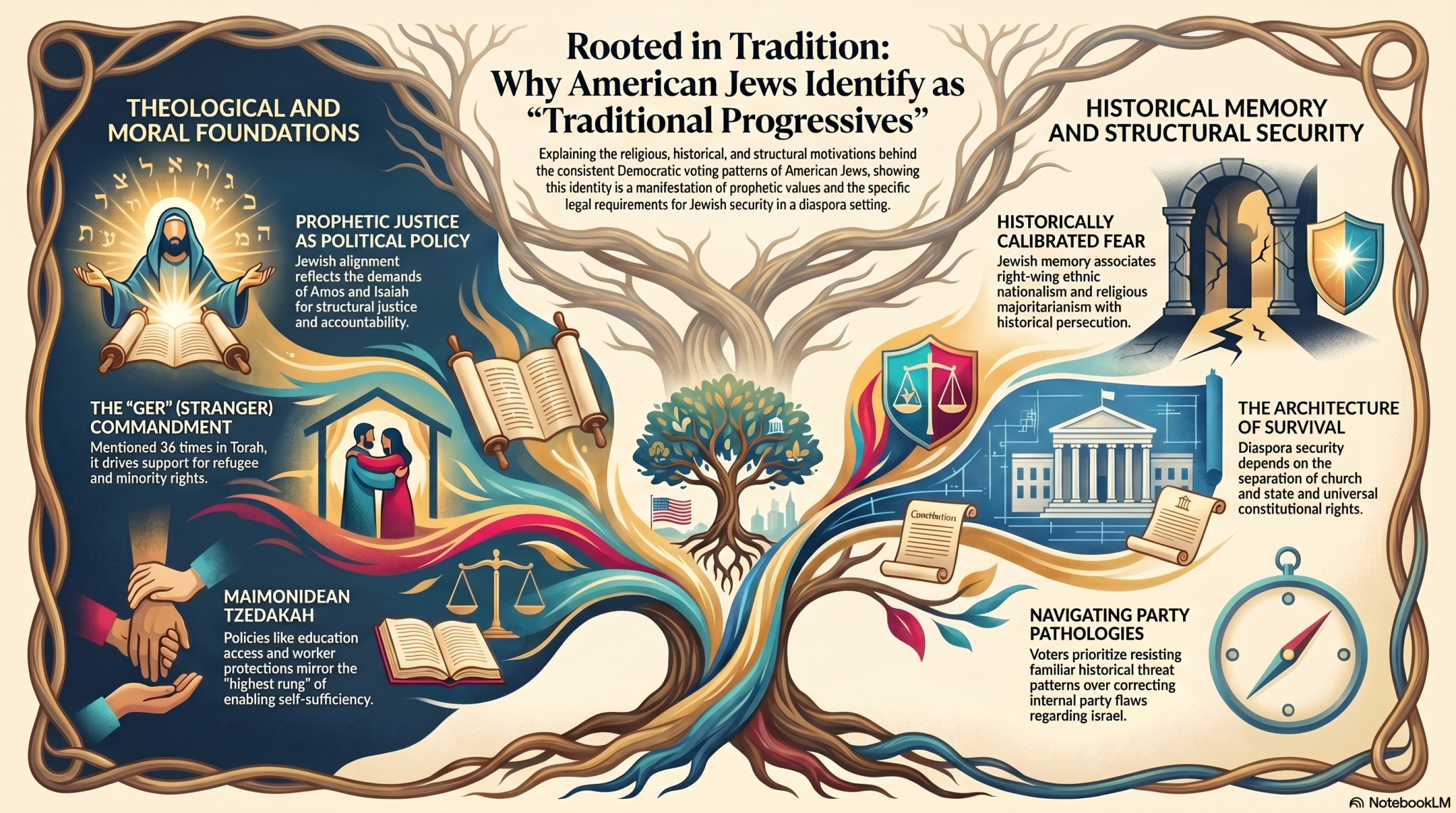
Explaining to Israelis Why the Overwhelming Majority of American Jews Identify as Democrats and Traditional Progressives
A recurring source of friction between Israeli Jews and their American counterparts is political. Israelis, who have watched the Democratic Party grow increasingly uncomfortable on Israel, and who see a Republican Party that offers loud, unconditional support, find it genuinely baffling that roughly 70% of American Jews consistently vote Democratic. The question gets asked with mounting frustration: how can American Jews support a party that seems to tolerate hostility toward the Jewish state, when the alternative offers such enthusiastic embrace?
The question deserves a serious answer — not a defensive one. Because the alignment is not irrational, not tribal inertia, and not simple ignorance of Israeli interests. It is rooted in something deeper: a coherent, values-grounded political identity that most American Jews would recognize, if asked to name it honestly, as Traditional Progressive. Understanding why requires understanding what that means — and why it has proven so durable across generations of enormous change.
What “Traditional Progressive” Actually Means
First, let us be clear about what we are not describing. We are not describing the progressive left’s identitarian wing — the campus movements that have made “anti-Zionism” a progressive credential, the Squad’s casual tolerance of antisemitic framing, the ideological maximalism that has made some Democratic spaces hostile to Jewish particularity. American Jews who remain in the Democratic coalition are not blind to these developments. They find them genuinely alarming.
What most American Jews identify with is something older, prouder, and more substantive: the tradition of the New Deal, the civil rights coalition, the labor movement, the Marshall Plan Democrats. A politics rooted not in ideological performance but in the prophetic Jewish demand for structural justice — dignity of labor, care for the vulnerable, protection of the stranger, accountability of the powerful. A politics aimed not at dependency but at opportunity — enabling self-sufficiency rather than permanent assistance, which is precisely Maimonides’ highest rung of tzedakah.
This is Traditional Progressive politics: rooted in enduring values, applied forward to present conditions. It is, in ways most American Jews feel instinctively even when they cannot articulate theologically, Judaism expressed in the available civic vocabulary.
The Prophets Were Political
Israelis who know their Tanakh well should find the political connection less surprising than they do. Amos did not merely counsel private charity. He thundered against rigged economic systems: “They sell the righteous for silver, and the poor for a pair of sandals.” Isaiah did not merely comfort the afflicted. He indicted the powerful who “grind the faces of the poor.” The Torah’s commandment to care for the ger — the stranger — appears 36 times, more than any other ethical injunction. Its grounding is explicitly experiential and political: “You know the soul of the stranger, for you were strangers in Egypt.”
This is not a private ethic. It is a demand for the structuring of society — for legal systems, economic arrangements, and political power to be organized around the dignity of the vulnerable rather than the convenience of the powerful. American Jews who vote for labor protections, anti-monopoly enforcement, immigration reform, and minority rights are not departing from their tradition. They are expressing it in the institutional language available to them as American citizens.
The Maimonidean framework reinforces this. The highest form of tzedakah is not the handout but the hand up — the loan, the partnership, the employment, the skills transfer that enables a person to need no further assistance. Traditional Progressive politics at its best — education access, fair lending, worker protections, anti-discrimination law — is organized around exactly that principle. Not dependency creation. Dignity restoration.
A Historically Calibrated Fear
Here is something Israelis need to understand about American Jewish political psychology: the fear is not irrational, and it is not old. It is historically calibrated against a threat pattern that has recurred with terrible consistency.
The forces that produced Jewish persecution in Europe and America shared a specific ideological configuration: ethnic nationalism, religious majoritarianism, contempt for cosmopolitan outsiders, authoritarian executive power, and the scapegoating of minorities during periods of social stress. That configuration lived, with remarkable consistency, on the political right — from the Pale of Settlement to the Dreyfus Affair, from the American numerus clausus to the Ku Klux Klan’s explicitly antisemitic phase in the 1920s, from Father Coughlin’s Christian nationalist radio broadcasts to the immigration restriction acts designed specifically to exclude Eastern European Jews.
American Jews did not develop their political alignment arbitrarily. They calibrated it against observed threat patterns across generations of lived experience. And when the contemporary Republican coalition combines Christian nationalist themes, ethnic grievance politics, contempt for institutional norms, and authoritarian executive ambition, it activates — reasonably, not hysterically — the same historically trained alarm system.
This does not mean the Republican Party is Nazi Germany. It means that American Jews, whose grandparents watched the specific sequencing of democratic erosion into catastrophe, are not inclined to dismiss early warning signs as overreaction. That is not paranoia. It is the application of hard-won historical intelligence to present conditions.
The Architecture of American Jewish Freedom
There is a more structural reason for Democratic alignment that goes beyond history and values: self-interest, properly understood.
Jewish civic equality in America rests on a specific legal and constitutional architecture — universal rights, strict separation of church and state, constitutional protections for religious minorities, and the principle that citizenship is independent of religious identity. Jews hold their full civic standing on that framework. Its erosion is therefore an existential concern, not merely a policy preference.
Traditional Progressive politics has consistently been the custodian of that architecture. Church-state separation, minority rights protections, judicial independence, and constitutional norms are not peripheral concerns for American Jews — they are the foundation on which everything else rests. When American Jews vote to protect those norms, they are not being naive about Israel or indifferent to Jewish security. They are protecting the specific legal structure that makes Jewish life in America possible.
Israelis, who have the IDF and a sovereign state to guarantee Jewish security, sometimes underestimate how much American Jewish security depends on that constitutional framework. It is not a luxury. It is the architecture of survival in diaspora.
The Sociology of Arrival
The Democratic alignment is also, honestly, partly historical sociology — and there is no shame in acknowledging it. American Jewish identity was formed in the crucible of immigration, labor, and upward mobility. The grandparents who arrived from Eastern Europe — from the Pale, from the pogroms, from crushing poverty — found their champions in the labor movement, the Democratic Party, and the New Deal coalition. They experienced Republican nativism and corporate indifference as personal realities, not abstractions.
The Democratic Party was not an ideological choice. It was the party that fought for their right to organize, their children’s access to public education, their protection from discrimination, and their admission to a society that did not always welcome them. That experiential loyalty transmitted across generations with remarkable fidelity, becoming not merely political preference but communal identity.
The grandchildren of those immigrants are now doctors, lawyers, academics, and executives. The material conditions have transformed beyond recognition. But the values that produced the alignment — dignity of labor, protection of the vulnerable, suspicion of concentrated power, solidarity with the excluded — have not disappeared. They have been internalized, refined, and in many cases made more sophisticated by education and experience.
The Obligation to the Stranger, Lived
Perhaps the most distinctively Jewish element of this alignment is the one that puzzles Israelis most: American Jewish identification with other minority communities — African Americans, Latino immigrants, refugees, the excluded of various kinds.
Israelis sometimes read this as naive universalism, or worse, as a form of Jewish self-abnegation that places abstract solidarity above particular Jewish interests. That reading is understandable but mistaken.
The ger commandment is not abstract. It is grounded in particular Jewish historical memory — in the experience of being the stranger, the excluded, the one whose humanity required defense. “You know the soul of the stranger” is not a philosophical proposition. It is an appeal to memory as the basis for moral obligation. American Jews who fought for Black civil rights, who support humane immigration policy, who resist nativist exclusion are not betraying Jewish particularity. They are expressing it — through the universalist means available in a pluralist democracy, in precisely the structure the Torah itself prescribes.
This is also, it should be said, enlightened self-interest. A society that protects minority rights protects Jewish minority rights. A legal culture that resists the scapegoating of outsiders is a legal culture less likely to scapegoat Jews. American Jews understood this structurally long before it became an articulate political theory.
Why They Stay Despite the Tensions
The hardest question for Israelis to understand is why American Jews remain in the Democratic coalition despite its genuine failures on Israel and antisemitism. The answer is not comfortable but it is honest.
American Jews are not choosing between a perfect party and an imperfect one. They are choosing between a party whose pathologies are correctible from within and a party whose core coalition has re-activated the specific historical threat pattern Jews have learned — at catastrophic cost — to recognize. The Democratic Party’s tolerance of anti-Israel hostility on its progressive flank is a serious problem. The Republican Party’s embrace of ethnic nationalism, Christian supremacism, and authoritarian politics is, for historically calibrated American Jews, a more fundamental and familiar one.
This is not a comfortable position. It produces genuine anguish — the anguish of belonging to a coalition that includes people who despise your homeland, in order to resist a coalition whose ideological structure you have seen before and know where it leads. American Jews who remain Democrats are not ignorant of this tension. They are navigating it, imperfectly, with eyes open.
The characteristically Jewish response to institutional corruption is not exit. It is prophetic witness from within — calling the institution back to its own best values. That is what the prophets did with Israel. It is what Traditional Progressive Jews are doing, in their own way, with the Democratic Party.
A Word Directly to Israelis
You live in a country where Jewish power is sovereign, where the IDF guarantees physical security, where Jewish identity requires no defense from constitutional protections. That is a magnificent achievement — one that American Jews celebrate and support.
But American Jews live in diaspora, as Jews have lived for most of their history, navigating a world where they are a minority dependent on the goodwill of institutions and the protection of law. Their political choices are calibrated to that reality, not to yours. When they vote for minority rights protections, church-state separation, and resistance to ethnic nationalism, they are not being naive about the Middle East. They are being rational about America.
The alignment between American Jewish identity and Traditional Progressive politics is not an accident of sociology or a failure of Zionist consciousness. It is the expression — in the language of American civic life — of values formed over three thousand years of prophetic tradition, Talmudic ethics, and hard historical experience. It is, in the deepest sense, a Jewish politics.
Understanding that will not resolve every disagreement between Israeli and American Jews. But it might replace mutual frustration with something more useful: the recognition that both communities are being faithful, in their different contexts, to the same ancient obligation — to build a world in which the powerful are accountable, the vulnerable are protected, the stranger is welcomed, and human dignity is not negotiable.
That is what the prophets demanded. It is what Traditional Progressive American Jews are still trying to deliver.