Author of 'Juggernaut: a Paradigm Shift on Antisemitism"
Hard questions on where America and Israel head
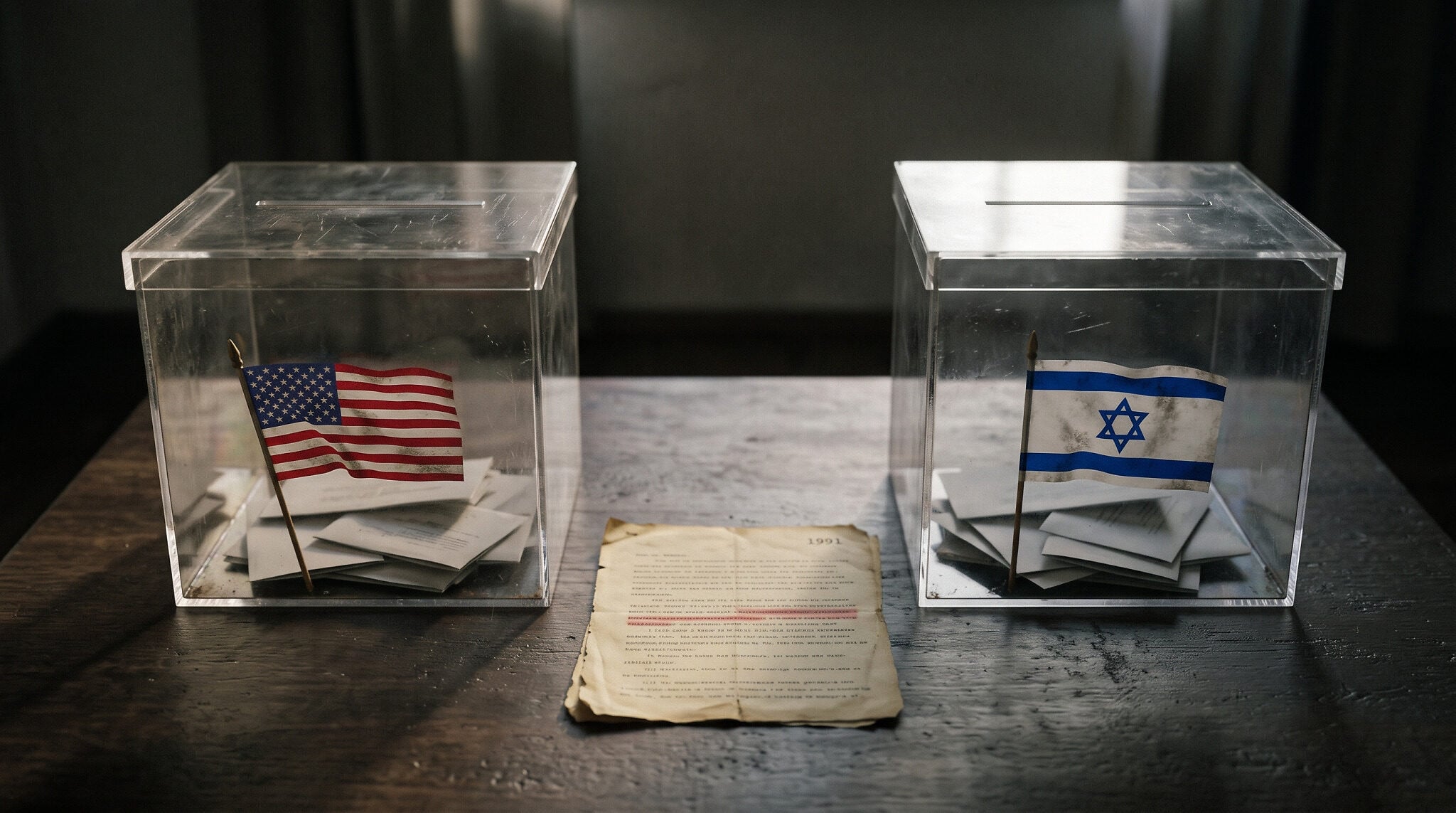
We live in interesting times
This is not a political article, nor a political opinion. I look at societies and civilizations. Not at politics. Politics is a completely different game, which most people confuse with many other things politics uses in order to mask its actions. So when you read this, remember to look through the eyes of someone who knows nothing about politics (American or otherwise).
A day after the American midterm election, an Israeli news page posted a short carousel post on Social Media from November 3rd, 2026. It showed a clickbait image of a long line of Muslim voters outside a polling station, under the headline: “Our country became Islamized, and we didn’t know?”
I’ll start with the obvious, because everything written here depends on it. The people in that line are American citizens exercising the most American right there is. They are voting in their democratic country, under their democratic right. Standing in line to vote is not an invasion. Therefore, the voters are not the subject of this article. You might ask me, “As an Israeli author and security specialist, how can you say that? You talk about the dangers of Islamization all the time!” Well, the answer is simple. Every system of control has its pros and cons, and we have to accept them. We have the obligation to make our countries better and safer, but we also have to accept that a “free world” also means accepting the fact that we don’t always get what we want.
So back to the Social Media post. The post was pure clickbait. It was engineered to gather likes, clicks, and comments. Not to represent an opinion or truth. But the reaction thread, though, shows something interesting. And that is the entire purpose of this article.
Many Israelis in the comment section did not see a line of voters. They saw a pattern they have known and feared for almost a hundred years. One wrote: “It always starts small with us and then big in America.” Another wrote: “When will the Americans wake up?” A few commenters in the same thread answered them openly: “Allahu Akbar, what’s the fear?” but another commented: “Soon we’ll rule the whole world.” He could have been an inciting bot; he could have been real. It is hard to know these days. I never trust anything I see on Social Media – but I do watch and learn the patterns, as the bots are still operated by a human who wants to engineer Perception Management.
In any case, one side recognized something instantly, and the other asked: “how it could possibly not have known”. The third side instilled fear-mongering. This article is about that gap, and it starts with a document we all know.
An Explanatory Memorandum
On May 22, 1991, Mohamed Akram, a member of the Muslim Brotherhood in America, wrote an internal paper to the Brotherhood’s Shura Council. It was titled An Explanatory Memorandum on the General Strategic Goal for the Group in North America. It was never meant for outside eyes. Federal agents found it in 2004 in a house in Annandale, Virginia, and it was entered as evidence in the Holy Land Foundation terrorism-financing trial. Whether the Brotherhood ever formally adopted it as policy is disputed. What its author believed is not, because he wrote it down.
It defines the Brotherhood’s mission in America in its own words:
“The Ikhwan must understand that their work in America is a kind of grand Jihad in eliminating and destroying the Western civilization from within and ‘sabotaging’ its miserable house by their hands and the hands of the believers so that it is eliminated and God’s religion is made victorious over all other religions.”
Then it explains the method. The author admits the Brotherhood cannot do it alone, and he spells out its role:
“They are then to work to employ, direct and unify Muslims’ efforts and powers for this process. In order to do that, we must possess a mastery of the art of ‘coalitions’, the art of ‘absorption’ and the principles of ‘cooperation’.”
The memo calls for “A shift from the collision mentality to the absorption mentality.” It lists what its political organization should include: “A central political party. Local political offices. Political symbols. Relationships and alliances.” It also understood America very well: “we are in a country which understands no language other than the language of the organizations.”
It ends with a list of twenty-nine organizations under the heading “A list of our organizations and the organizations of our friends,” with a note beside it: “Imagine if they all march according to one plan!!!” Number 24 on that list is the Occupied Land Fund. It later became the Holy Land Foundation, and in 2008 a federal jury in Dallas convicted the Foundation and five of its leaders of providing material support to Hamas.
What does Hamas say about itself? Article 2 of its 1988 Charter: “The Islamic Resistance Movement is a branch of the Muslim Brotherhood chapter in Palestine.” Article 13: “There is no solution to the Palestinian Problem except by Jihad. The initiatives, options, and international conferences are a waste of time and a kind of child’s play.”
The memo and the charter come from the same family, and both are written down.
Why do Israelis read these documents literally?
Article 7 of the Charter names its own lineage. It ties Hamas to “the Martyr ‘Izz al-Din al-Qassam and his Mujahid brothers in 1936.” That is how we read these documents. We have no reason to read them any other way.
Hebron in 1929. The Arab Revolt of 1936. The buses of the Second Intifada. October 7. Each time, open incitement came first, and each time, the world around us said the words were only rhetoric.
On October 7, the movement whose founding document says there is no solution except jihad acted on its founding document. Israelis didn’t need a think tank to explain it. We had read Article 13.
During the Second Intifada, when the buses started exploding, most Israelis learned that the language of peace could not run on a reality of jihad. That is the whole gap. Israel is a Hardware nation: its identity is anchored in land, memory, and survival. It reads a declaration of war as a declaration of war, because it has paid for every misreading in blood. The West is a Software nation that runs on updates and good intentions. It reads the same declaration and looks for a version where the words don’t mean what they say.
By their hands
There are three words in the middle of the 1991 Memorandum that say: “by their hands.”
The memorandum’s author was counting on the West to do part of the work itself. This is enough to sow seeds of panic, fear, and conspiracy within the hearts of many. You see, the author wrote plainly: he expected Western tolerance to protect people who are intolerant, and Western civil rights to shelter those who would dismantle them. He was basically betting on a civilization uneasy with its own house.
The memo does not plan to break down America’s door. It sows a seed of fear that claims that a certain movement plans to work against the house, from inside the house, through the house’s own institutions, in the house’s own language. A coalition, an alliance, a political office: none of these is illegal, and that is the point. A strategy built entirely out of legal tools never sets off an alarm in a society that only listens for alarms too late. The alarm never goes off before the fire has already spread; therefore, these sorts of alarms always ring too late.
There are two kinds of movement here. The Jewish return to Zion and an Islamist project described in these documents as unbounded. Israel wants one place. The movement that wrote these papers wrote that it wants far more.
The question
So when Americans watch their own elections, are they seeing the 1991 plan being carried out?
I am not asking whether those voters belong in that line. They do – all legitimate voters do. I am asking who wants to stand at the head of the line. A movement wrote that it intends to “employ, direct and unify” Muslims’ efforts in America. Is anyone doing that today, and toward what? The Charter answered for itself in 1988, and the Memorandum in 1991. The West refuses even to ask.
Civilizations are rarely murdered. They commit suicide.
The last question
There is one more question, and it may be the one that matters most. Is this really about a world that is changing? I don’t think it is. I think it is about people who are afraid of change itself.
Western society has changed many times in the past two thousand years. Empires fell, faiths rose, borders moved, languages died and new ones were born. I am sure that on every Tuesday of those two thousand years, someone was sitting under a tree arguing about the politics of the day, certain the world was ending. We forgot them. We also forgot that change, whether we like it or not, is something we have to accept. You cannot fight the tide. You can only protect yourself from it as best you can.
Israel learned this the hard way. We also do not get to choose the tide. We only get to choose how well we prepare for it.
A week before the Americans voted, we voted too. On October 27, Arab citizens of Israel went to the polls in record numbers, and the two Arab-led parties, Ra’am and the Joint List, won a record 19 of the Knesset’s 120 seats. Neither Netanyahu’s bloc, with 53 seats, nor Gadi Eisenkot’s, with 48, can reach the 61 needed for a majority on its own. This week, both Arab parties recommended Eisenkot to President Herzog, giving him 67 recommendations, and Herzog will announce on Sunday who gets the mandate to form the next government.
I am not a political analyst, and I am not going to tell anyone who should sit in our next government. But I can connect the dots as someone who spent the greater majority of his life protecting his country and studying history and living in the Middle East. Ra’am is the political wing of the Southern Branch of the Islamic Movement in Israel, a movement that has its roots in the Muslim Brotherhood, the same family that wrote the 1991 memorandum, though its leader, Mansour Abbas, denies any such connection. This week Abbas also told the President that his party supports the full disarmament of Hamas. Both things are true at the same time. And the rule I applied to the line of voters in America applies here too: Arab citizens of Israel who vote are exercising their democratic right, and they are not the subject.
The question is the same one. Who wants to stand at the head of the line, and what did they write down about where they want to lead it?
The difference is that in Israel, we ask it out loud. Eisenkot, like Netanyahu, has ruled out forming a government with the Arab-led parties, and three of the Jewish-led parties in his own bloc refuse to partner with them. Some Israelis are marching in the streets for a Jewish-Arab coalition, and others swear they will never accept one. That is not a crisis. That is a democracy reading the documents and arguing about them in public, which is exactly what I am asking America to do.
Even though I am not a political analyst, I am not unfamiliar with it; I can say only this without breaking my own rule: in politics – opinions do not matter. Only the decisions of the leadership and the votes of the people matter.
The people standing in the voters’ lines understood this better than anyone in the comment section. Whatever America and Israel are becoming, we will have to learn to work with it, and it requires knowledge – not rage in comment sections.
Related Topics
Related Posts