
CEO of Time to Stand Up for Israel
Hate Before a State
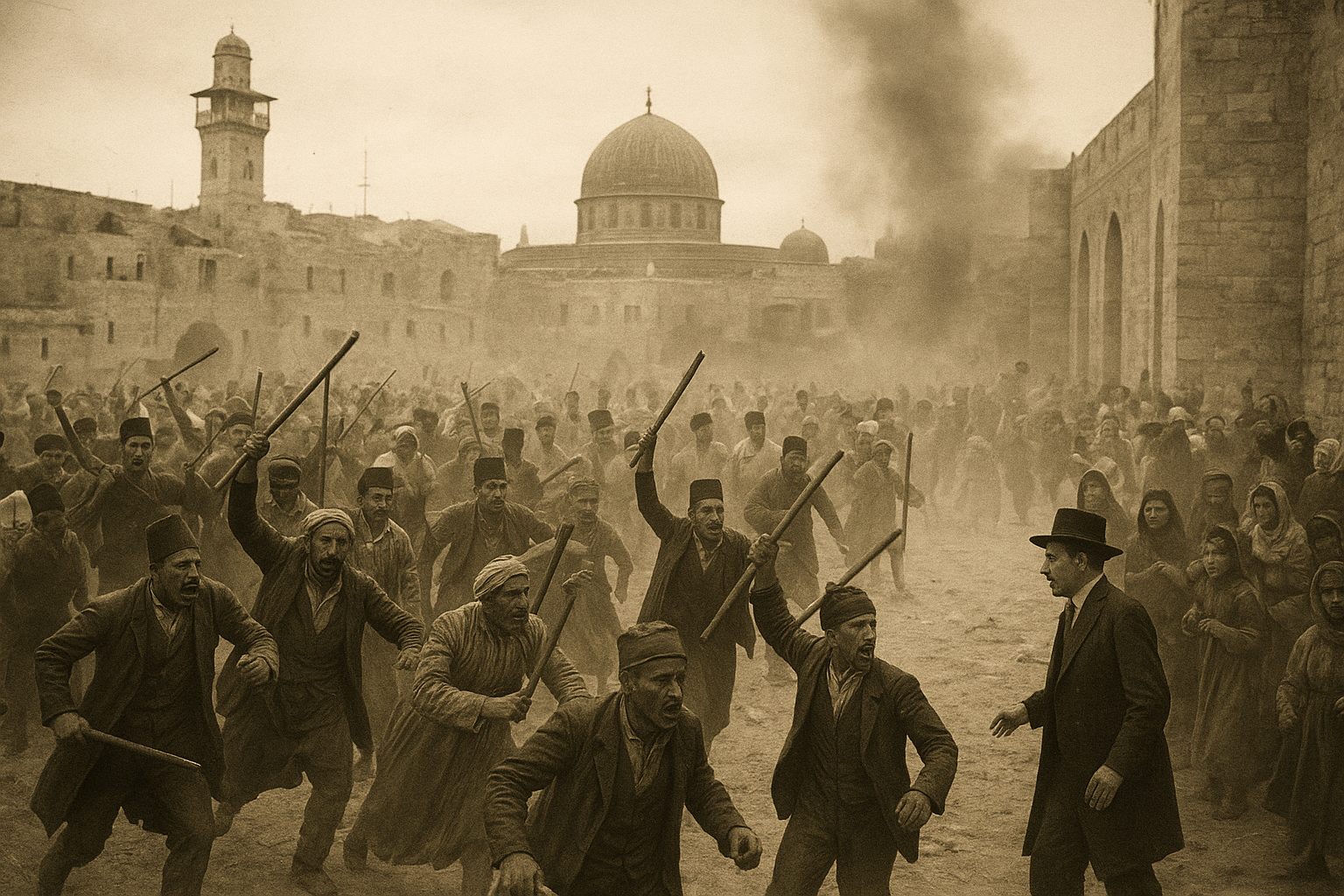
Photo Credits: Sabine Sterk (AI)
Hate Before a State
When critics today accuse Israel of being the obstacle to peace, it is worth pausing and remembering some inconvenient history. In 1920, there was no Palestinian state. There wasn’t even the concept of one. The land was under the British Mandate, freshly carved out of the collapsed Ottoman Empire. Yet even then, Arab leaders already called for the killing of Jews. Why?
The reason wasn’t occupation, checkpoints, or borders. None of those existed. What existed was Zionism: the simple, just idea that the Jewish people had the right to return to their ancestral homeland and rebuild their nation after centuries of exile. That idea alone was enough to spark furious and violent opposition.
At the Nebi Musa riots of 1920, Arab crowds, incited by religious and nationalist leaders, poured into Jerusalem. Instead of celebrating, they turned the streets into a bloodbath. Jews were murdered, hundreds were injured, synagogues looted, and homes destroyed. The mobs shouted that Jews were “dogs” and had no place in the land. And remember: this was nearly three decades before the rebirth of the State of Israel in 1948.
The violence of those days makes something crystal clear: the opposition to Jewish sovereignty was never about a so-called “Palestinian state.” That entity never existed. The riots were not driven by questions of borders, settlements, or negotiations. They were driven by something much more fundamental, the denial of the Jewish people’s right to self-determination in their own homeland.
It is here that one must address the deception woven into modern narratives. The word “Palestine” has been politically repurposed to construct a myth of an ancient Arab nation that supposedly lost its state. But history tells another story. The Romans first used the term “Palestina” after destroying Judea in the second century, deliberately erasing Jewish identity from the land. For centuries that followed under Byzantine, Arab, Crusader, Ottoman, and British rule, Palestine remained nothing more than a geographic expression. It was never an Arab country, never a sovereign state, never a political entity with recognized borders or institutions.
Before 1948, the Arabs of the region did not even call themselves Palestinians. They considered themselves part of the broader Arab world. The identity of “Palestinian” only began to take shape in the 20th century, primarily as a tool of opposition against the reborn State of Israel. What was once merely a regional label was transformed into a rallying cry to deny Jewish legitimacy, first to incite mobs to murder Jews, and now to wage propaganda wars against Israel.
The consistency of this pattern is telling. From the Nebi Musa riots of 1920, to the Hebron massacre of 1929, to the Arab Revolt of 1936–1939, to the outright rejection of the United Nations partition plan in 1947, the story was the same: not compromise, not coexistence, but rejection and violence. Each generation of Arab leaders found ways to repackage the same message: Jews must not be allowed to have sovereignty in their homeland.
Today, groups like Hamas carry that torch of rejectionism with renewed fervor. They dress their ideology in the language of liberation, but their actions and their charters tell the truth. The “Palestinian cause” has become less about building a future for Arabs and more about destroying the Jewish one. And tragically, this message has gained traction not only in the Middle East but across much of the international community. The disinformation campaigns are relentless. They weaponize the word “Palestine” to paint Israel as a usurper, when in fact it is the Jewish state that represents the indigenous nation of the land.
What the world seems too willing to forget is that the Jewish people are not colonizers. They are the native sons and daughters of Judea and Jerusalem. Every stone in the Old City, every scroll unearthed in the caves of Qumran, every ancient synagogue ruins scattered across the land, testifies to this truth. Israel is not an accident of post-war diplomacy, it is the natural rebirth of an indigenous people in their rightful homeland.
And yet, a century after Nebi Musa, the strategy remains the same. First, use the name “Palestine” to fabricate a history that never existed. Second, use that false narrative to demonize Jews and their state. Third, justify violence, whether through riots, wars, or terrorism. The only thing that has changed is the sophistication of the propaganda.
Israel’s right to exist is not up for negotiation. It was earned through millennia of history, paid for with Jewish blood, and affirmed in international law. What stands in the way of peace is not Israel’s existence, nor its borders, nor its policies. What stands in the way of peace is the same hate that erupted in 1920, that murdered Jews in Hebron in 1929, that rejected partition in 1947, and that still fuels rockets from Gaza today.
The truth is simple, even if the world refuses to see it: the Jewish people are the indigenous people of the land. The rest is propaganda, dressed up in new clothes but rooted in the same old desire; to erase Israel and to kill Jews. History shows it. The present confirms it. And the future depends on whether the world finally chooses truth over lies.
Related Topics
Related Posts