‘Have Hope and Believe’ – The Epic Saga of Holocaust Survivor Mike Jacobs
“The Holocaust is a central event in many people’s lives, but it also has become a metaphor for our century. There cannot be an end to speaking and writing about it.”- Aharon Appelfeld
Mike Jacobs – Shoah survivor and resolute remembrance advocate – was the embodiment of Appelfeld’s words. Over the course of decades, he shared his powerful story with thousands of people of all ages before passing away July 28, 2014 at age 89.
And he had quite a story to tell – living in an unimaginably overcrowded ghetto; enduring the living hell of two extermination camps; forced onto the infamous Auschwitz death march; and finally, suffering as a slave laborer in the waning days of the war.
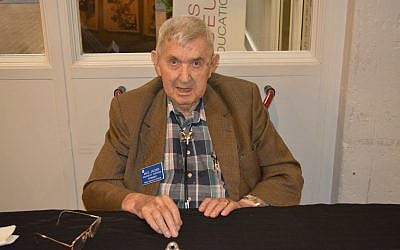
Endless accounts have emerged from the Holocaust, but I only recently became aware of Mike’s while watching a new History Channel docuseries, WWII with Tom Hanks. One segment was devoted to the Holocaust, and Mike’s ordeal was woven throughout the episode. This, I decided, was a life worth exploring.
The conclusion noted that Mike moved to Dallas after the war, so I reached out to Karen Garfield, Israel Bonds executive director for the Southwest and Mountain West Regions, who I knew from my own time at Bonds.
Karen praised Mike as “beloved and revered. He was considered a leader in the community, and highly respected. He really wanted people to hear his story.”
Social media, so-called influencers, conspiracy theorists and disinformation have raised antisemitism, Israel hatred and Holocaust denial to shocking levels. It is essential, therefore, to convey the narratives of individuals subjected to the most heinous crime in human history. Here, then, is the extraordinary life, and inspiring legacy, of Mike Jacobs.
“I Never Lost My Hope, Never Lost My Belief”
He was born Mendel Jakubowicz in the central Polish town of Konin, the last of six children. His father worked hard to support the family, earning a living making deliveries via horse-drawn cart. Mendel’s older brothers, both master tailors, also contributed, and the family led a comfortable life. Then, on September 1, 1939, Adolf Hitler unleashed hell on Poland. When the Germans marched into Konin, they desecrated the synagogue, eventually turning it into a horse stable, and confiscated Torah scrolls and prayer books, throwing them into a bonfire in the town square.
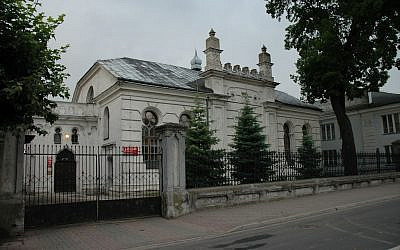
Shortly thereafter, Mendel, now 14, and his family were packed into a boxcar and, he later wrote, “after three days of traveling with no food, no water, no room to lay down and sleep,” they arrived in the Jewish ghetto in Ostrowiec, in southeast Poland.
They were crowded into a small apartment with two other families, 16 people in all. “I used to walk the ghetto streets, and I could see people dying, people screaming.” Yet, in spite of terror and misery, “I still did not believe what was going to happen.” He soon found out.
In 1942, the Jews of Ostrowiec were rounded up. His family was directed to the main square, but Mendel and his brother slipped away to a different square. They were placed on work details, while the rest of his family was sent to Treblinka, murdered along with over 900,000 other Jews.
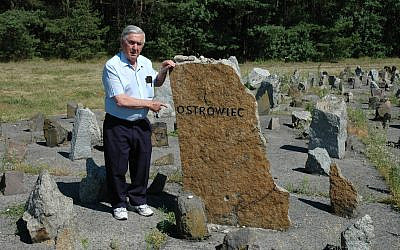
In 1944, Mendel was transported to Auschwitz-Birkenau. “The boxcar opened and we went down the ramp. As we waited, the orchestra was playing. I said to my friends, ‘Take a look, we came into a paradise.’”
But suddenly, “the dehumanization process begins. They take away your name and identity, and give you a number. I became B4990, but in my mind, I was still a free person. How did I survive? I was a dreamer, a fantasizer. I tried to make myself human. In those moments, I was free. Reminding myself that I’m a person, like anybody else, kept me going. I never lost my hope, never lost my belief.”
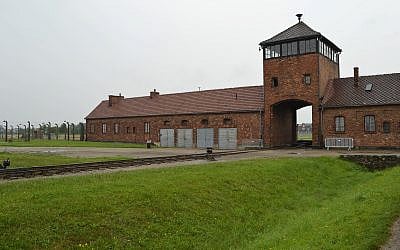
In January 1945, Auschwitz-Birkenau was liberated by the Soviet Red Army. Unfortunately, they arrived too late to save Mendel and thousands of others from yet another horror – the notorious death march. Freezing temperatures, starvation and brutality led to countless deaths.
Those who survived were dispersed to new camps. Mendel was sent to Mauthausen, in Austria, where, in the Gusen II subcamp, he toiled as a slave laborer in inhumane conditions, building Messerschmitts in a factory deep inside a mountain. “I had one wish – that someday I would be free. The Nazis could torture and starve my body, but they could never kill my spirit.”
When the American Army liberated Mauthausen in May 1945, Mendel was 19 years old, and weighed 70 pounds. Mendel’s son, Mark Jacobs, describes his father’s nearly six-year ordeal as “not knowing from day to day whether you were going to survive.” Now, the nightmare was over. Mendel’s dream to be free was finally realized.
A New Life Begins
Mark – who, inspired by his father’s journey to freedom, became an immigration lawyer –continues the story: “He did not go to a displaced persons camp. His attitude was, ‘I’m not having anything to do with another camp.’” Together with friends, Mendel shared an apartment in Mittenwald, outside Munich. He did various tasks for the American Army, and became a certified physical education instructor.
In 1951, Mendel decided to immigrate to New York, but the person processing his paperwork said Dallas offered greater opportunities. Mendel sailed from Germany to New Orleans, continuing by rail to Dallas.
Because it was easier to pronounce, Mendel began using the name Michael Jacobs at the suggestion of a Jewish Family Services case worker. He held a series of jobs, including working as a clerk at a plumbing supply company, and employment at a large scrap metal company, which became the impetus for starting his own scrap metal business.
Mendel also taught physical fitness and gymnastics on a part-time basis at the local Jewish Community Center, where he met his bride-to-be, Ginger. They had four children, three sons and a daughter, with Mark being the oldest.
Mark and his siblings “were aware of the basics of Dad’s life but when we saw his Auschwitz-Birkenau tattoo, it was just a part of Dad. We didn’t question what it meant. Friends who were survivors would come over and play pinochle. When you were that age and didn’t really think about it, we just knew they were from Europe and spoke with accents. As we grew older, he told us more about his family, his youth, his life during and after the Holocaust, and his early life in Dallas.”
Mendel’s path to public speaking began when he took a Dale Carnegie course to improve his English. As part of the course, he spoke about his Holocaust experiences, and that was the beginning of years of addressing audiences on the horrors of the Shoah.
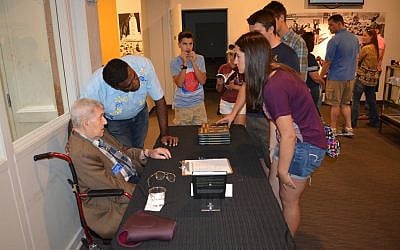
Those audiences were diverse. In addition to obvious Jewish-specific places, “School kids, church groups, civic groups, even troops at Ft. Hood listened to his story,” Mark recalls. “At one point, Dad was speaking three to four times a week. People would take pictures with him. They looked at his tattoo, and he didn’t hide it. It was a part of who he was.”
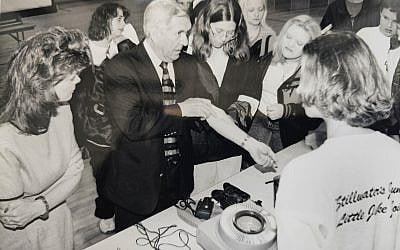
Mendel’s great dream, Mark explains, “was to build a Holocaust museum. He went to a survivors’ conference, and started a group with the goal of building the museum.” It began on the ground floor of the Dallas JCC, consisting of exhibit space, a library, a boxcar, a memorial room and offices. The Dallas Holocaust Center for Holocaust Studies – the first independent Holocaust center in the U.S. – was dedicated April 15, 1984.
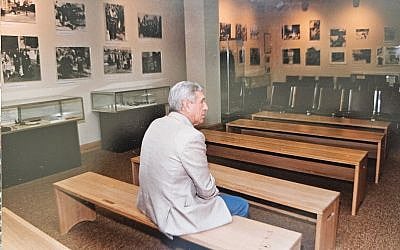
Eventually, the fledgling museum moved to a larger, temporary space in downtown Dallas and, following a fundraising campaign generating nearly $50 million, including from the non-Jewish community, on September 17, 2019, the Dallas Holocaust and Human Rights Museum became a reality.
Mendel also authored a book, titled Holocaust Survivor – Mike Jacobs’ Triumph Over Tragedy. When signing copies, he wrote “Never Again,” together with what Mark termed his father’s mantra: “Have hope and believe.”
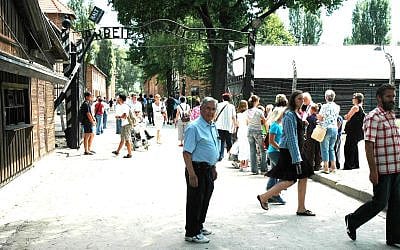
Mendel made several return trips to Poland. “We were shocked that he wanted to make such a trip,” Mark remembers. But, “as awful as it was – he lost about 80 relatives, including his immediate family – he actually liked going back. It was where he had wonderful memories of his childhood and family. He made at least seven trips to Poland with Mom, including trips with each of his children, and a trip that included his granddaughters.”
On a return to Auschwitz-Birkenau, Mendel held a section of the barbed wire surrounding the camp and shouted, “I’m free!” On another trip, standing among the ruins of the Gusen II subcamp, he announced, with a big smile, “This is where I was liberated!”
Moreover, “Dad was very Zionistic. He visited Israel many times. He was active with Israel Bonds, a chairman for years. Israel Bonds was his primary means of ensuring a strong, thriving Israel.”
Seeing how much Mendel meant to the community inspired Mark to perpetuate his father’s mission. “Dad spoke a lot. I felt people wanted to hear him rather than me. Once he passed away, I started speaking. People were happy to meet me, because I had a direct connection to a survivor, and they really cherished that. It falls on the second generation,” Mark emphasizes, “to preserve the memory and tell the stories of survivors.”
Asked to define Mendel’s legacy, Mark cites the Dallas Holocaust and Human Rights Museum. “It demonstrates that you have to stand up to haters and Holocaust deniers. It happened – don’t let anyone try to tell you otherwise. He was adamant about people being educated about what occurred. It could happen anywhere, at any time. You have to be vigilant.”
Epilogue
Mendel was 14 when darkness descended. When he passed away 75 years later, hundreds attended his funeral, demonstrating a collective desire to pay tribute to a remarkable, resolute individual who touched the lives of thousands of people.
Throughout his life, he was a fighter – first for survival, then for remembrance. In reflecting on his terrifying experiences, Mendel Jakubowicz/Mike Jacobs declared, “I will never stop talking, whether people want to listen to me or not. If I have two people and they listen to me for five minutes and walk away, I accomplished five minutes. I’ve never stopped, because it’s very close to me. People should know about it – this generation and generations to come. It should never happen again.”
(All photos courtesy of Mark Jacobs except where noted, and are free for use on a commercial platform in accordance with copyright law.)