
Carrie Bradshaw of the Middle East
He Fumbled Me Like a Nuclear Negotiation
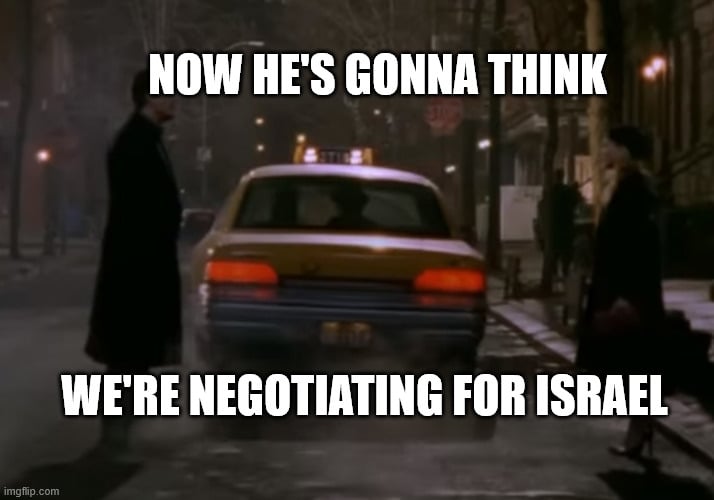
Adapted meme based on a scene from Sex and the City (HBO), included here for cultural commentary.
Moving to Los Angeles ten years ago hit me like a nuclear bomb. I had just been through my first round with Alcoholic Ex-Boyfriend (for those who have been reading and are familiar with my lore) and had lost all hope in dating, so I did what every girl who doesn’t want to date does—I dated.
Nuclear Softboy and I met on Tinder (it was 2016). We talked about God and his banjo and go on long walks to different bookstores all over the city. He was having an existential crisis unbecoming of a man in his early thirties, and I was trying to forget that I had let a different man throw a glass of wine at me—or at least in my direction—one month earlier. Neither of us could give each other much, but we tried to negotiate the best from one another.
A negotiation doesn’t mean both parties magically get what they want. It usually means both parties cede ground until both are equally unhappy. In 2015, just a year before I met Softboy, the US (and the UK, France, Germany, China, Russia, and the EU) signed what became known as the Iran Deal. Some praised it. Some said Obama had sold the US and Israel to Iran. The idea was never to make the Islamic Regime suddenly good; it was to create a long-term incentive by allowing it to reenter the global economy. Not a friendship, but a potential future handshake.
We dated for roughly two months. I met his brother (who would go on to ask me out years later. That’s another story). I saw his struggling stand-up routine. I made him breakfast. He met my friends. It wasn’t serious; it was an ambiguous agreement. Then he texted me one day to tell me he wasn’t ready to be emotionally attached to me but wanted us to be friends. I understood and figured we’d never speak again. The next day, he showed up at my door. We had made plans prior to his break-up text. I was numb enough to men back then to let him just be my friend.
Nuclear Softboy became one of my best friends and a huge part of my early life in Los Angeles, despite my other, more sane friends’ objections. We saw each other frequently, even if just for a quick coffee before class. I never told him about Alcoholic Ex or the other men I was still somehow seeing. He didn’t tell me he had started seeing someone else.
Under the Iran Deal, the Islamic Regime could still see other people. They continued their ballistic missile program and relationships with Hamas and Hezbollah. All they had to do was wait until 2030 for major restrictions around uranium to end. Critics of this deal would mention that Iran was getting increased funding because of sanctions relief during this time.
I never met Nuclear Softboy’s girlfriend, but she was a brunette who didn’t like me. I rolled my eyes and couldn’t believe anyone could see our friendship as more than platonic, but maybe she was saying something I couldn’t. Softboy texted me that he couldn’t be friends with me anymore because it upset his girlfriend. That one hurt. I called him to tell him you couldn’t pick people up and put them down when you felt like it, then hung up convinced I’d never hear from him again. I didn’t see him romantically, but I knew I’d miss his friendship.
Obama’s initial Iran Deal wasn’t all that bad. It reduced Iran’s uranium stockpile by a whopping 98% and allowed the International Atomic Energy Agency greater oversight. Some would say an imperfect deal is better than no deal. Trump was not one of those people.
Trump withdrew from the Iran Deal in 2018, calling it “defective at its core,” which is a petty way to describe an ex-boyfriend. With the US out, Iran was no longer receiving most of the economic benefits it was promised and began reversing its own course, bringing it much closer to nuclear capacity. The relationship structure may not have been perfect, but once it collapsed, both sides became more reactive, suspicious, and unstable. Which, grossly summarizing the past ten years aside, brings us to where we are today.
It took Nuclear Softboy two years to reach back out to me. I was alone one night when I got his text. It read something like, “I was in love with you then and I’m still in love with you now.” I didn’t know what to say other than I guess his girlfriend had been right all along. Softboy came over with pizza and we sat on the floor, taking turns rubbing my cat’s belly. He hadn’t broken up with his girlfriend, but he would if I just said the word. Ah, romance.
I scanned Nuclear Softboy’s eyes. He was honest. I don’t know if he really was in love with me, but he really believed that he was. He was a good man who was finally outgrowing his existential crisis. Part of me wanted to give him a chance, but I couldn’t bring myself to do it. The moment was haunted by our broken friendship.
The current US-Iran-Israel talks are haunted, too. When the U.S. left the agreement in 2018, Iran restarted major enrichment activity, Israel became increasingly convinced diplomacy was failing, and now everyone is negotiating from a place of deeper distrust and higher emotional stakes than before. The talks aren’t about a way to find stability in the relationship; they’re about building some sort of framework out of betrayal and fear. You can’t define the relationship after the emotional centrifuges have already spun out of control.
Under the Iran Deal, Iran’s nuclear program was constrained, monitored, and partially integrated into diplomacy. It didn’t solve the issue, but it may have created a path to a solution had we stayed in it. The relationship may not have been sustainable forever but destroying it didn’t solve the underlying problem.
Trump wants a victory. So does Iran. Netanyahu doesn’t have much say in what happens next. Maybe that’s why the Abraham Accords have been thrown into the mix: to form new alliances after a messy breakup because you no longer trust the original relationship framework to protect you.
Some agreements collapse dramatically. Others expire slowly enough that nobody notices until years later. Nuclear Softboy and I never got together. I couldn’t trust that he would be there emotionally, as a friend or as a love interest. He broke up with his girlfriend and started dating someone else shortly after we negotiated over pizza on my living room floor. I ran into him while on a date with a different guy a few years ago, but I barely recognized him.
Related Topics
Related Posts