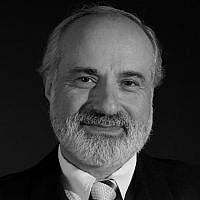
He Has a Home: What Mike Leven Taught Me About Building the Jewish Future
I want to tell you about a room I was in on June 3rd.
Isreal’s Ambassador to the United Nations, Danny Danon had just come off one of the ugliest weeks Israel has faced at the United Nations in recent memory. Israel had been placed on a sexual violence blacklist alongside Hamas and ISIS, organizations that raped women, murdered families, and kidnapped children. Think about that for a moment. The same institutions that exist to uphold human dignity had just told the world that Israel belongs on a list with monsters.
And then Danny walked into that room.
He looked out at the crowd and said something I have not stopped thinking about since. He said: usually, I am the only ambassador speaking on behalf of Israel. Tonight, this whole room is full of ambassadors. That is what Jewish community looks like when it is working. Not reaction. Not grief. Not defense. A room full of people who have decided, in the face of everything, to show up.
We were there to honor Mike Leven. And as I sat in that room, I found myself thinking about what the word ‘honor’ really means when it is applied to a man like him.
It is not about a career, though his career has been extraordinary, decades at the highest levels of American business, from the Georgia Aquarium to Las Vegas Sands to the Asian American Owners Association. Danny Danon named those things and then set them aside. He said: the reason we honor Mike tonight is not because of what he built in business. It is because of what he chose to build for the Jewish people.
That distinction is everything. Because most people, when they reach a certain age and a certain level of success, stop building. They give. They endow. They write checks. All of that matters. But Mike Leven did something different. He built an idea into an institution. He took a conviction, that the Jewish future does not guarantee itself, that someone must deliberately, generously, and courageously construct it, and he turned that conviction into the Jewish Future Promise. And then he spent his later years making sure it would outlast him. Success is not only what you achieve in your own lifetime. It is what you pass on to those who come after you.
I want to tell you how Mike got there. Because he told us that night, and I think it is the most important story in the room.
Mike grew up in Boston, in a three-bedroom apartment in a three-story building, alongside his maternal grandparents. His grandfather had come to America from near Odessa in 1895, at the age of fifteen. He worked in the garment industry, never made much money, and served as a vice president of the Modern Orthodox synagogue down the street. He was the man who stood in as a father figure while Mike’s own father fought in World War II.
One cold day in November of 1947, ten-year-old Mike came home from Shabbat services. He walked into the kitchen and found something he had never seen before. His grandfather had the radio on.
Mike said: “Pa, you can’t listen to the radio on Shabbos.” His grandfather held up his hand and said, “Sah Sha.” Then he noticed the pencil. The piece of paper. His grandfather was writing. “Pa, you can’t write on Shabbos.” Again, his grandfather held up his hand.And then his grandfather began to cry. Tears running down his face. Mike had never seen his grandfather cry. Not once.
That day was November 29, 1947. The United Nations had just voted to partition what would become the State of Israel. And Mike’s grandfather, a man who had come to America as a teenager from a country that didn’t want him, who had built a life in a three-bedroom apartment in Boston, who had kept Shabbos every week for decades, looked at his ten-year-old grandson and said, in broken English: “We have a home. We have a home.”
I have been in many rooms where people talk about Jewish continuity. I have heard many arguments about why the Jewish future matters and what we must do to protect it. But I have rarely heard anything that explains the urgency as simply or as completely as that story. Mike Leven did not build the Jewish Future Promise (which now has almost 200,000 signers) out of abstraction. He built it because he was in that kitchen in 1947. Because he watched a man who had carried the weight of exile his entire life finally set it down, just for a moment, and weep with relief.
That is what a homeland means. That is what we are responsible to protect.
The award Mike received that night was not a plaque. I want to be specific about this, because the specificity matters.
Olami, the global Jewish student organization that hosted the evening, presented Mike with a scroll. On it were 10,000 names. Every Olami student, on every campus the organization touches around the world, had signed Mike Leven’s Jewish Youth Promise of the Jewish Future Promise. Their names, from A to Z, printed and bound and handed to a man surrounded by his wife, sons, and grandchildren.
I watched him receive it. And I thought: this is what legacy looks like when it works. Not a building with your name on it. Not an endowment that compounds quietly in the background. Ten thousand young Jews, on campuses where Jewish identity has never been more contested or more costly, who looked at what this man built and said: I promise too.
Mike understood something that I believe is the central challenge of this moment: you cannot simply defend the Jewish future. You must make young people want to build it. You must give them a reason to sign their name to something. And that requires more than money. It requires conviction, example, and the willingness to be the kind of person whose life is itself an argument.
Before the evening ended, Mike told one more story. In 1951, he was thirteen years old. His oldest friend, Norman, had drafted him into a temple show for their congregation in Boston. They were asked to sing two songs, one in Yiddish, one in English. The song they sang in Yiddish was Eli Eli. That was 75 years ago. Two Jewish boys on a small stage in Boston, performing the uncertainty of Jewish existence, not knowing yet what the State of Israel would become or what their own lives would build.
Mike said he thought they might like to repeat that song tonight. I have been thinking about that moment ever since. The distance between 1951 and 2026, and a room full of people who showed up as ambassadors. Between a grandfather weeping over a radio on Shabbat and 10,000 names on a scroll. That distance was not traveled automatically. It was built. Deliberately, generously, and by people who refused to let the story end with exile.
We are living through a moment that is trying to tell a new generation of Jews something very old and very dangerous: that the home we have is illegitimate. That the self-determination our grandparents wept over is a crime. That Jewish pride is something to manage rather than carry.
Against that narrative, Mike Leven’s life is a rebuttal. Not a loud one. Not a performative one. A quiet, steady, 80+ rebuttal built out of institutions and pledges and dollars and conversations and, yes, a grandfather’s tears on a November Shabbat in 1947.
This is what Jewish Future Promise exists to carry forward. The idea that the Jewish future is not a given. That it is, as Danny Danon said that night, a promise, and that a promise must be kept.
Mike Leven has kept his. For decades, with everything he had. The 10,000 names on that scroll are people who have decided to keep theirs. The question the rest of us have to answer is simple, and it is the same one Mike’s grandfather answered in a kitchen in Boston in 1947, with a pencil and a piece of paper and tears he couldn’t stop: What are you building because of who you are?