
Headbutting Forward
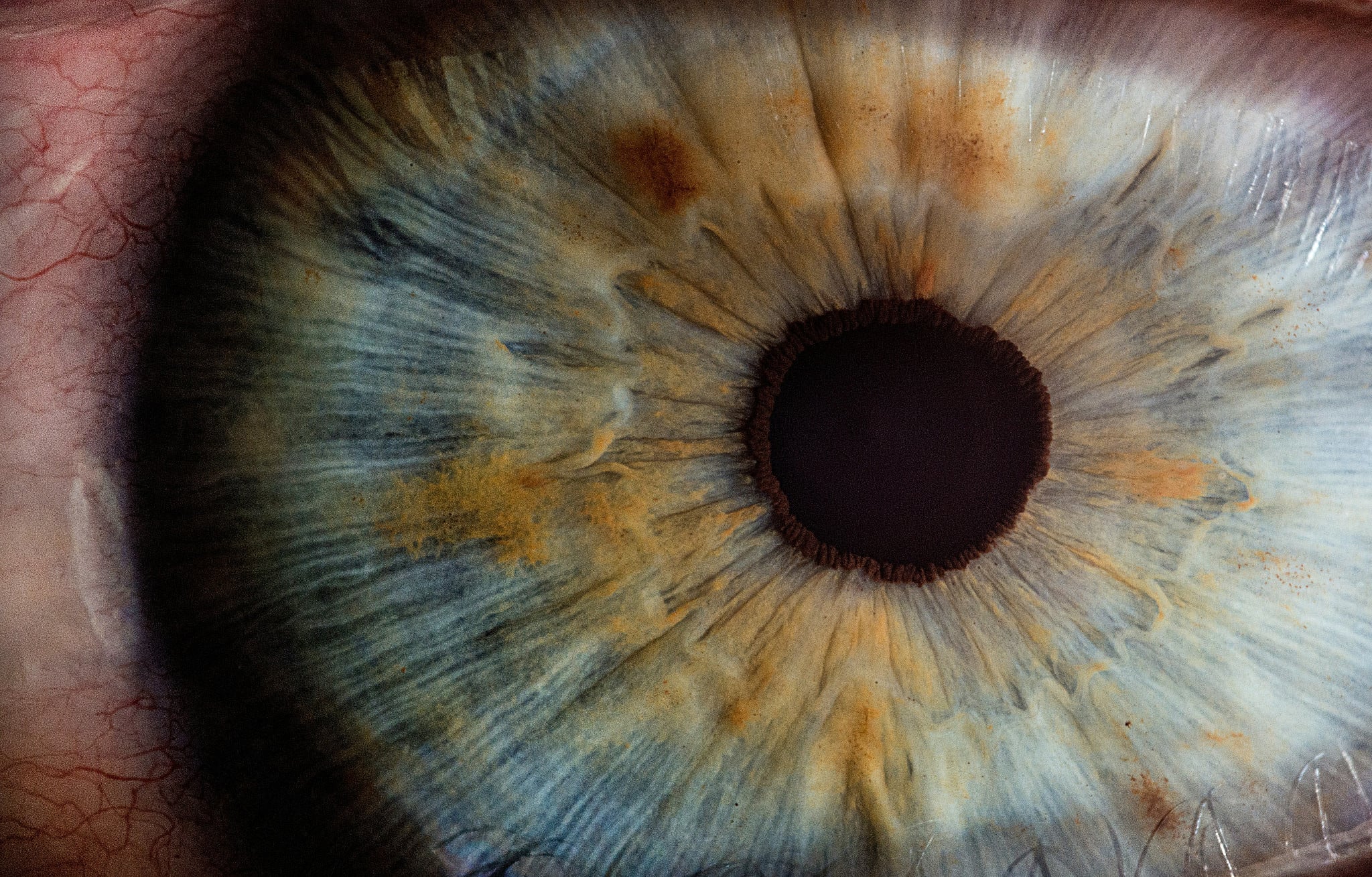
The world’s largest forehead study, and what it taught us about the future of human vision.
From Human Potential
Do you know who Cornel Amariei is? Have you heard that name before? Well, that’s who we’re going to talk about today. His inspiring journey will lead us back to one of our favorite themes: AI at the service of Humanity, or, more broadly, technology for human augmentation.
Let’s begin by getting to know the person behind the name. Imagine someone who, from an early age, refused to accept the limits imposed by her circumstances. Someone whose life took her through extraordinary challenges, unexpected transformations, and achievements that seem almost impossible when taken together.
Cornel was born in Bucharest, Romania, in a family where both of his parents have locomotive disabilities, and his sister cerebral disability. He faced poverty and lack of stable housing in childhood, yet revealed remarkable intellectual precocity. He started programming at 7, built robots at 13, and founded Romania’s first high school robotics club at 15, which proceeded to win over seventy international awards in three years to finance his studies at the Constructor University in Bremen, Germany.
To Human Augmentation
But his greatest achievement is, no doubt, .lumen. He did not build this company to find a market. When this Romanian wunderkind set out to build glasses for the blind, he thought the hardest part would be the artificial intelligence. He was wrong.
“Every head is different. We ended up studying anthropometry, weight distribution, adjustability, and hundreds of forehead scans. As I like to say, we accidentally created the world’s largest forehead study.”
That is how Cornel describes the journey toward building something nobody else has built: Pedestrian Autonomous Driving AI. The same algorithms and AI models that power a self-driving car, miniaturized into a wearable device for blind and low-vision users. Backed by the European Innovation Council and supported by Intel, Nvidia, and Microsoft, with over 50 researchers, engineers, and business developers and $15 million raised, .lumen is a serious technical operation pointed at a problem the rest of the industry has mostly avoided: taking Autonomous Driving Off the Road.
“We basically took the same algorithms and AI models of a self-driving car and applied them for the pedestrian world. A self-driving car uses cameras and sensors to understand the environment, decide where it can safely go, calculate a path, and continuously correct that path. We do the same thing, except the computer is on your head and the vehicle is a human being.”
.lumen’s glasses run the world’s best Pedestrian Semantic Segmentation ML model, tested in over 20 countries. The device perceives the environment in 3D, mapping, visual odometry, and semantic surface understanding, all built in-house. Processing happens entirely on-device, with no cloud dependency. As the company puts it: “Everything a self-driving car does, 70% of the performance, 10% of the size.”
“I don’t think there is another company in the world building what we are building. Most assistive technologies convert visual information into non-visual information. I think that is fundamentally wrong. The world is simply too complex to represent everything around you. Our approach is different: the AI understands the environment, decides where it is safe to walk, and gives you one simple instruction through haptics — the direction to move. Blind people already rely heavily on hearing to understand the world. We don’t want to interfere with something that already works. That’s why haptics became our primary language. It is intuitive, continuous, and leaves your hearing free. Some blind people have been able to use the Glasses with zero training. That’s what a universal interface should feel like.”
The hardware is ready. Edge AI chips are now small enough to run real-time neural inference in a device that fits behind an ear. Semantic segmentation models that once required a server farm now run at 30 frames per second on a device the size of a hearing aid. Miniature wide-angle cameras with sub-centimeter housings transmit video wirelessly over Bluetooth 5.0 with under 50 milliseconds of latency. The hardware bottleneck that made human vision augmentation impossible five years ago no longer exists.
“It took humanity thousands of years to get to around 28,000 guide dogs in the world. The moment we ship our 28,001st pair of .lumen glasses, we have changed a millennia-old paradigm. That’s goal number one. We already have plans up to goal number seven. And the glasses are only the first application of our Pedestrian Autonomous Driving AI. The same technology that guides a human can eventually guide a humanoid robot.”
But .lumen is navigation. Iridescence is display. Nobody yet has built the full stack, a system that captures what the eye sees, processes it at the edge without a cloud or a phone, and returns an augmented, enhanced version of reality back to the human wearing it. Continuously. Without being triggered.
The pieces exist. The chips are small enough. The models are fast enough. The form factor is close enough. What the world is waiting for is someone to put it all together, not for a car, not for a store, not for a checkpoint. For the person. That is the next frontier. And it remains, for now, open.