The views expressed herein are solely mine.
Hebrew: The Only Language Fully Revived
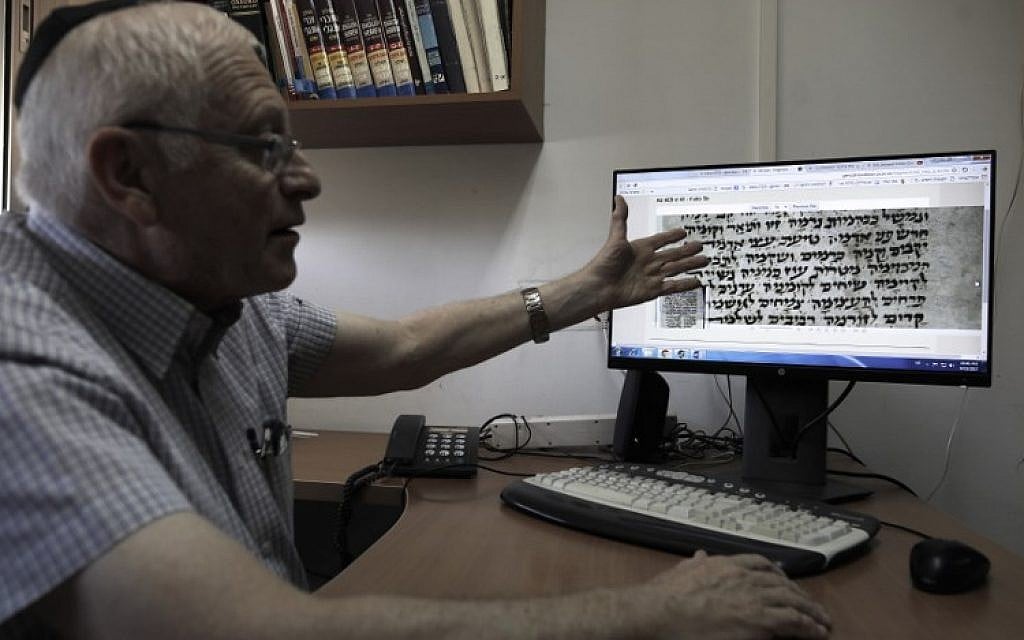
Gabriel Birnbaum, senior researcher at Historical Dictionary Project at Israel's Academy of the Hebrew Language in Jerusalem, shows an old Hebrew text on his personal computer at his office in Jerusalem, August 23, 2017. (AFP/MENAHEM KAHANA)
The revival of Hebrew in the late 19th and early 20th centuries is often flattened into a tidy legend centered on Eliezer Ben-Yehuda. Still, the historical record tells a far more complex and global story—one of diasporic convergence rather than individual genius. Hebrew did not return through decree; it reemerged through collision.
Between the 1880s and the 1930s, successive waves of Jewish migrants from Yemen, Morocco, Russia, Kurdistan, Bukhara, and Central Europe arrived in Ottoman and later Mandate Palestine carrying radically different relationships to Hebrew.
For some, it was a liturgical language frozen in prayer; for others, a commercial register used in contracts and correspondence; for still others, a poetic or exegetical medium shaped by centuries of rabbinic debate. No two communities pronounced it the same way, stressed it the same way, or even agreed on how certain letters should sound.
Plainly, these differences were not resolved politely—they were forced into contact.
In the first Hebrew-only schools, teachers imposed immersion with near-military discipline, insisting children speak Hebrew not only in class but during recess and at home.
In agricultural settlements, workers improvised a living vocabulary to describe tools, crops, and weather that biblical Hebrew had never named. Early newspapers standardized grammar and coined thousands of new terms in real time, while rabbinic authorities from divergent traditions argued fiercely over pronunciation, morphology, and legitimacy.
The result was not the resurrection of a single ancient tongue, but the synthesis of many.
To be precise, Modern Hebrew absorbed Yemenite consonantal clarity, Sephardi vowel systems, Ashkenazi syntactic habits, and an avalanche of neologisms engineered to serve science, medicine, law, and modern warfare.
By the 1920s, Hebrew was no longer merely taught; it was spoken natively by children who had never known another mother tongue.
Within two generations, a language that had been largely dormant as a vernacular for nearly 2,000 years transitioned from sacred script to everyday speech—an outcome without historical precedent.
Although other languages have been preserved, revitalized, or politically protected, none have undergone such a complete transformation from textual continuity to full societal dominance.
Thus, modern Hebrew’s resilience and adaptability stem precisely from this plural genetic makeup. It survived not because it was purified, but because it was contested, blended, and relentlessly used.
Beyond question, its rebirth was not an act of nostalgia, but a feat of collective improvisation—proof that languages, like civilizations, return to life only when many worlds are forced to speak together.
Related Topics
Related Posts