
Left is not a dirty word
Who benefits from single-gender classes?
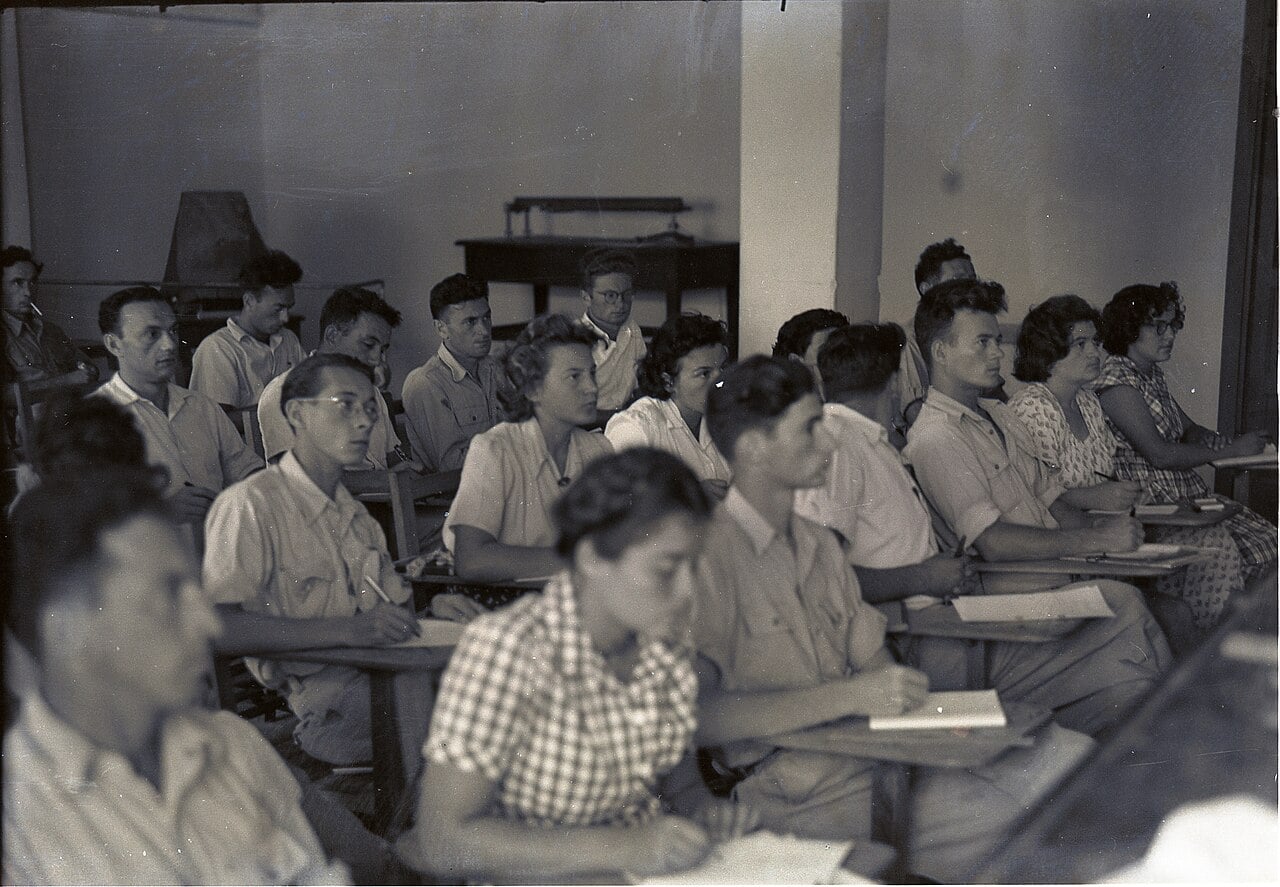
Women and men studying together in the Hebrew Universty in the 1950s. Credit: Benno Rothenberg /Meitar Collection / National Library of Israel / The Pritzker Family National Photography Collection via Wikimedia commons
A new law would expand single-gender classes – to graduate students. I know, I know. Among all the new laws being passed with the expressed aim of dismantling our democracy, this law seems tame. It gives institutes of higher learning leeway to cater to their student body. What could be wrong with that?
“It will enable female Haredim to attain higher education,’ says one MP, while another, predictably in the opposite corner, says it will do so at the expense of other female students.
So first, let’s set the record straight: It will do so at the expense of students of both genders. Having spent years talking to graduate students in the sciences, I can say with confidence that the more a group is mixed, the more it is likely to be creative, innovative and inventive; ahead of the curve on the charts. When those classes are in the social sciences, for example, they will be more likely to be narrowly-focused, more dogmatic and less likely to engage the students in active dialogue. And that, to one like me who believes that freedom of thought and free discussion are some of the most basic foundations of free democracy, is dangerous.
In addition, having a graduate degree myself, I can tell you there are plenty of Haredi women in academia, braving the challenges of the world outside their bubbles every day. They are doctors and lawyers, professors and teachers. If you ask me, they don’t need patronizing laws to give them a hand. They need free childcare and scholarships, assistance with navigating the secular culture, clubs where they can compare notes, and leeway in turning in assignments. They need mentorship from the Haredi women who have taken on the world of academia and succeeded.
I understand their fears. I was terrified the first time I was graded on my participation in class discussion. But academia, if it is to have any value, is meant to challenge students. We are not doing these women – many of whom have presumably already obtained undergraduate degrees in mixed settings – any favors by limiting their opportunities for collaboration and learning from others.
We can add this law to the one revoking the ability of supermarkets and restaurants to choose their kashrut inspectors, thus taking back all power over the very food we are allowed to eat to the religious parties, to the government’s race to pass laws giving men who study Torah a special status raising them above the secular ones who are being called up to reserve duty as soon as they finish their army service. We can add it to attempts to segregate men and women in public events, including in so-called “secular” cities.
We are not doing these women any favors by limiting their opportunities for collaboration and learning from others
Suddenly, Israel is feeling more and more like Iran. We don’t have rabbis for prime ministers (not that they were ever prime ministers), and we still have elections, but it is the rabbis who, slowly but surely are pulling the strings. And they are pulling them tighter and tighter. Plus, every time we have new elections, they gain in power. That is the reason Bibi is racing to pass a bill he knows is ultimately destructive to the very state he heads. That is why the opposition parties are already holding talks with the Haredi ones.
The question is: When do we cross the line from being a Jewish, democratic state to being a theocracy?
The line is unclear. In response to comments on kashrut or busses on Shabbat (which save lives), I have been told: Yes, but it’s the Jewish state. To those people, there was, up until recently, a status quo: They could drive on Shabbat, but those who do not own cars must walk. To those people, I would say that there is no such thing as a status quo. There is only a slippery slope. Today you find your favorite hangout is suddenly closed on Shabbat; tomorrow your daughter cannot learn in the same classroom as men.
The hypocrisy is no less than mind-blowing, no matter how many times I see it and read it. Because the rabbis are interested in power, not tens of thousands of new converts to their courts. They do not care so much what the rest of us believe, as they care how much control they can exert to improve their own lots. They are, for the most part, insular and uninterested in new members, outside of tremendous natural growth. That is why, for example, they want us to believe that their followers must get special consideration, while others do not. By their own claims, if we all abandon army service and professional training and study Torah 20 hours a day, the country will be saved. No, wait, that’s not what they meant! If asked to explain how many studying Torah is enough to save us in the heavens, the numbers will be about exactly the numbers currently enrolled (though not necessarily studying) in Yeshivas.
This is not so much a physical danger to the Jewish state, even admitting the army is worn dangerously thin and the predominantly secular, professional, tech class who used to pay higher taxes is deserting in droves, but an implosion of the Zionist ideal. The Jewish democratic state may have always been more democratic for some than for others. But rights are now being allotted based on religious affiliation, so that some Jews will now be “more equal than others.” Our state, which was always something of an experiment, a government that made it up on the fly, an attempt to address the needs of incredibly diverse populations and groups while giving everyone a chance to get ahead, is now showing its hard core to be a run-of-the-mill theocracy.
They will only make us cover our heads or attend synagogue when it suits them. But treading on our academic institutions apparently suits them now, and the law will pass, if for no other reason, than exhaustion on the part of the opposition. Our side can only fight so many battles, and single-gender classes will be a moot issue if other laws currently in the pipeline – or should I say rapids? – are passed in the coming weeks.
Still, we should beware of laws like this, which leave the door open to the occasional small single-gender seminar class, but also to whole academic fields segregated by gender. If the point is to bring more Haredi women into graduate studies, let’s not revamp entire systems to their benefit, but rather, let’s find a way to include them in the academic discourse that is already taking place. We might all benefit.
Related Topics
Related Posts