
CFO | Empower Society for Good I Author
Hebron, Sovereignty, and the Divine Reset
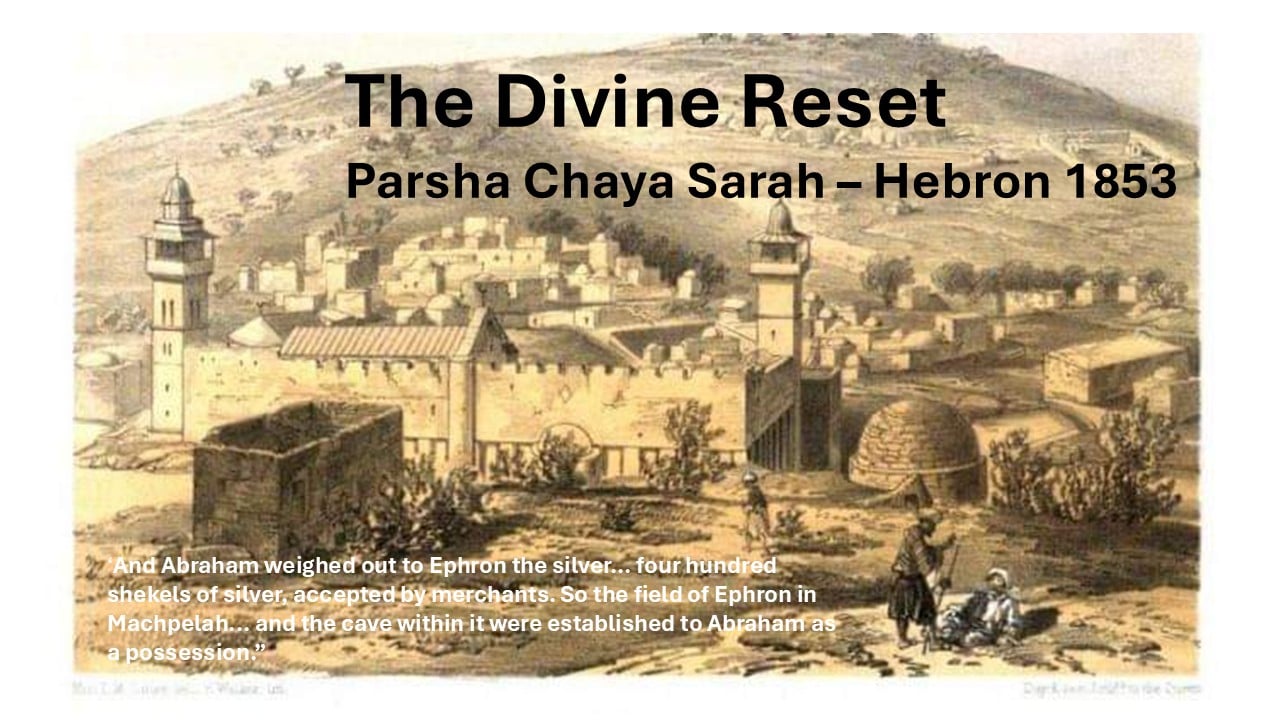
This Week’s Parsha Debunks the Lie
“And Abraham weighed out to Ephron the silver… four hundred shekels of silver, accepted by merchants. So the field of Ephron in Machpelah… and the cave within it were established to Abraham as a possession.” — Bereishit (Genesis) 23:16–20
This week’s Parsha, Chayei Sarah, begins not with a birth but with a burial — and in that burial lies the birth of Jewish sovereignty.
Abraham insists on buying the Cave of Machpelah in Hebron for full price, in the presence of witnesses, establishing the first legal and moral title deed to the Land of Israel.
This single act refutes every modern falsehood hurled at the Jewish people. The Parsha itself debunks the myths of colonialism and occupation — the blood libels of our time.
The accusation that Jews are foreign settlers in their own homeland is historically, legally, factually, archaeologically, biblically, and even Quranically false.
Abraham’s transaction proves that the Jewish connection to the Land of Israel rests not on might but on moral right — on faith, law, and integrity. The Torah devotes twenty verses to describe this event so that no generation could ever claim ignorance of Israel’s legitimacy.
And yet, Hebron — the city where that covenant began — became a symbol of distortion. Let us remember: Hebron was home to a sizable Jewish community for centuries until 1929, when Arab mobs, incited by false rumors, massacred 67 Jews and expelled the rest. Families who had lived there since Ottoman times were murdered, their homes looted, their synagogues desecrated.
That atrocity did not mark the start of Jewish presence — it marked its violent interruption. When Jews returned in 1967, they did not invade; they came home.
This week’s Parsha proves what history confirms: the Jewish people are not colonizers in Hebron — they are its founders and its heirs.
Hebron Through the Ages: A City of Two Peoples
The Jewish Presence
Hebron has been one of the Four Holy Cities of Judaism for centuries. By the 18th century, Jews had rebuilt the Avraham Avinu Synagogue, first established in 1540.
By the 1800s, about 700–800 Jews — roughly one-fifth of the city’s population — lived among 8,000–10,000 Arabs, maintaining yeshivot, study halls, and charitable institutions.
Despite heavy Ottoman taxes and periodic harassment, they remained steadfast — until the 1929 massacre shattered centuries of coexistence.
After the Six-Day War, Jews returned to rebuild their homes, synagogues, and lives. Today, about 700 Jews live in Hebron’s historic core, preserving the city’s ancient soul.
The Arab Presence
Hebron’s Arab population — Al-Khalil, “the Friend of God” — also has deep roots. Its respected clans, such as Ja’abari, Tamimi, and Qawasmeh, maintained influence for generations.
Muslims venerated the Patriarchs’ Tomb (Al-Haram Al-Ibrahimi). Under Ottoman and later British rule, Jews and Muslims often coexisted, though Jews lived as dhimmis — tolerated but subordinate.
By 1922, Hebron had about 17,000 residents, including 700 Jews. Despite coexistence in trade and daily life, incitement turned neighbor against neighbor. Even amid the 1929 violence, a few brave Arab families sheltered Jews — a reminder that hatred was not destiny but manipulation.
Today, over 200,000 Palestinians live in greater Hebron under Palestinian Authority control, alongside the revived Jewish quarter. It remains a city of both tension and potential — a mirror of the region’s complexity.
My Vision: Hebron as a Beacon of Peace
My vision is that Hebron once again becomes a beacon of peace — a city that welcomes pilgrims of all faiths.
A place where Jews, Muslims, and Christians walk the same streets in safety and reverence; where the Cave of Machpelah (Ma’arat HaMachpelah / Al-Haram Al-Ibrahimi) stands not as a site of tension but as a bridge of faith.
Hebron could become a global heritage and tourism hub, celebrating the legacy of Abraham — the father of nations.
Imagine walking tours that follow the footsteps of Abraham and Sarah; interfaith centers where Torah and Qur’an are studied side by side; and vibrant markets alive with life, not fear.
Peace in Hebron will not be born from political illusion, but from truth and mutual recognition — from understanding that the Jewish return is not an intrusion but a homecoming.
If Abraham could purchase this land with integrity, then we, his descendants, can surely share it in dignity.
The Birthright of Hebron – A Deed of Faith and Law
Abraham’s purchase of the Cave of Machpelah is the first recorded legal transaction in history — the cornerstone of Jewish sovereignty.
He did not conquer the land; he bought it. He taught humanity that rightful ownership is rooted in justice, not violence.
Hebron thus remains the birthright of the Jewish people, consecrated by faith, law, and moral integrity.
Correcting Historical Wrongs and Legal Realities
The League of Nations Mandate (1922) recognized the entire territory west of the Jordan as the Jewish national home. When Britain carved out Transjordan, it removed 80 percent of the promised land.
Legal scholar Natasha Hausdorff clarifies:
“There is no situation of occupation in Judea and Samaria. Under the doctrine of uti possidetis juris, the State of Israel inherited the borders of the Mandate of Palestine … including the eastern boundary along the Jordan River.”
When Israel regained Judea and Samaria in 1967, it was not occupying another’s territory; it was liberating land unlawfully seized by Jordan in 1948.
History, law, and morality align: Israel’s presence is the expression of legitimacy, not its negation.
The Divine Reset: Responsibility and Regional Renewal
The Divine Reset calls for a new moral order in the Middle East — where nations act not as destroyers but as builders of justice, peace, and accountability.
- Jordan, created on land promised to the Jews, must assume responsibility for Palestinians east of the Jordan River.
It can either cling to grievance or embrace partnership, investing in stability and shared prosperity. - Egypt must take responsibility for Gaza’s governance and rehabilitation.
It must end the flow of weapons and materials used to build terror tunnels and instead channel its resources into rebuilding homes, schools, and infrastructure.
Egypt can be a builder of peace or a silent enabler of destruction — the choice is moral, not political. - The Kurds, a proud and ancient nation, deserve a sovereign homeland, protected from oppression and recognized for their courage and contribution to regional balance.
- The Druze, loyal allies of Israel and defenders of shared values, deserve security, dignity, and autonomy under Israeli protection, particularly those endangered in Syria and Lebanon.
The Egyptians, Lebanese, Syrians, and Jordanians now face a defining choice:
Will they build — embracing coexistence, reform, and regional renewal —
or will they continue to destroy, trapped in cycles of denial and hate?
The Divine Reset offers two paths:
- The path of truth and renewal, where nations accept responsibility and join in progress; or
- The path of resentment and ruin, where extremism devours its own future.
True leadership will be measured not by slogans, but by the courage to rebuild on truth, not lies.
Lessons from the Bible and the Qur’an
As Samer Sinijlawi, one of the few Palestinian voices speaking with moral clarity and pragmatic hope, said:
“We need to change the narrative. I don’t know why until now we are not recognizing the historical links of Jews in this land. If you open the Qur’an, the biggest chapter — Surat al-Baqarah — speaks in detail about the history of Jews in this land.… Even if Israel will be one day weak, they still have the full right to exist in this country, because we need to accept and recognize that fact.”
His words echo Abraham’s faith: it is not an issue of might, but of right.
Both the Bible and the Qur’an affirm the Jewish people’s bond to this land. Denial breeds confusion; acknowledgment opens the door to peace.
From Hebron to Today: The Eternal Covenant
Hebron is not a symbol of occupation — it is a testimony of continuity.
Every stone, every verse, and every archaeological find testifies that the Jewish people did not seize this land — they returned to it.
The 1929 massacre did not erase that truth; it made the return holier.
Hebron must rise again as a beacon of peace, a tourist and spiritual hub, and a living bridge between faiths.
The world must reject propaganda and return to the truth written in Scripture, carved in stone, and lived in history.
Hebron was never stolen — it was bought in full.
It remains, eternally, the moral cornerstone of Israel’s covenant with God — and the world’s invitation to rebuild peace upon truth.
From Hebron to Jerusalem – The Eternal Covenant
Hebron is only the beginning — the first chapter of Israel’s living story.
From Machpelah to the Temple Mount, every stone and every verse speaks the same truth:
the Jewish people are not visitors here — they are home.
For nearly 2,000 years, Jews prayed facing Jerusalem, whispering “Next year in Jerusalem.”
No other people in history has kept such a promise across exile and time.
Our return was not a conquest but a restoration.
The Proof That Speaks Even from Rome
Even the records of others bear witness.
The first-century Jewish general turned Roman historian, Flavius Josephus, wrote of Jerusalem’s grandeur:
“As for the Temple, it was the most wonderful edifice ever seen… it appeared to strangers, when they were at a distance, like a mountain covered with snow.”
— The Jewish War (Book 5, Chapter 5)
And if that is not enough, go to Rome.
Stand before the Arch of Titus, carved with the Menorah and vessels looted from the Temple in Jerusalem.
Look upon the Colosseum, built from the spoils of the Jewish revolt.
“Even our conquerors became our witnesses.”
They sought to erase us, yet they engraved our story in stone —
the ultimate proof of a truth the world still tries to deny.
The Ultimate Travesty – The Moral Inversion of Our Time
To call the Jewish people colonisers in their own land is not only false — it is a moral inversion of history, the greatest travesty of our age.
We are a nation that has walked this land for over 3,000 years — building, planting, and praying here since before Europe had nations or borders.
No European people is ever accused of being colonisers in their ancestral lands —though their histories are filled with tribal wars and imperial conquests.
Yet the one people whose every city, prayer, and prophecy testifies to its homeland — the Jewish people — are slandered as intruders and colonisers.
That is not ignorance; it is moral blindness — a refusal to see truth itself.
To deny our right to the Land of Israel — from Hebron to Jerusalem, from Beersheba to the Galilee — is to wage war not merely against a people but against truth.
We are not a colonial project.
We are the living continuity of a 3,000-year covenant — still breathing, still praying, still rebuilding the land of our forefathers.
Even the monuments of Rome testify that we were here, that we were exiled in tears, and that we have returned in faith.
This — the restoration of truth, history, and faith — is the Divine Reset the world so desperately needs.
Epilogue – The Moral Message of Chayei Sarah
The story of Chayei Sarah is not ancient history; it is the moral map of our time.
Abraham’s purchase of Hebron teaches that sovereignty is not born of conquest but of integrity.
It reminds us that truth is not defined by propaganda but by justice, covenant, and faith.
“Hebron was never stolen — it was bought in full.”
And it stands today as a call to the nations: return to truth, reject falsehood, and rebuild peace upon righteousness.
From Hebron to Jerusalem, from the Land of the Bible to the modern State of Israel, the message remains:
We came home.
And the light of that home — the light of truth, faith, and peace — will continue to shine for all humanity.
This is the Divine Reset our generation needs — to restore truth, courage, and faith to a world that has lost its moral compass.
Cover image – sourced from Facebook – free of copyright
Related Topics
Related Posts