Helping People Live Until They Die
Many people believe that palliative care begins when medicine has run out of ideas, and they are right. But they are also wrong, and wrong very significantly, because of the unspoken assumption that goes with this belief. That assumption is that all that remains to be done is to keep the patient comfortable, usually by giving morphine for pain relief. It is hard to think of a less accurate description of the field. It’s also a bitter irony, because it offers a medical “solution” at precisely the point medicine has run out of solutions.
Yes, palliative care includes managing the patient’s comfort in their final days. But that is perhaps the smallest part of the enormous amount left to do.
As a young doctor at Charing Cross Hospital in London, I spent three months on a radiotherapy ward under the supervision of Dr. Mike, an exceptional senior registrar who had already completed his specialist training and was taking the final step toward becoming a consultant. Like many young doctors (and, unfortunately, some experienced ones), I assumed that success in medicine meant curing disease, and no more. Quietly, and without ever saying so directly, he dismantled that belief. He taught us the science of symptom control: pain, shortness of breath, nausea, constipation, anxiety, and the countless indignities that serious illness inflicts on body and mind. But he also taught us something more important. Knowledge matters, but compassion matters just as much. One without the other is never enough.
Halfway through my rotation, before we had properly absorbed this, Mike announced that he had accepted a consultant appointment in Oxford. I expected him to be heading a prestigious oncology department, as did Satya, my fellow house officer. Instead, he was going to lead a hospice. At the age of 25, I thought he was retreating from the front line of medicine. Only many years later did I realize that medicine has more than one front line, and he was heading toward one of the most important ones.
Mike had shown us something that has shaped my professional life ever since. In many branches of medicine, success is measured by cure. Naturally, despite our best efforts, we often fail. In palliative care, success is measured differently. We cannot prevent death, but we can almost always relieve suffering, preserve dignity, and support a family through one of the most difficult journeys they will ever undertake.
That is not failure. That is medicine at its most human. But to be successful at it, we must recognize it as a success. That requires escaping the limited, strictly medical success/failure binary I was stuck in at the age of 25. At some point, the physics of treating the body must give way to the metaphysics of treating the spirit.
After completing my family medicine residency, while I was building a family medicine practice, I spent several years caring for patients in a home hospice program. I entered the homes of families at the most traumatic moments of their lives, homes where fear, anger, denial, and exhaustion often lived together under one roof.
Eventually, the dual workload became difficult to sustain, and I devoted most of my time to my family practice. But I never abandoned hospice care entirely; I simply integrated it into my family practice.
Family medicine has often been described as caring for patients from cradle to grave. I have happily outsourced much of the cradle to my pediatrician wife, who manages that part of the cycle better than I can. The grave, however, I prefer not to outsource. Whenever it is possible for me to do so, I believe it is my responsibility to accompany my own patients on the final stage of their journey.
One recent home visit reminded me why.
The caregiver opened the door with an anxious expression. Across the room lay Amos on a living room couch, frightened and withdrawn. His son sat silently on a second couch in a distant corner. His daughter stood alone on the balcony. His wife busied herself in the kitchen. The family occupied the same apartment but was emotionally miles apart, each trying to protect the others from a truth everyone already knew.
I walked straight across the room and sat beside my patient. Within minutes his expression had changed. He spoke animatedly about the kibbutz he had helped build and the physical strength for which he had once been known. Then he apologized that he could no longer stand and make me a cup of coffee. But he wasn’t really talking about coffee. He was opening up about the painful gap between the man he remembered and the man illness had made. The illness and our standard medical approach had gradually reduced him to a diagnosis. For a few precious minutes, simply because I had treated him as if he were as much a person as he had always been, he became himself again.
The problem, as I see it, is that most people, including many doctors, think palliative care is about dying. In reality, it is about helping people continue to live until they die. It means controlling symptoms before they overwhelm the patient. It means explaining what lies ahead so that fear no longer fills every silence. It means recognizing that the family are not bystanders but part of the “unit of care” itself. They provide much of the day-to-day support, they suffer alongside the patient, and they too need guidance, reassurance, and care.
Over subsequent visits I spoke often with Dalia, his wife. She always seemed to have something to do in the kitchen. The illness had separated them long before death would. Gradually, however, our conversations shifted from medications and practicalities to memories, fears, and the future. We spoke about the life they had built together and about the fact that Amos’s greatest remaining need was not another test or another treatment, but simply to know that they could still share this journey.
Several visits later, Dalia crossed the room carrying Amos a glass of water. For the first time since his illness had become serious, I watched her sit beside him before handing it to him. She simply took his hand. Then they embraced. They cried together and began speaking of shared memories that had remained unspoken for months.
“I love you.”
“Do you remember the time when…”
Their daughter came back inside. Their son watched quietly. Tears flowed freely. Nothing about the cancer had changed, but everything about the room had.
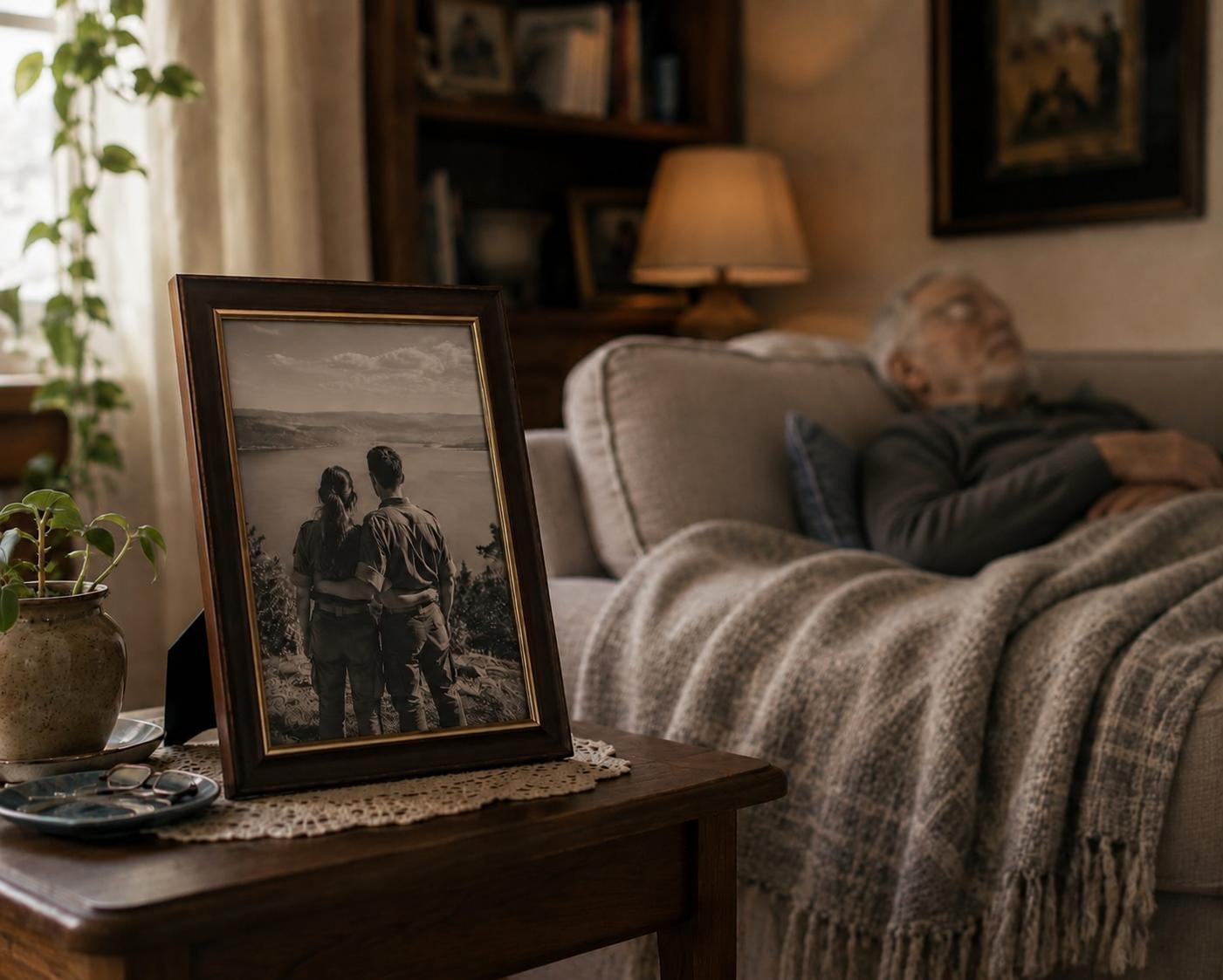
By then, my role was no longer to prescribe or explain. It was simply to allow that moment to happen. As I prepared to leave, my eyes rested on an old photograph standing on a cabinet nearby. Two young Nahal soldiers overlooked the Kinneret, gazing confidently toward a future that must have seemed endless. I slipped quietly out of the apartment and sat in my car for several minutes before I was able to drive away.
When people ask why I chose to practice palliative care alongside family medicine, I explain that I was lucky enough to discover, very early in my career, how much can still be done once cure is no longer possible. Success in medicine is measured not only by the sophistication of its technology or the brilliance of its surgeons, but also by the care it offers those whom it cannot save.
For me, palliative care remains one of the purest expressions of a society’s humanity.
–
Names and identifying details have been changed to protect patient confidentiality