

Her Name, in Hebrew
The week Iran buried Ali Khamenei, Iranians in a Stuttgart square raised the Israeli flag — and told me why they stopped being afraid.
A woman came over to say hello, one of many who did that afternoon. The first thing I saw was the pendant at her neck. Her name, written in Hebrew. I read it to her. She wears her own name in the language of the people this regime has named its first enemy, and she wears it openly, on a public square where anyone can walk past and read it. She did not do it for me.
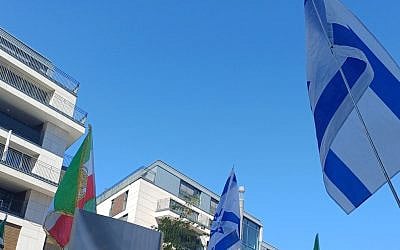
I had come to a small square off Mailänder Platz, where a few dozen people were standing. Iranians. The old imperial flag with the Lion and the Sun — the real one, they say, without the crab: their name for the stylized Allah the Islamic Republic put at the center of the flag in place of the lion. I counted: some twenty-five Iranian flags, seven or eight Israeli. A blue Star of David over a German square, in Iranian hands. Not a single headscarf in the crowd.
Two police officers stood nearby. That was all.
Iran had just finished burying Ali Khamenei — killed in February in a strike by the two adversaries he built his life around, the United States and Israel. His son and successor has not appeared in public since his appointment, not even at the funeral. American strikes were landing again this week. The theocracy is deeper in crisis than at any point in its forty-seven years. And in a German square, Iranians were not mourning. They were raising the flag of Israel.
It was not always like this, and they told me so themselves. Before October 7, they said, you thought twice before wearing the Lion and the Sun on these streets — a Faravahar at the neck could feel like an invitation, and the danger was not the German state but the regime’s reach and those here who share its hatreds. What changed, several of them told me, was watching Israel refuse to let October 7 pass — watching it go after Hamas house by house, then Hezbollah, and then, in the twelve-day war, the regime itself. Somewhere in those months, one of them said, we stopped being afraid even to gather. That fear did not lift on its own. It lifted because Israel acted.
This is not a one-time gesture. Among the monarchists — the followers of Reza Pahlavi, the exiled son of the last shah and a friend of Israel — the Israeli flag has become part of their political identity. They raise it at rally after rally, and often stitch the two flags into one banner: the Star of David on one face, the Lion and the Sun on the other.
Hold those two police officers in your mind, because in this city an Israeli flag is not a safe thing to carry. On June 8, 2024, a police officer handed me a written order to leave an area; the reason was entered by hand — showing the flag of Israel. A Palestinian march was passing, I had reached for a flag, and I never got it out of my pocket. They removed the flag, not the aggression. In three years here I have not seen one person on these streets in Israeli symbols; the observant fold the kippah under a cap. And when a pro-Israel demonstration does assemble, the state rings it in armor — special-unit vans ahead and behind, a wall of officers for a handful of people. The same blue star that draws all that steel flew over this square with two policemen watching.
Why? Is it because they are Iranians, and the street forgives Iranians what it will not forgive us? No. It is not that no one threatens them — the regime’s reach into its diaspora is documented, and they understand it better than anyone. It is that they raise these flags constantly — here, in Berlin, in Los Angeles, wherever this diaspora gathers — week after week, without flinching, until the sight of them stopped being an emergency. Courage repeated stops being an event. And no one sends a hundred officers to guard an ordinary evening.
They asked me to say a few words. I had a few minutes to put the words together, no more. What I said was not mine alone; it is what many Israelis would say, standing where I stood.
Brothers and sisters. The friendship between the Iranian and the Jewish people is not new. It is two and a half thousand years old — twenty-five centuries, since Cyrus the Great set my people free. This regime is forty-seven years old. Forty-seven, against twenty-five centuries. That is not history. That is a footnote that thinks it is the whole book. I am a Jew. I am an Israeli. And I came here to tell you one thing: my people watch Iran with our hearts. Your pain is our pain, and your freedom will be our joy. I have no doubt — none — that the end of this regime is near. Tyrants come and go. Iran remains. The Iranian people remain.
After I spoke, people kept coming over. An Israeli in a crowd of Iranians — you already have a picture in your head. Here is what actually happened. Some hugged me the way Israelis hug friends. Some shook my hand and said nothing. Several told me it mattered that an Israeli had come and said these things out loud, and you could see it was not politeness. When it ended, a family insisted on driving me home, so that nothing would happen to me on the way. The precaution was theirs, not mine, but I understood what it meant.
Let me say plainly where I write this from. I walk through this city at three in the morning in an Israeli shirt and a kippah, beside my dog from Bucha — sixteen shrapnel fragments in her body, and that is only where the vet stopped counting. I am not writing out of fear.
The lesson of that small square is not a comfortable one. Some of the people most willing to stand in the open under the Star of David in this city are Iranians — the very people this regime swears must hate us. They were afraid once; they told me so. They are still within the regime’s reach. They stood anyway, and they keep standing. I am not calling anyone a coward — some of the fear in this city is rational, and I have written about why. But there are two ways to live with fear: examine it, or obey it. The fear on that square has not disappeared; the family that drove me home carried their share of it. It has simply stopped giving orders.
When it was time to close, I closed the way they close — in their language, as she wears her name in mine.
Javid Shah. Payande Iran.