Her True Name
On the Nepperhan and What We Call Things
I.
I grew up in Scarsdale, which means I grew up on the Saw Mill River Parkway. It is a road. It takes you from Westchester to the Henry Hudson Parkway that goes to the city, or from Southern to Northern Westchester County. Saw Mill River Road runs alongside it. The name is everywhere. I had never wondered what it meant, whether there had been an actual sawmill, or what stood there before the parkway. It was infrastructure. Background. It was always just the landscape I drove through on the way somewhere else. I would always drive through carefully, because the Saw Mill is one of those old Westchester parkways with lanes so narrow and curves so blind that even at the posted fifty it takes all your attention. You keep your eyes on the road. You do not look around.
When it rains hard, the parkway floods. I filed it under the ordinary nuisances of Westchester driving. It did not occur to me until much later that the road was not flooding from bad drainage. It was flooding because there is a river right beside it — the Saw Mill — climbing its banks and onto the road every time it rains, insisting on itself. I never made the connection.
I left Westchester in my thirties, spent seven years in Colorado, came back in 2016, and settled in Dobbs Ferry — a village on the Hudson, right alongside the parkway I had driven my whole life. For years it stayed background. A commute. A fact.
I cannot say exactly when that changed. Midlife had something to do with it. Getting sober, seven years ago, had more — and the meditation practice that came with it. Mostly, I think, it was the slow work of learning to pay attention, of slowing down enough to actually see where I was. Mary Oliver had been with me through those years, all that patient attention to one patch of Provincetown until the whole universe turned up in it. Then this spring I started reading William Carlos Williams, the Rutherford doctor who spent a career insisting the sacred is not somewhere else but here, in this place, in these particular things. No ideas but in things. Attention as a practice. The local ground as the text. Something woke up. I started writing poems about the landscape I live in, and for the first time I started to look at it.
That is how I learned the Saw Mill has another name. An older one, given by people who knew it long before there was a road. The name turned out to be the start of a story I had not gone looking for.
II.
The name Nepperhan shows up on old maps of Westchester, marking the river the parkway now shadows. I found it while researching the landscape for poems, and it stopped me — not because it was strange, but because it wasn’t. I had seen it. There is a Nepperhan Avenue in Yonkers, running near the river. I had driven past the sign for years without registering what it pointed at. Now the name was everywhere, hiding in plain sight.
Nepperhan. It sounded like it meant something. I wanted to know what.
The internet was not much help. Sources disagreed. Some called it Munsee Lenape for something like rapid little stream. Others gave other translations. A few used the spelling Nappeckamack — close, but not the same word. The harder I looked, the more the meaning receded.
What I did find stopped me cold: the river had been buried. Not as a figure of speech. Between 1917 and 1922, as Yonkers industrialized, the downtown reach of the Nepperhan was culverted — sealed in pipe, paved over, reduced to a drainage problem. The river did not leave. It kept flowing in the dark, unnamed on the streets above it.
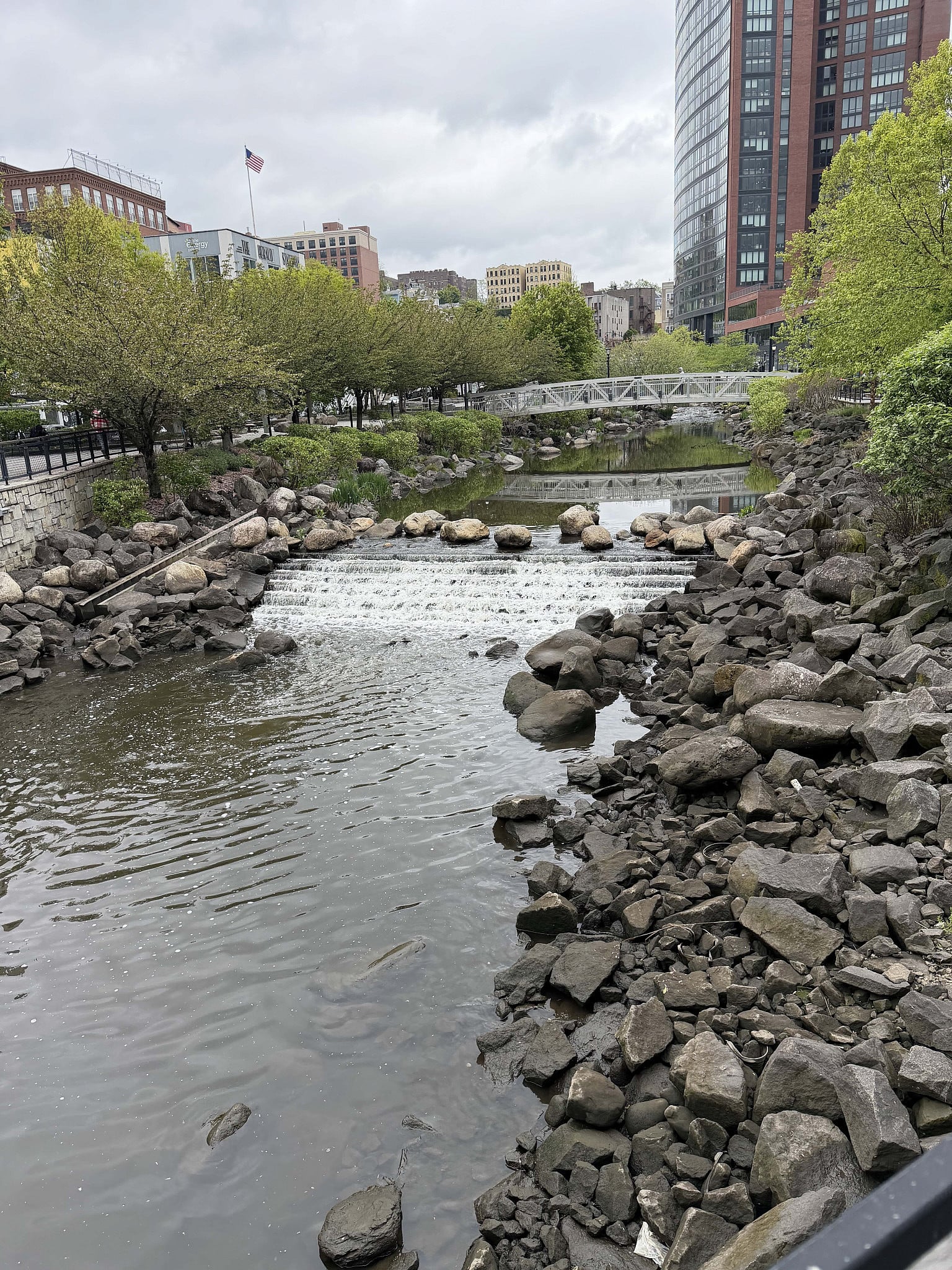
Then, improbably, the city undid it. In 2010 Yonkers broke ground on a project to take the concrete back off. They called this project “daylighting the river.” By November 2011 the river ran in open air through downtown for the first time in 90 years. The parking lot at Larkin Plaza became a park. They rebuilt the banks, planted native species, and waited to see what came back.
The eels came back — it is an old eel river. The turtles came back. The birds came back. A heron turned up and decided to stay.
I read about this and thought: I need to go stand next to that river and find out what her name means. So on a Thursday morning in late April, I drove to Yonkers.
III.
The map sent me to Van der Donck Park. A Dutch name, a Yonkers park; I did not think about it. I parked and walked toward the sound of water.
The sound was the first surprise. A parkway gives you tires and engines, never water. Here, a few blocks from downtown, between the buildings and the highway noise, there was moving water. I heard it before I saw it.
Then I saw it. A real river, running through the middle of a city, green and alive, native grasses and wildflowers along the banks. Not large — the Nepperhan was never wide or dramatic — but unmistakably itself. It moved with purpose. It caught the light. It smelled of wet moss and stone, and something opened in my chest I had not expected. Birds worked the vegetation along the water, many species, drawn back since the restoration. Left alone, water calls life back to itself.
A man sat on a bench near the bank, smoking a cigarillo. Well dressed — a bowler cap, the bearing of someone who takes care with himself — and relaxed, a man enjoying a morning that belonged to him. I asked if he was enjoying the river.
He opened right up. His name was Tom. He had worked for the city, on the crew that brought the river back to the surface. He pulled out his phone and started showing me pictures — turtles on the rocks, birds in the reeds. No turtles today, he said; it had just rained and was still too cold and wet for them, but they’d be back. He nodded toward the water, where several birds moved through the bank growth. Herons? Maybe herons, maybe wrens — he wasn’t sure. They were there, though, and before the daylighting they had not been.
He seemed proud. Not boastful. Satisfied. The river was running, the birds were back, the turtles were somewhere warm waiting out the cold. He had helped make that happen.
He mentioned that he lives in Riverdale, in the Bronx. He drives up to Yonkers to sit beside a river he helped dig out from under a century of concrete. I thought about that the whole way home.
When Tom left, I glanced up at the park sign. Van der Donck. It read differently now. Adriaen van der Donck was the Dutch colonist granted this land in the 1640s, who built one of the first sawmills at the river’s mouth — the mills that gave the Nepperhan its colonial name, the one that ended up on the parkway. (Yonkers itself comes from his Dutch title, Jonkheer, “young gentleman.”) The park where the river was freed, where Tom helped bring her up into the light, is named for the man whose industry set her burial in motion.
I sat down on the bench he had left and stayed a while. I closed my eyes and meditated. I heard the water. I heard the birds moving in the reeds. I heard the traffic on the nearby streets.
Then I took out my notebook, and a poem came.
IV.
I was still on the bench when my wife Shosh called. Where was I? I told her — the river, the park, the poem I had just written. She was with our friend Tara. They were coming.
When they arrived I read them the poem by the water, the rivers rushing on and the birds fluttering around us, indifferent to our human language. Then we walked toward the Hudson.
We passed under the Yonkers train station, the tracks overhead, the underpass damp and close, the city going muffled above us. The air changed in that seam between the small river and the great one, in the cool dark where the two worlds meet.
We came out the other side at the place where the Nepperhan empties into the Hudson. I had learned the Hudson’s older name a week earlier, in the same research that brought me here: Mahicannituck. The river that flows both ways. The tidal Hudson runs north and south by season and wind, fresh water and salt water meeting and mixing. It is the water’s own name for itself. Hudson tells you nothing about the river — only about the Englishman who sailed up it in 1609 looking for Asia and finding something else. He got his name on the water. The river kept its behavior.
Under the overpass, the two rivers somewhere close beneath our feet, there were birds everywhere — more species than I could count, unbothered by the trains or by the three of us standing there.
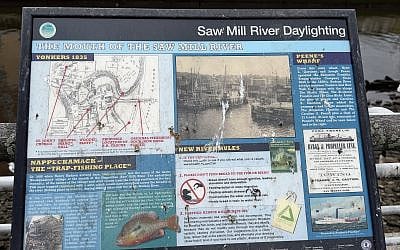
On the wall was a plaque. There, finally, was the answer to the question I had carried since the old map: the place had a name from before the mills and the parkway and the concrete. Nappeckamack. The plaque told me what it meant.
The trap-fishing place.
V.
Nappeckamack. The trap-fishing place. The name is a record of what happened here. The Lenape who lived along these banks built weirs in the shallows where the fresh water meets the tide, woven branches and stakes set to catch fish on the move. This confluence was one of the richest fishing places in the region. People fed their families here for thousands of years, and the name held the memory of it long after the weirs were gone and the people who built them had been displaced.
I am a rabbi. My work is organized around language — the weight of a word, the difference a single letter makes in a line of Hebrew. In my tradition, the first thing the human being does in the garden is name the animals. To name something is to enter a relationship with it. To let its name be forgotten is to let the relationship go.
Both of the older names — Nappeckamack, Mahicannituck — belong to the river: its work, its gifts. The names that replaced them belong to us: what we built, who passed through. Saw Mill is our industry. Hudson is a man’s name, not the river’s. Either way, the river itself dropped out of its own name. I had been driving through that erasure for forty years and calling it a commute.
She was here before the mills. She will be here after the parkway. She knew what she was. The open question was whether we did.
VI.
I have been thinking about names ever since.
Here is the part that surprised me: no one ever decided to rename the river. There was no vote, no decree, no day it became official. “Saw Mill” simply accreted — van der Donck’s mill, then Philipse’s, then four centuries of use, then a parkway named for a road named for the mills. The Lenape name was never abolished. It was demoted. It survives on a street sign — Nepperhan Avenue, a few blocks from where the river now runs free. The next stream over, Tibbetts Brook, kept its Lenape name too, Moshulu, which today names a parkway and little else.
That is how these names die. Not in a single act you could point to and protest. By attrition. By being moved out of sight and left there.
Daylighting the river took years, tens of millions of dollars, crews like Tom’s, the coordination of city agencies and nonprofits. Restoring a name costs none of that. No machinery, no permits. It takes a decision — a willingness to call a thing by what it is rather than by what we made of it.
I am not naive about it. Names settle into addresses, deeds, GPS systems, the muscle memory of everyone who has ever driven the road. Change is slow, and it gets resisted even when it is obvious. The deeper point is not mine to settle, either: the Munsee Lenape who fished this confluence were forced off this land generations ago, and their descendant nations are in Oklahoma, Wisconsin, and Ontario now. Dobbs Ferry, where I live, sits on what was Lenape ground. A name like this cannot be restored by a rabbi who likes how it sounds. It would have to begin with the people whose name it is. The first question is not what Westchester wants to call the river. It is what the Lenape descendants think should happen — whether returning the name would honor them or merely borrow them for a gesture, and what they would want it to carry.
In early June I drove to Tuckahoe for a ceremony I had read about. Westchester County had bought the old Ward House — Revolutionary-era, once a colonial post office Benjamin Franklin commissioned, standing on Lenape land — and was opening it as a home and gathering place for the Lenape people, working with the Lenape Center. The county executive swung the front door open. The Lenape Center spoke about the invisibility of their people finally breaking. The mayor of Tuckahoe put it plainly: “welcome home.” I stood in the crowd and thought about the river. The people who named these waters are not only in Oklahoma and Wisconsin and Ontario; some are being asked back to the county that took the land. If the first question is ever going to be asked — what the Lenape themselves want — there is somewhere nearby to ask it.
The question can still be raised. Yonkers already leans on “Nepperhan” when it tells its own history; the local guides and the restoration groups use the old name freely. If a buried river can be brought back into daylight, a buried name can be too. Maybe Nappeckamack is still down there under Yonkers, like the water under the concrete — flowing in the dark, waiting.
VII.
A few days after Yonkers, I was walking my dog Oz along the river near home — I have started calling it the Nepperhan, at least to myself — where it runs past V.E. Macy Park off the parkway, between the highway noise and the tree line. Not the daylighted section. Just a river moving through a suburban park on a weekday morning, which is its own kind of thing.
I noticed a sign I had never seen. Habitat Restoration. The Saw Mill River Coalition, a program of Groundwork Hudson Valley, working with the county to turn this stretch of bank into native meadow — pulling the invasive vines that strangle the trees, replanting what belongs here, giving the river back section by section to the birds and the wildlife. At the bottom, a number to call about volunteering.
I called it standing there by the water. Next weekend, the woman told me, was their annual cleanup — sites all along the corridor, from Yonkers up through Westchester, a day of people doing on a smaller scale what Tom’s crew did: showing up, year after year, section by section.
Oh, I said, you mean the Nepperhan?
She laughed. She knew exactly what I meant.
I signed up.
Her name is Nepperhan. It always was.
—
Companion poem, written on the bench that morning:
Nepperhan
Nepperhan,
river, whose name’s meaning
was lost in history,
trapped under steel and concrete
for over a hundred years.
The sister to the Mahhicannituck,
into whom you flow.
Turtles and wren
and heron,
river,
who was “daylighted”
in 2011.
I met Tom,
who worked for the city
and helped uncover you,
showed me pictures of
your turtles and wren and heron.
You who once were
mighty and small,
where the Wiechquaesgeek people
found their fish.
The river is forgiving,
flows around obstacles,
she who has been flowing
covered under the ground
for a hundred years,
who was a place of great fish,
became a dumping ground
for our garbage.
And yet she healed.
And yet on she flowed,
quietly underground,
covered up.
Return,
and you will know
her name.