
Where history exposes power and moral failure
Here We Go Again: Seinfeld and the Disgrace of Onstage Meltdowns
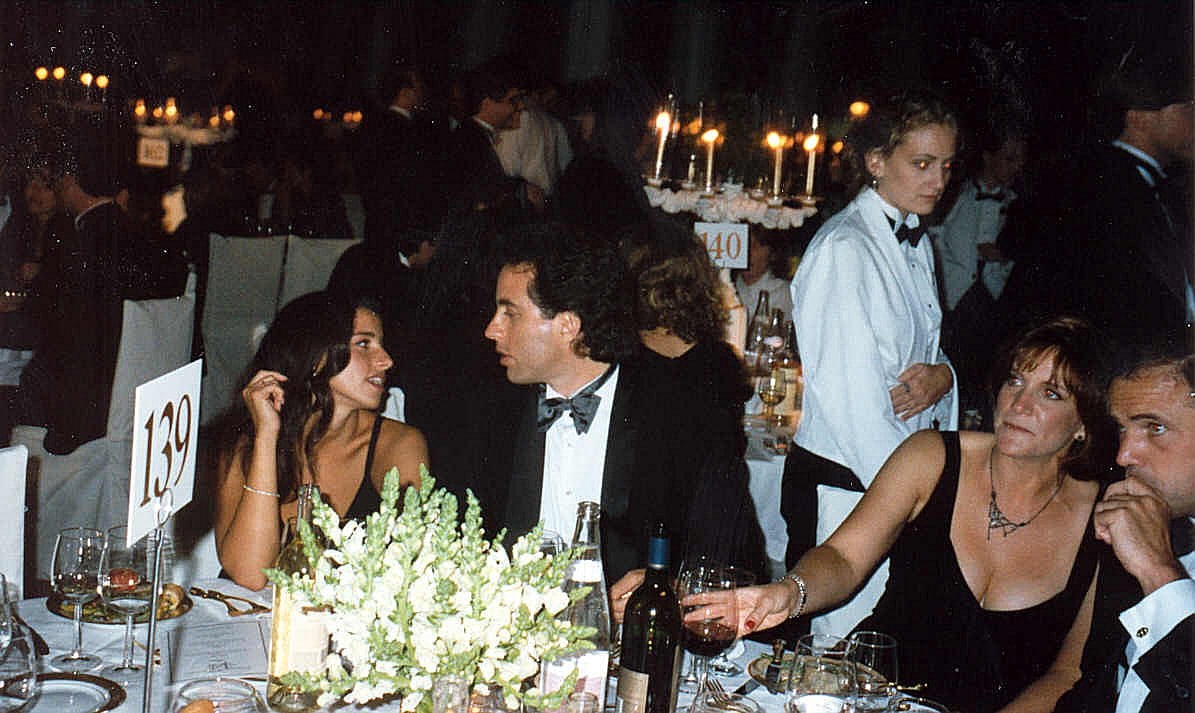
Jerry Seinfeld, 41, with his 19-year-old girlfriend Shoshanna Lonstein and Carol Leifer at the Emmy Awards Governor’s Ball, September 10, 1995. Photo by Alan Light; reproduced with permission via Wikimedia Commons.
In November 2006, Michael Richards stood onstage at the Laugh Factory in Los Angeles and unleashed a racist tirade against Black audience members who had interrupted his performance. Richards, then best known for playing Cosmo Kramer on Seinfeld, repeatedly used a racial slur, the worst racial slur, invoked the violence of an earlier American racial order, and eventually abandoned the stage. His subsequent apology on The Late Show with David Letterman did little to rescue his professional reputation. Nearly twenty years later, his name remains inseparable from those two minutes.
On October 9, 2026, Jerry Seinfeld was interrupted during a performance in Chicago by protesters accusing him of supporting Israel’s military actions in Gaza. One man shouted that 74,000 Palestinians had been killed. Seinfeld replied, “I am a racist.” Another protester raised the killing of Palestinian children, and Seinfeld answered, “I’m racist, it’s a genocide, I’m into it.” He also announced that he would find out what one protester had paid for his ticket and send that amount to Israel. Then he added, “No, I won’t, I’m keeping it.” During the removal of a female protester, Seinfeld danced onstage.
Here we go again.
Jerry Seinfeld is a performer, but it takes a lot of confidence to stand before a paying audience, hear an accusation concerning the mass killing of civilians, including many thousands of children, and decide that the appropriate response is to make the accusation itself ridiculous and to prance around the stage.
Seinfeld, whose professional reputation rests upon decades of observational comedy, perhaps most famously about airplane food, and physical comedy involving acts like donning “puffy shirts,” certainly understands how absurdity and sarcasm work. Maybe he was performing absurdity and being sarcastic. Maybe not. It doesn’t really matter; the pull-quote stands. He was inviting his audience to laugh at the people who had raised the concern about thousands of Palestinian children killed by the Israeli military Seinfeld had been photographed supporting.
And it isn’t as though the hecklers’ concerns appeared from the ether. In February 2025, when approached in New York City and asked to say, “Free Palestine,” Jerry Seinfeld explicitly stated, “I don’t care about Palestine.” He decided to make his views much more severe when, in June 2026, he responded to the same request by saying of Palestine, “It doesn’t exist.” (157 of the 193 United Nations member states disagree.) Perhaps his most concerning comment, though, was made at Duke University in September 2025, when he compared the Free Palestine movement with the KKK and said, “Compared to the Ku Klux Klan, I’m actually thinking the Klan is actually a little better here.”
Michael Richards’s outburst was furious and explicitly racist. It was horrible. It had an air of impulsivity to it, but it was easy to immediately condemn for its blatantly anti-Black language, and Michael Richards was almost unanimously seen as persona non grata. JK Rowling’s increasingly targeted and mean-spirited transphobic social media posting and political activity has led many people, whether or not they are a part of the LGBTQ+ community or are allies, who once adored Harry Potter to decide that they cannot contribute emotionally or financially to the IP any longer.
Seinfeld’s behavior prior to what happened in Chicago and during the event onstage was controlled, sarcastic, and political. Whether the latter proves as destructive to the reputation of Seinfeld as the former remains to be seen, although I would argue that the moral implications of Seinfeld’s performance are at least as serious as what Michael Richards did and what JK Rowling has done. Richards lost control in front of an audience. JK Rowling has spent years targeting a vulnerable group and defending the harm. Seinfeld appears to have remained perfectly comfortable with what he was saying.
The allegations he was mocking in Chicago have a substantial evidentiary history, despite his denial. In September 2025, Senator Bernie Sanders, himself Jewish, publicly declared that Israel was committing genocide in Gaza, citing statements by Israeli officials as evidence of intent. A United Nations commission of inquiry reached the same conclusion. Israel disputes the genocide allegation, and the question of legal responsibility remains subject to international legal proceedings. But the people examining that question include investigators, international-law specialists, historians, rabbis, and elected officials. Seinfeld’s hecklers were repeating an accusation that had already received sustained, serious examination by very qualified scholars, political figures, legal analysts, and first-person witnesses.
Nor does criticism of Israel require hostility toward Jews, however much Jerry Seinfeld’s public statements have encouraged that conflation. Jewish opposition to Israel’s treatment of Palestinians is substantial, historically grounded, and publicly visible, including among some of the most accomplished figures in the entertainment industry.
Wallace Shawn has condemned Israeli policy toward Palestinians. Jonathan Glazer, accepting his Academy Award for The Zone of Interest, challenged the appropriation of Jewish identity and Holocaust memory in defense of occupation, drawing considerable criticism from people apparently more offended by his speech than by the suffering he was describing. Simone Zimmerman defended him, as did filmmaker Jesse Peretz and sportswriter Dave Zirin. Mandy Patinkin has repeatedly spoken about Palestinian civilian suffering, humanitarian assistance, and the need to end the violence. These are Jewish artists, writers, and public figures speaking openly about the conduct of a modern state whose government does not represent their individual consciences.
Jewish Voice for Peace has continued organizing large, peaceful demonstrations demanding Palestinian freedom and an end to Israel’s military campaign in Gaza. Its opposition to Zionism is explicit, and it belongs to a much longer history of Jewish disagreement over nationalism, political sovereignty, and the relationship between Jewish identity and the State of Israel. Jewish anti-Zionism existed decades before Israel’s founding in 1948, including among religious communities, socialist movements, and Jewish intellectuals who rejected the proposition that Jewish survival required a territorial nation-state. The Bundist tradition, in particular, located Jewish political and cultural life within the societies where Jews already lived, rather than treating emigration to Palestine as the necessary destination of Jewish history. These disagreements survived the Holocaust and the establishment of Israel, and they continue among Jewish communities throughout the world.
The existence of these Jewish voices makes Seinfeld’s earlier comparison of the Free Palestine movement to the Ku Klux Klan particularly objectionable. In September 2025, he suggested that the Klan was more honest about its antisemitism than people using the slogan “Free Palestine.” That comparison asks the public to regard a demand for Palestinian freedom as an expression of hatred toward Jews, even while Jewish protesters, filmmakers, writers, religious figures, and political organizers are making precisely that demand themselves. The Ku Klux Klan has a documented history of racial terrorism, antisemitism, intimidation, and murder. Its victims included Jews, most notoriously Leo Frank, lynched in Georgia in 1915. Invoking that organization to characterize a political movement that includes Jewish participants is an extraordinary historical comparison for a public figure to make.
Antisemitism is a serious and demonstrable danger, and Jewish people should never be made collectively answerable for the decisions of Israel’s government. That principle applies equally to Jewish critics of Israel, whose identity cannot be withdrawn because their political conclusions offend another Jewish public figure. Jerry Seinfeld is entitled to his opinions about Israel, the war, and the protesters who interrupt his performances. He has no authority to determine that Jewish identity entails support for Israeli military policy, or that Palestinian demands for freedom are inherently expressions of antisemitic hatred. The historical persecution of Jewish people deserves far better than its deployment in arguments that obscure the responsibilities of identifiable governments, military commanders, and political officials.
And there is something especially repugnant about using the history of Jewish persecution to dismiss accusations concerning the violent deaths of Palestinian children.
The Holocaust was one of the worst catastrophes in recorded human history. Its victims deserve precise and unique remembrance, not to be a political instrument through which contemporary suffering may be excused or ridiculed. But Jewish identity and historical memory cannot confer immunity upon a state or its government or military, and they cannot relieve a prominent entertainer of responsibility for his own public words. Seinfeld’s sarcastic response in Chicago belongs in the same record as his earlier statements about Palestine and his comparison of Palestinian solidarity activists to the Ku Klux Klan. His words are available for examination. So are the Jewish voices he has chosen to disregard and the lives of Palestinians.
Seinfeld has visited Israel, met survivors of the horrific October 7 Hamas massacres, and expressed his admiration for the people he encountered. The murders and hostage-taking of October 7 were terrorist atrocities, and the suffering of those families deserves serious attention and compassionate care. Seinfeld’s decision to meet them was entirely understandable and I applaud it. Yet at Seinfeld’s show in Chicago, his audience cheered for him and encouraged physical violence against a female protester.
The really extraordinary thing about this episode is that Seinfeld has spent the better part of forty years enjoying the kind of cultural security most entertainers can only dream about. His sitcom ended in 1998, but the reruns, streaming agreements, syndication revenue, and endless references to its characters have kept him enormously wealthy and culturally relevant. He could have spent the rest of his career discussing breakfast cereal, awkward dinner parties, and the peculiar habits of airline passengers, occasionally collecting another substantial payment for the privilege.
Instead, he has made his views about Palestine an increasingly conspicuous part of his public identity, and audiences are entitled to consider those views when deciding what to make of the man and his work. His enormous professional success does not oblige anyone to continue admiring him, purchasing tickets, watching his programs, or pretending that his public conduct has no bearing on their relationship with his comedy.
There is also something revealing about the disparity between Seinfeld’s professional accomplishments and the rather limited intellectual demands of his response in Chicago. Here was a comedian whose reputation was built on finding unexpected absurdities in ordinary situations, confronted with a grave political accusation, and his answer was essentially to repeat the accusation in a silly voice. About dead children. Then he danced. This was the creative contribution of one of the wealthiest and most celebrated comedians in American television history. But then, this is a man who made a film about a bee in a romantic relationship with a human woman.
Michael Richards spent nearly twenty years attempting to escape the consequences of what he said onstage. J.K. Rowling has watched her public political identity become inseparable from discussions of the fictional world she created. Just like her, Jerry Seinfeld may discover that his own words indelibly stamp themselves onto the cultural history he created, long after the laughter in Chicago has died away.
He has every right to say what he pleases. The rest of us have every right to remember it.
I have watched every episode of Seinfeld many times and was looking forward to introducing my son to the show. We won’t ever watch it again. That won’t affect his massive fortune, and he won’t care about it, but it affects my family. We have the right not to partake of him or to forgive him, and that’s what matters. We care about doing our part to respect others. For that reason, Jerry Seinfeld is no longer welcome in our home.
Related Topics