The views expressed herein are solely mine.
Hezbollah Reloaded: Israel’s Darkest War Looms
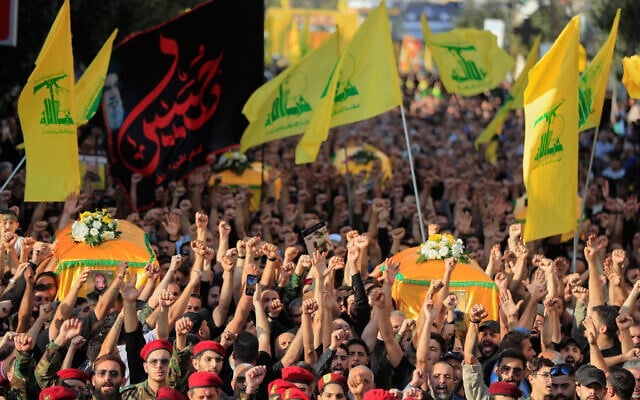
Hezbollah fighters and supporters raise their fists and chant slogans as they march in the funeral procession of five comrades killed in Israeli strikes in recent days, in the southern town of Nabatieh, Lebanon, November 2, 2025. (AP Photo/Mohammad Zaatari)
Hezbollah is rearming — not gradually, not quietly, but ferociously — in a way that humiliates every optimistic briefing given after Israel’s bruising 2023-2024 direct military campaign.
The data could not be clearer: the so-called “degraded militia” is rebuilding itself into an even more distributed, more precise, and more lethal force than the one Israel fought two years ago.
Before October 7th, 2023, Hezbollah held 130,000–150,000 rockets and missiles, the largest terrorist arsenal in human history.
The State of Israel managed to destroy 20–25% of it — but those were tactical gains, not strategic ones.
By early 2025, Western intelligence confirmed that Hezbollah had already replenished 60–70% of its pre-war stockpile. That puts the group back above 100,000 munitions, now hidden not in massive bunkers, but across micro-depots buried under schools, apartments, and municipal buildings.
In other words, Hezbollah is now using Hamas’s strategy in Gaza.
This way, the second a new conflict ignites, they can roll out their manufactured outrage — screaming that Israel ‘bombs schools and hospitals’ while smearing Jerusalem as committing ‘genocide.’
This way, Hezbollah’s transformation from centralized depots to hyper-distributed arsenals has turned southern Lebanon into a multi-layered subterranean fortress.
Certainly, this new phase of rearmament is defined by speed and innovation and demonstrates that although the terrorist organization has seen 5,000 of its members killed or sent to retirement in the last two years, they are still strong.
Hezbollah has abandoned large convoys for single-vehicle shipments, decoy humanitarian trucks, nighttime coastal drops from Tartus, and heavily guarded Syrian land routes. Israeli interdictions slowed the flow but could not stop it.
Nasrallah’s puppies adjusted and adapted — faster, smarter, and with Iranian strategic guidance; nevertheless, the most dangerous development is qualitative.
Today, Iran is delivering guidance kits that transform crude rockets into precision strike weapons with 10–30 meter accuracy. Targets that once required statistical luck can now be hit with deliberate intention: airbases, power stations, desalination plants, intelligence nodes, and transportation hubs.
Add smuggled components for Fateh-110 and Zolfaghar missiles capable of striking 200–700 km deep into Israel, and the threat becomes not just tactical, but existential.
This raises the obvious question: how can Hezbollah rebuild at this scale after Israel carved through its infrastructure in 2023?
The answer is the geopolitical rot surrounding Hezbollah — a system Israel damaged but did not dismantle.
As we all know, Lebanon’s government is bankrupt, fragmented, and increasingly irrelevant, while the Lebanese Armed Forces (LAF), despite its uniforms and flags, has been hollowed out politically.
Hezbollah controls the streets, the borders, the ports (many Lebanese still insist that Hezbollah’s clandestine activities and weapons stockpiles at the port set the stage for the 2020 Beirut explosion…), the pipelines, and in many cases, the ministries themselves.
Why?
Because of its explosive political expansion, Hezbollah has a chokehold over every major institution, and the demographic rise of a Shia community that has not been officially counted since the last census in 1932 allows it to bully other sects and pushes them into surrendering power.
Unquestionably, the other groups are terrified that a new population count would expose Hezbollah’s true dominance and blow apart Lebanon’s fragile constitutional order, and make things worse.
Irrefutably, the Lebanese state does not restrain Hezbollah — it survives under it.
And here lies a catastrophic American miscalculation: Washington is preparing to send 90 million dollars to the LAF. The assumption is that the weak LAF will serve as a counterweight to Hezbollah.
Nonetheless, reality — and data from the last 15 years — shows the opposite.
As the facts make clear, every time the LAF collapses territorially or financially, Hezbollah steps in and absorbs its assets. This includes ammunition, armored vehicles, communications equipment, and in some documented cases, tanks.
Without forcing Lebanon’s political system to demilitarize Hezbollah immediately, Washington risks turning its own aid into Hezbollah’s next resupply convoy.
Thus, the US cannot continue financing an army that, intentionally or not, has already served as Hezbollah’s logistical backstop.
If France—the former colonial power that knows Lebanon’s institutions best—refuses to fund the Lebanese Army because it no longer trusts it, why should the United States shoulder that burden?
Consequently, if the Lebanese government refuses full demilitarization, any aid package becomes a subsidy to Hezbollah’s historic reorganization — the most sophisticated terrorist restructuring ever recorded.
Meanwhile, Syria’s corridors — Hezbollah’s lifeline — remain intact.
Even with hundreds of Israeli strikes and the elimination of Maher Al-Assad’s captagon pipeline that endlessly financed Hezbollah, over 70% of Iranian shipments still reach their destination, and Hezbollah is still economically strong due to their activities in the “Triple Frontier” and fraudulent Western banking schemes.
Currently, Iran hides its cargo behind civilian flights, humanitarian labels, and dual-use of commercial containers. Even satellite imagery reveals expanded underground storage at Syria’s Al-Qusayr and T-4, showing that Iran is not just maintaining its supply chain — it is fortifying it for long-term escalation.
Meanwhile, UNIFIL, designed to prevent exactly this scenario, has become little more than a blue-helmeted spectator.
With over 1,000 violations each year, blocked patrols, confiscated equipment, and Hezbollah’s faux environmental NGOs acting as military outposts, the UN has lost all deterrent value.
Today, Hezbollah treats UNIFIL as background noise.
This leads to the strategic nightmare: Hezbollah is preparing a saturation doctrine — overwhelming Israel’s missile defenses through sheer volume.
Alarmingly, Israeli commanders warn the group could now fire 2,500–3,000 rockets per day, a rate designed to break Israel’s anti-missile architecture and make its economy collapse.
That said, the economics are brutally imbalanced: Iron Dome’s use costs $50,000–150,000 per interceptor, while Hezbollah’s rockets cost $500–5,000.
Ergo, Israel’s new laser-defense system will be essential because, unlike the Iron Dome’s expensive interceptor missiles, every laser shot costs less than 10 dollars, allowing Israel to protect its skies more sustainably and affordably while maintaining the same life-saving defensive edge.
While Hezbollah is building an attritional machine — cheap, replenishable, and devastating —the regional consequences are devastating.
A stronger Hezbollah amplifies Iran’s reach from Tehran to Beirut, tightens the land corridor through Iraq and Syria, and emboldens Tehran to pressure Jordan, destabilize Gulf states, and threaten Eastern Mediterranean shipping.
With precision missiles in Hezbollah’s hands, Iran acquires veto power over regional escalation.
The Gulf states see it. Jordan sees it. Even Egypt sees it.
As a result, this is where the strategic necessity of an Israeli–Syrian security agreement becomes unavoidable.
Syria is the artery; Hezbollah is the organ. If Israel wants to constrain Hezbollah’s rearmament, it must address the Syrian logistical pipeline.
Aware that a new Aoun and Al-Sharaa agreement to prevent Hezbollah from controlling the border between Lebanon and Syria, I strongly believe that a new security arrangement — even limited, even transactional — that fully restricts Iranian-influenced presence west of the Damascus–Homs line grants Israel intelligence visibility, and thusly verifiable constraints on Iranian shipments would suffocate the rearmament cycle.
Doubtlessly, this would not normalize Israeli–Syrian relations, but it would rip out the supply routes that keep Hezbollah alive.
Moreover, any regional plan to weaken Hezbollah requires that Israel and the United States pressure Lebanon to demilitarize Hezbollah immediately.
The Lebanese state must be forced — through diplomatic, economic, and security means— to choose between sovereignty or servitude.
If the US continues funding the Lebanese Army without conditions, those aforementioned 90 million dollars and their hardware will inevitably, directly or indirectly, fortify Hezbollah’s arsenal because you cannot defeat a terrorist army while subsidizing the country that feeds it.
Hezbollah today is rearming faster than the region is responding.
Sadly, it is modernizing faster than Western diplomacy is adapting while strategically embedding itself deeper into a Lebanese state too weak — or too compromised — to resist.
Clearly, the next war in the north will not be like in 2006 or 2023. Without a doubt, it will be faster, larger, more precise, and far more destructive.
Unless Israel reshapes the strategic landscape — by cutting Hezbollah’s Syrian lifelines, forcing Lebanese demilitarization, and preventing American aid from fueling Hezbollah’s reorganization — the next explosion on the northern front will shake more than the Galilee.
And beyond any doubt, it could destabilize the entire Middle East and the West like we had never seen before.
Related Topics
Related Posts