Hezbollah’s Thank-You Confessional to Tehran
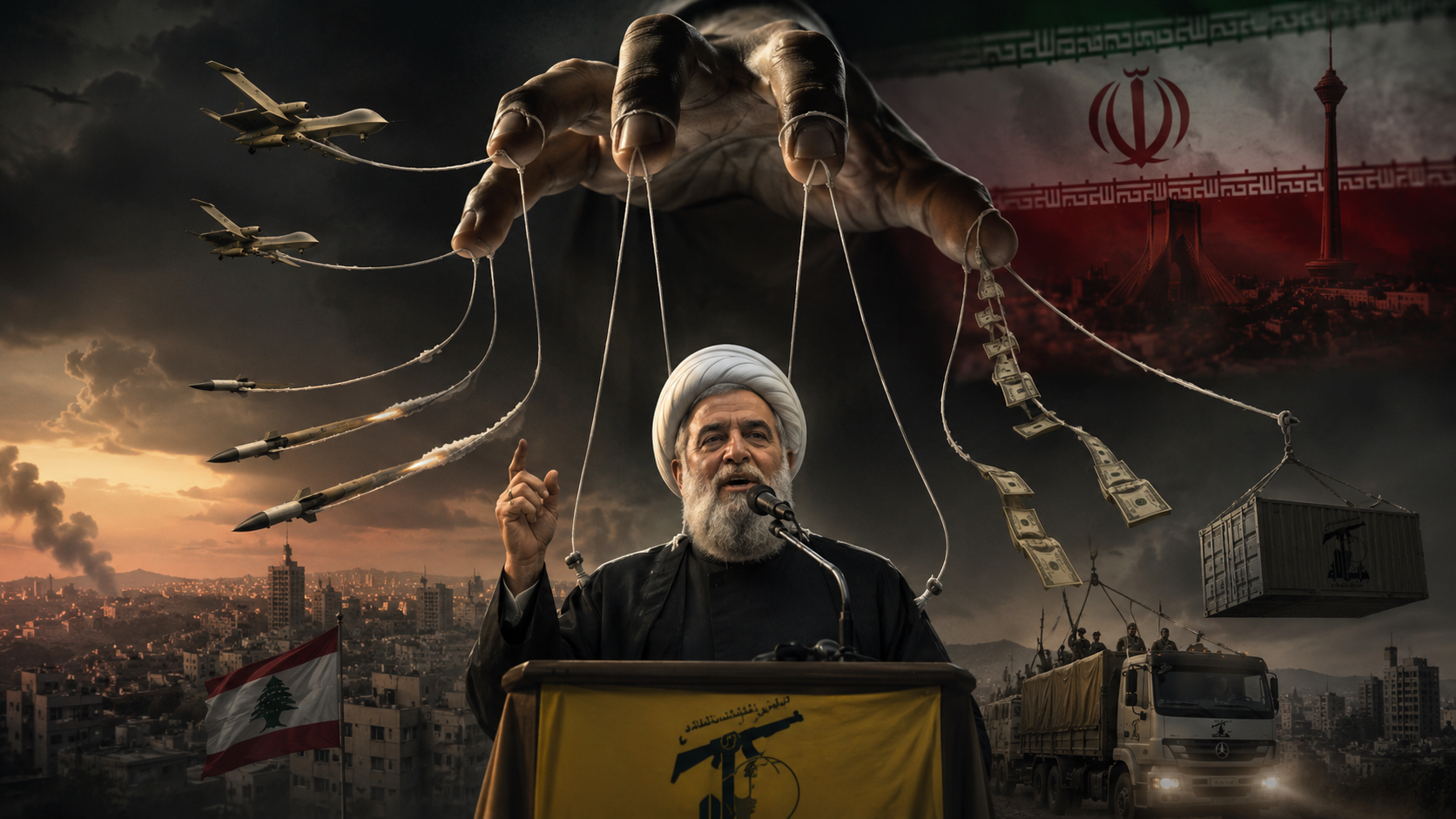
Every so often, Iran’s own media publishes something that makes Israel’s argument for it, and does not seem to notice.
On June 16, the Iranian state-aligned Fars News Agency carried remarks by Naim Qassem, the secretary-general of Hezbollah, thanking his Iranian patrons. The tone was devotional. The content was a confession.
Qassem said that Iran “has given everything to Hezbollah, the resistance, and the people of Lebanon, and has taken nothing from them.” He thanked Tehran for supplying “capabilities, the strength to liberate their land.” He said Iran was now “giving blood,” confronting Israel in response to its strike on Beirut’s Dahieh, and declared, “I say this loudly: Iran is a symbol of dignity and honor.”
The contradiction sits in plain sight. A benefactor that has “taken nothing” is, one sentence later, described as bleeding and fighting on Hezbollah’s behalf. Both cannot be the innocent description Qassem intends. What he is actually describing, in the warm language of gratitude, is an organization whose weapons, whose strategy, and whose wars are not its own. The capabilities come from Tehran. The “strength to liberate their land” was issued from Tehran. The blood being spilled is spilled in service of Tehran’s confrontation with Israel, on Lebanese soil, using Lebanese lives.
For years, the careful position in Western capitals was that Hezbollah is a complicated thing: a Lebanese political party, a social movement, a militia, an authentic expression of a community. Israel argued otherwise, that Hezbollah is at bottom an Iranian instrument, a forward operating base for the Islamic Republic dressed in Lebanese clothing. That argument no longer rests on Israel’s word. It rests on Qassem’s. He has said, proudly, that the instrument is grateful to the hand that wields it.
There is a second admission folded into the same statement, and it is stranger still. Qassem directed his thanks to Ayatollah Seyyed Mojtaba Khamenei, who became Iran’s supreme leader after his father was killed in a March airstrike. He asked that his “thanks and appreciation” be conveyed to the new leader, “who has surrounded us with his care.”
The peculiar fact about this man is that nobody has seen him. In three months as supreme leader, Mojtaba Khamenei has not appeared in a single photograph, video, or audio recording. Western outlets including The Wall Street Journal have reported he remains out of public view after a severe injury. The regime governs in his name through messages attributed to him and officials who claim to have met him, while producing no evidence that he is well, or active, or even present. And now a Hezbollah leader sends thanks to this invisible patron, relayed through intermediaries, addressed to a man whose own state cannot show him to his own people. The proxy thanks the patron through a curtain, and neither side appears to find this strange.
That is the part worth additional thought. The entire architecture is now mediated. Iran’s leader exists as text. Hezbollah’s gratitude is conveyed secondhand. The “care” Qassem describes flows from a figure no camera has captured in a quarter of a year. What holds the axis together, at least in its public presentation, is a chain of assertions that none of its members can or will verify.
None of this changes the military reality on the ground, where the fighting is real and the consequences are borne by real people on both sides of Israel’s northern border. But it clarifies the politics. When the leader of Hezbollah stands up to thank Iran for giving his organization the capacity to make war, and to thank a supreme leader nobody has seen for surrounding him with care, he is not performing Lebanese independence. He is performing dependence, and calling it honor.
The most useful intelligence sometimes arrives not from what an adversary hides, but from what it is proud to say out loud. Qassem meant his words as tribute. They read, to anyone paying attention, as testimony.