
President of Shahvand Think Tank
The Pitch as a Battleground
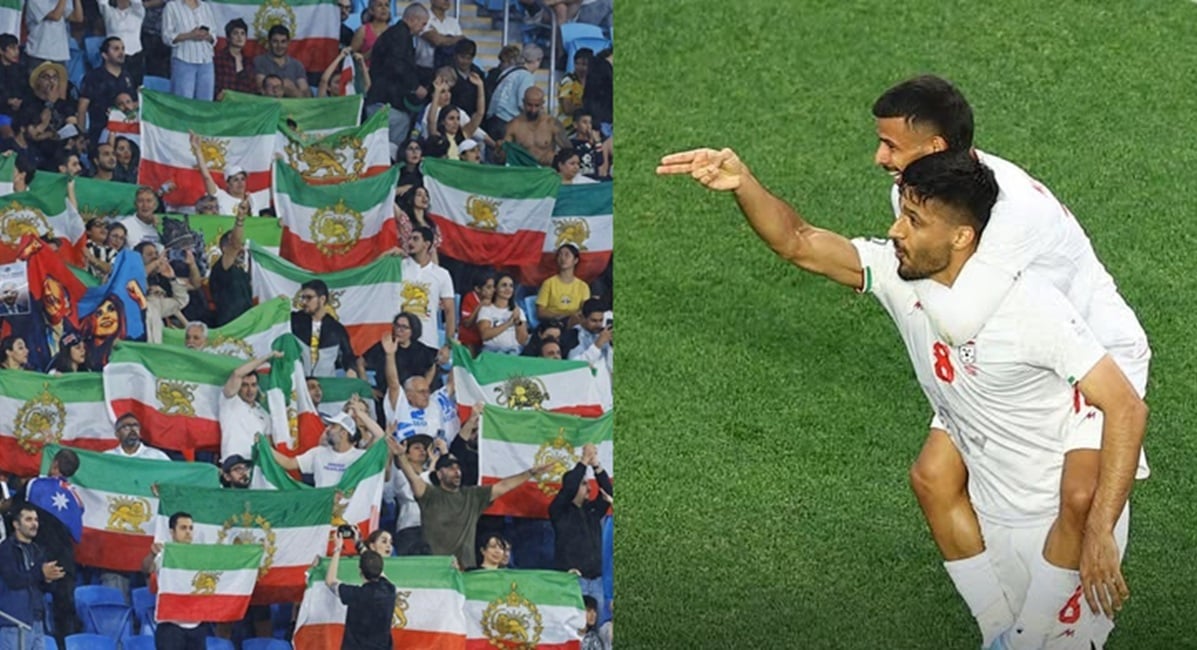
Image Credit: X — Iran–New Zealand World Cup, Los Angeles
A Goal Celebration and the Politics of Intimidation
The Iran–New Zealand World Cup opener in Los Angeles was not merely a football match; it was a public stage on which Iran’s political conflict unfolded before the world. The final 2–2 scoreline mattered, but it was secondary to the spectacle in the stands, where the stadium became an arena of open confrontation between supporters of the regime and those who reject it.
The display of the pre-1979 Lion and Sun flag was not decorative. It was a deliberate act of political defiance—a rejection of the Islamic Republic’s claim to speak for the Iranian nation and a visible assertion that the opposition also inhabits the Iranian body politic. Thousands of spectators transformed the stadium into a space where an alternative vision of Iran could be seen, photographed, and broadcast globally.
It was in this context that Mohammad Mohebi’s gun-firing celebration took on a meaning far beyond sport. As documented in video footage and visual evidence, the gesture was directed toward a section of the crowd openly displaying Lion and Sun flags—the most visible symbol of opposition to the Islamic Republic inside the stadium. In an ordinary match, such a celebration might be dismissed as theatrical exuberance. In Los Angeles, it was something else.
When a player points a mock weapon toward spectators visibly expressing political dissent, the act ceases to be politically neutral. It becomes a symbolic display of force. It communicates hostility rather than unity. It reinforces the divide between those aligned with the regime’s vision of Iran and those who challenge it. The issue was not the gesture alone, but the audience toward whom it was directed.
This is what made the moment politically explosive. Football often serves as a soft arena for national representation, but in Los Angeles it became a hard-edged theatre of power. The celebration did not bridge divisions; it deepened them. It did not merely express triumph; it projected intimidation.
At a moment when opposition supporters had transformed the stands into a visible challenge to the regime’s claim of national representation, the response from the pitch appeared less like spontaneous celebration than a symbolic counter-assertion of power. In a stadium where the opposition had already reclaimed visual space through the Lion and Sun flag—a reality visible throughout the match—the gesture carried a meaning that extended far beyond football.
Whether intended as intimidation or not, it was received as such by many spectators and observers. That alone explains why the incident resonated far beyond the final score. The image projected was not one of national unity, but of confrontation. The message received by many in the crowd was unmistakable: dissent would not be acknowledged, debated, or respected—it would be confronted.
That is why this episode matters. It was not merely a football celebration. It was a reminder that the struggle over Iran’s future no longer exists only in political institutions, media platforms, or exile organizations.
It now emerges wherever Iranians gather in large numbers. Even on a football pitch, the battle over who represents the nation—and who has the right to speak in its name—continues.
Related Topics