
B’Yachad candidate for Knesset and a biotech executive
Hi-tech is Israel’s growth engine and its security edge. Let’s treat it that way
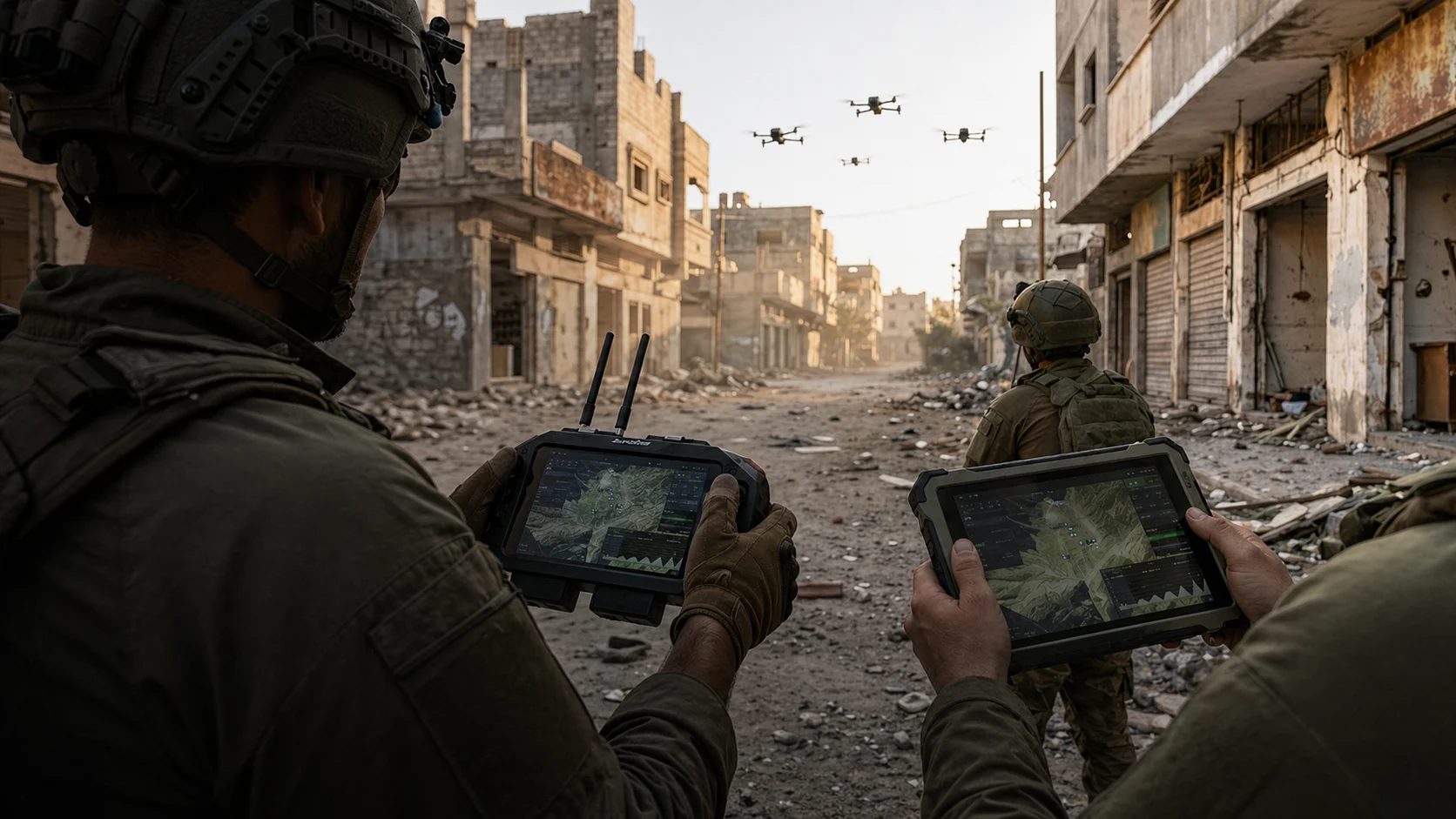
IDF soldiers use Israeli-founded defense tech startup EyesAtop's universal remote controller to operate a variety of drones. (Courtesy EyesAtop)
On the morning of October 7th, as the state’s institutions froze, something else moved. Just like the countless Israelis who rose like lions on the battlefield and the home front as the government collapsed, within hours, engineers, product managers, and founders had turned startup offices into civilian war rooms. They built databases to locate the missing and the kidnapped, organized logistics for tens of thousands of evacuees, and moved supplies to the front lines. On October 8th, and through the long months that followed, they kept going, many of them in uniform. The hi-tech sector has carried a disproportionate share of the reserve burden, with teams emptied out for months while their companies held the line at home.
This was no coincidence. A large portion of the civil society that rose up when the government failed us was led by the people of Israeli hi-tech: the same networks, the same skills, the same instinct to build a solution before anyone gives permission. Hi-tech isn’t just an industry. It is one of the keystones of Israeli society.
Today, that keystone is under strain and at increased risk, and the government is looking the other way. I am proud to be part of our B’Yachad team led by Naftali Bennett that has a detailed plan to fix this beginning on the very first day of a new government.
The engine of the economy
Hi-tech produces about 18% of our GDP, roughly half of our economic growth, and about 35% of the state’s income tax revenue. That is the money that funds our schools, our hospitals, our roads, and our army. When hi-tech sneezes, every Israeli catches a cold.
Beneath the headlines about the sector’s resilience, the trends are alarming. Investment deals have fallen to a ten-year low, new company formation is down about 25%, and the number of R&D workers has declined for the first time in a decade. Israeli companies and researchers face boycotts abroad, while capital, decision-making, and some of our best people are relocating overseas.
None of this is an act of nature. It is the product of regulatory chaos, damage to Israel’s international standing, and political instability manufactured in Jerusalem. Investors flee uncertainty, and this government has made uncertainty its signature product.
Tomorrow’s battlefield is being built in today’s labs
Iron Dome, David’s Sling, and Arrow came out of the same ecosystem of Israeli engineers, scientists, and entrepreneurs that powers our startups. Drone and counter-drone warfare, cyber, AI-driven intelligence, and quantum computing will decide the wars of the coming decades. They are the next global arms race. Such technologies that protect us on the battlefield are the same ones that will lead tomorrow’s economy. A country that lets its hi-tech base erode is not saving money. It is putting at risk its future security.
Top three in AI and deep tech
The new global arms race is an AI race. Whoever controls computing power and data controls the future, and leading nations are making AI the core of their national strength. Israel has world-class talent, but without a national strategy, and without the computing power and infrastructure to match, the gap keeps growing. B’Yachad’s goal is clear: to make Israel among the top three nations in the world in AI and deep tech, and to lead in the technologies that come next, from quantum computing to physical AI.
That means national computing infrastructure, including supercomputing and GPU clusters, open to academia, startups, and the defense establishment. This so that Israel never depends on the goodwill of a foreign company or country. It means a Tech Resilience Fund for dual-use technologies that serve the IDF and break into civilian markets, from cyber to drones to quantum. And it means the state becoming the first customer for Israeli innovation: through regulatory sandboxes and fast-track pilots, government ministries, hospitals, and local authorities will use Israeli AI to give citizens better, faster public services. At the same time, Israeli startups will gain the proof of concept they need to win customers around the world.
Bringing our people home
The most painful number of all, especially for me as someone who made Aliyah: nearly 300,000 Israelis have left the country during this government’s term. Many are exactly the people we can least afford to lose: engineers, doctors, researchers, and founders. Every one of them is a reservist, a taxpayer, a mentor, a potential employer.
Our current system almost seems designed to keep them away. Tax benefits for returning residents actually rewards staying away longer. Meanwhile, those who left recently, who are also the easiest to bring back, get almost nothing. And double taxation on stock options punishes those who return.
B’yachad will reverse this. A proactive “Returnees’ Desk” will go out to Israeli communities abroad, find talent, and walk each returning family through taxes, housing, schools, and finding employment for the entire family. We will open an intermediate track for those who have been abroad for three to six years, fix the double taxation on options, and invest in world-class labs so senior researchers can come home and continue their work. Our goal is a positive migration balance, especially in the tech sector.
One hand on the wheel
Strengthening this sector requires a government that stops being the brake and becomes the fuel. Rather than today’s setup of numerous ministries with overlapping responsibilities and disjointed policies, we need one hand on the wheel to guide and steer national policy and implementation from education through academia, investments, startups and industry. We will make this happen by replacing the existing Ministry of Science and Technology with a Ministry of AI and Technology, designed to meet the challenges of the coming decades and beyond.
We will build an “economic Iron Dome” for investors: constitutional stability, no retroactive tax or regulatory changes, and a predictable multi-year framework. We will launch “Yozma 2.0”, co-investing alongside private funds to bring global capital back to Israel, and we will let entrepreneurs open a company in a single day.
Building the Israel of the future
In the long run, everything rests on education and research. Israel must be a world leader in science and technology, and that leadership begins in the classroom: AI literacy from first grade, deep STEM and AI studies in every high school, and industry internships built into technology degrees. We will open the gates of hi-tech to those who have too often been left outside, including women, Haredim, Arab citizens, and the periphery, with R&D centers and advanced manufacturing in the Galilee and the Negev. From Kiryat Shmona to Rahat, the future of Israel has to be built everywhere.
Leadership that speaks the language of technology
In the age of AI, national leadership cannot outsource its understanding of technology. Decisions about computing power, data, regulation, and AI on the battlefield will shape Israel’s security and prosperity for decades. They demand leaders who know this world from the inside.
Naftali Bennett does. Before entering public life, he co-founded and led Cyota, a cybersecurity startup acquired by RSA, and later served as CEO of Soluto. In government, he has served as Minister of Economy; as Minister of Education, where he led the national drive to double the number of students taking advanced mathematics; as Minister of Defense; and as Prime Minister. Few leaders anywhere have both built a technology company and run a country and its security establishment. That combination is exactly what this moment demands.
The people of Israeli hi-tech didn’t wait for permission on October 7th. They showed up for the country. Now the state has to show up for them, with a serious plan and leadership equal to the task. B’Yachad, we can make sure Israel remains the place where the future is built.
Related Posts