
Hidden in Plain Sight: Salafi Jihadism’s Quiet Advance
Imagine it is Election Night 2030. A charismatic, impeccably tailored candidate strides up the Capitol steps to take the oath of office. Commentators gush over his forward-thinking economic plans and inclusive rhetoric. Yet, tucked inside his little-read essays and missed by voters mesmerized by style, is an unwavering devotion to Salafi‑jihadism. Far-fetched? Only if we first understand what Salafi jihadism actually is. Thomas Jefferson warned that, “The government you elect is the government you deserve.” Our ignorance can hand power to those who despise everything the Constitution protects.
My aim is not to shame anyone for being unfamiliar with Salafi‑jihadi thought. Most of us who grew up in Western democracies, myself included, were never taught the vocabulary I am about to use. Salafi thinkers, on the other hand, have spent centuries perfecting a theology that justifies holy war against the very freedoms we prize. Let me make it clear: I am not here to hand you a blueprint; I am here only to make sure tomorrow’s generation of voters can spot the ideology already gnawing at our democracies.
Salafi jihadism is not a grab‑bag term for random violence; it is a tightly argued ideology joining a puritanical theology to a perpetual war program. Its scholars insist that only the earliest Muslims, the Salaf, practiced authentic Islam, so every later institution, from parliaments to national borders, is a sinful innovation. That premise underwrites five mutually reinforcing doctrines that give the creed its steel frame. First, tawhid proclaims God’s absolute sovereignty. Second, hakimiyya rejects any lawmaking apart from God’s, branding man‑made statutes idolatry. Third, al‑walaʾ wa‑l‑baraʾ demands total allegiance to “true” believers and total disavowal of everyone else. Fourth, takfīr empowers followers to exile other Muslims from the faith, erasing their rights. Finally, an ethic of offensive jihad and martyrdom turns violence into a redemptive, individual duty. As the Center for Strategic and International Studies notes, Salafi‑jihadists “seek to violently revive early Islam, view jihad as a personal obligation, and reject the modern state system.” In their binary moral universe, the planet is divided into territory already under their rule (dar al‑Islam) and territory that must be conquered (dar al‑harb). Once takfir is pronounced, entire communities can be extinguished with theological ease. Calling this merely “terrorism” is not harmless shorthand; it is a strategic misdiagnosis.
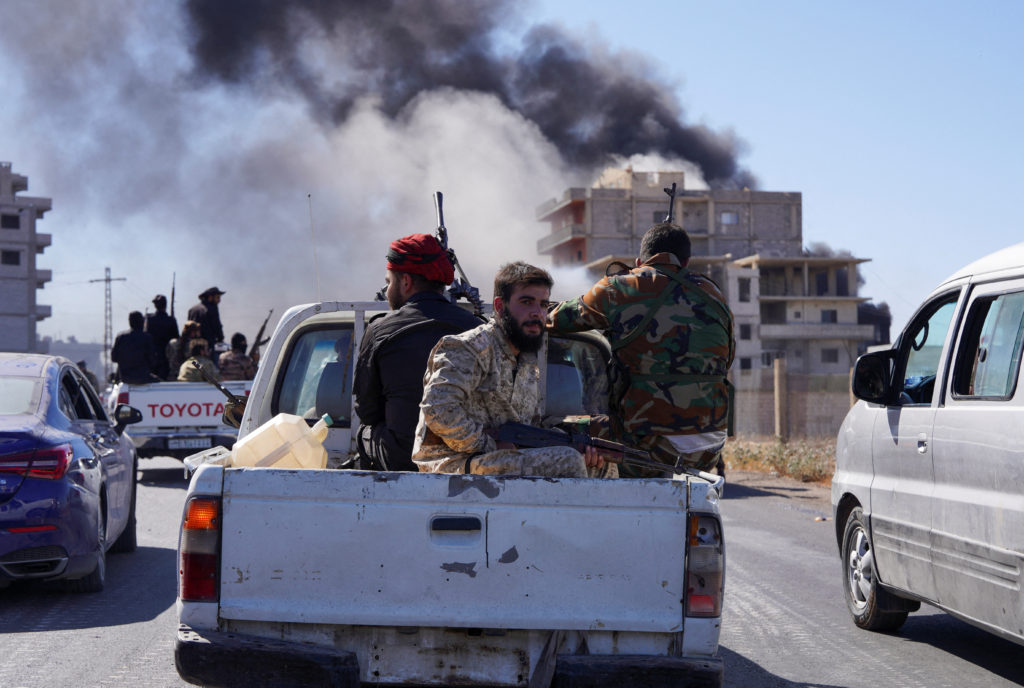
Syria’s Druze‑majority in Sweida province shows the cost of that error. When Abu Muhammad al-Jolani, formally President Ahmed al‑Sharaa, toppled Bashar al-Assad in 2025, he unleashed Salafi‑jihadi loyalists on the Druze. In a single July week, independent monitors counted nearly a thousand dead; videos captured villagers forced to their knees before automatic gunfire, elderly sheikhs humiliated on camera, whole neighborhoods torched, and more than 120,000 civilians driven from their homes. The atrocities followed the script exactly: declare the Druze heretics through takfīr, invoke the duty of offensive jihad, and justify slaughter with the loyalty‑and‑enmity code of al‑walaʾ wa‑l‑baraʾ. Dogma became policy overnight.
I learned the stakes firsthand. During an urban sweep in Gaza two years ago, my team searched a Hamas commander’s house. Amid the weapons and evidence left behind lay a book titled “Eighteenth-Century European Jewry.” And then it hit me. The enemy was not only studying Israeli military tactics; he was studying us — our origins, our psychology, our very essence. Their homework is thorough. Ours is overdue.
Could a Salafi‑jihadi sympathizer truly win high office in a modern democracy? Only if citizens, journalists, and policymakers stay blind to the creed’s vocabulary and aims. That blindness is curable. Educators can weave a concise curriculum on Salafi‑jihadi thought into high school and university civics courses. Newsrooms should abandon the reflex of filing every jihadist group under a generic “terror” label and instead explain ideology when it drives events. Policymakers ought to fund Arabic‑language open‑source analysis and minority‑protection initiatives with the urgency they give drones and cyber tools. Concerned citizens might begin with a freely available RAND monograph, The Roots of Salafi‑Jihadism, heavier than a Netflix binge, but far more consequential. The lesson for Western audiences is brutal but clear: ignorance of Salafi‑jihadism’s doctrinal DNA is not a harmless knowledge gap; it is an enabling condition for massacres that unfold while policymakers debate definitions. Until the ideology is named, mapped, and countered at the level of ideas and not just with drones and sanctions, minorities like the Druze will remain expendable, and men like al‑Jolani will continue to weaponize theology into policy.
Jefferson was right: We get the government we deserve, but only if we choose it in full knowledge. Start learning now, before a polished candidate exchanges the black flag for a blue suit and quotes the Constitution better than we do. In an age of information abundance, remaining uninformed is not just a private failing; it is a national risk.