
Journalist and Host of The Spiro Circle Podcast
Holden Caulfield Would’ve Hated Lech Lecha
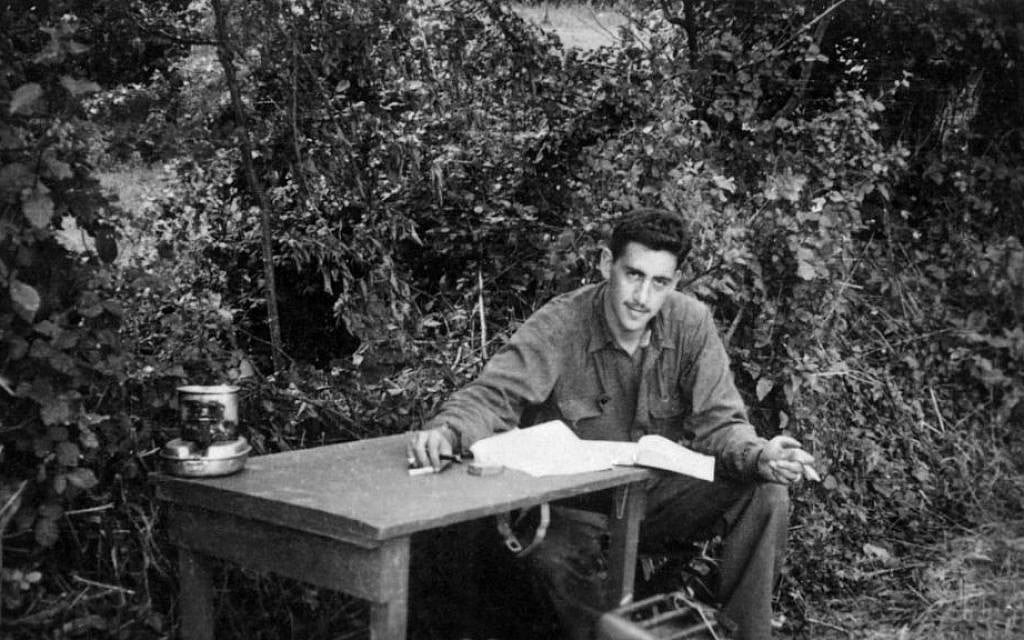
J.D. Salinger working on 'Catcher in the Rye' during World War II. (AP/The Story Factory, Paul Fitzgerald)
Last week I did something I don’t normally do: I read that week’s Torah portion, Lech Lecha. It was also around the same time I finished my first reread of J.D. Salinger’s The Catcher in the Rye.
I would not consider myself a strictly religious person, yet I couldn’t help but notice something extraordinary in how they each directly tied into my own life.
Lech Lecha sees God calling Abraham to leave his home and go to a land God will show him (Israel). It required Abraham to have faith and ‘go forth’: to depart from his homeland and move toward His promise. The portion highlights the faith to leave the familiar, seek out new paths, and perhaps redefine identity.
Holden Caulfield, meanwhile, wanted nothing more than for everything to stay exactly the same: He was constantly rebelling against change and repulsed by the adult world he had no choice but to grow into.
That same week, I departed from my job at CTech.
There’s a strange poetry in timing like that. One text demands motion; the other resists it. Abraham goes forth. Holden stays put. And I, somewhere between them, was trying to decide what it meant to move on. After 1,800 bylines, I decided to finally put my pen down to try new things and take on different projects in new areas that otherwise weren’t available to me. Primarily, that includes building my independent publication and podcast, The Spiro Circle.
The fear of growing up
Holden’s problem wasn’t rebellion. It was fear. He saw adulthood as a kind of slow death: a loss of innocence, a slide into falseness. He calls the world “phony,” but what he really means is changing. Every time he tries to hold on to something (his sister’s childhood, the museum exhibits, or even just a simple conversation), it slips through his hands. To him, growing up means losing authenticity. His dream is to become a catcher in the rye, metaphorically protecting children from losing their innocence.
I could understand that. There’s comfort in the familiar rhythm of a job, a company, or a city that doesn’t change. You can start to mistake predictability for purpose, and the very idea of losing your status or reputation can cause you to freeze in fear.
The call to “go forth”
But this week came Abraham, the man who started everything by leaving. No map. No plan. Just divine instruction: “Go forth to the land that I will show you,” God told him.
What kind of person hears that and actually goes?
Abraham’s courage isn’t that he believed – it’s that he moved. It’s one of the most radical moments in human history: the first recorded act of faith not in proof, but in promise. Abraham’s greatness lies not in belief alone, but in motion. He went forth.
Leaving CTech after five years to focus on The Spiro Circle wasn’t a biblical exodus. But it carried the same undertone of uncertainty: the fear that comes from stepping outside a comfort zone. After years of telling other people’s stories, I found myself called to take ownership of my own.
Two men, two callings
I keep thinking about how both Holden and Abraham share something: both men are searching for purity. But one tries to preserve it and the other tries to find it. Holden wants a world without compromise; Abraham understands that meaning requires movement.
Most of us, I think, live between them: You can’t write, create, or grow without leaving something behind or risking success through change. In a contemporary context, it can apply to a tech or professional venture, too, and something I have recently embarked on myself as I pursue new creative and professional avenues.
Going anyway
Perhaps most interesting from what I read this week is the Torah words themselves. Lech Lecha may teach us to go forth, but it is literally translated from Hebrew as “go to yourself.” It’s not just about geography: it’s about identity. Leaving one’s home, job, or comfort zone is an act of self-discovery. It takes you places you can’t imagine, across the world or even from your laptop.
Abraham took that leap without hesitation, but Holden couldn’t do it. He couldn’t leave the world he was stuck inside. But maybe that’s why both men still resonate with us after all these years. We recognize ourselves in their fear and faith; in the choices they make to fulfill their broader needs.
So this week, between Lech Lecha and The Catcher in the Rye, I’ve been thinking about what kind of movement “going forth” requires from me: Whereas Abraham would’ve called it purpose, Holden would’ve called it phony.
And me? I’m just trying to get there.
——-
James Spiro, formerly of CTech, now runs The Spiro Circle, an independent publication and podcast that explores ideas at the intersection of culture, technology, and meaning. You can subscribe here.
Related Topics
Related Posts