Historian, Librarian, Educator, and Artist
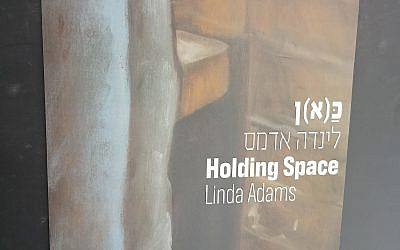
Holding Space: Linda Adams at Marie Gallery
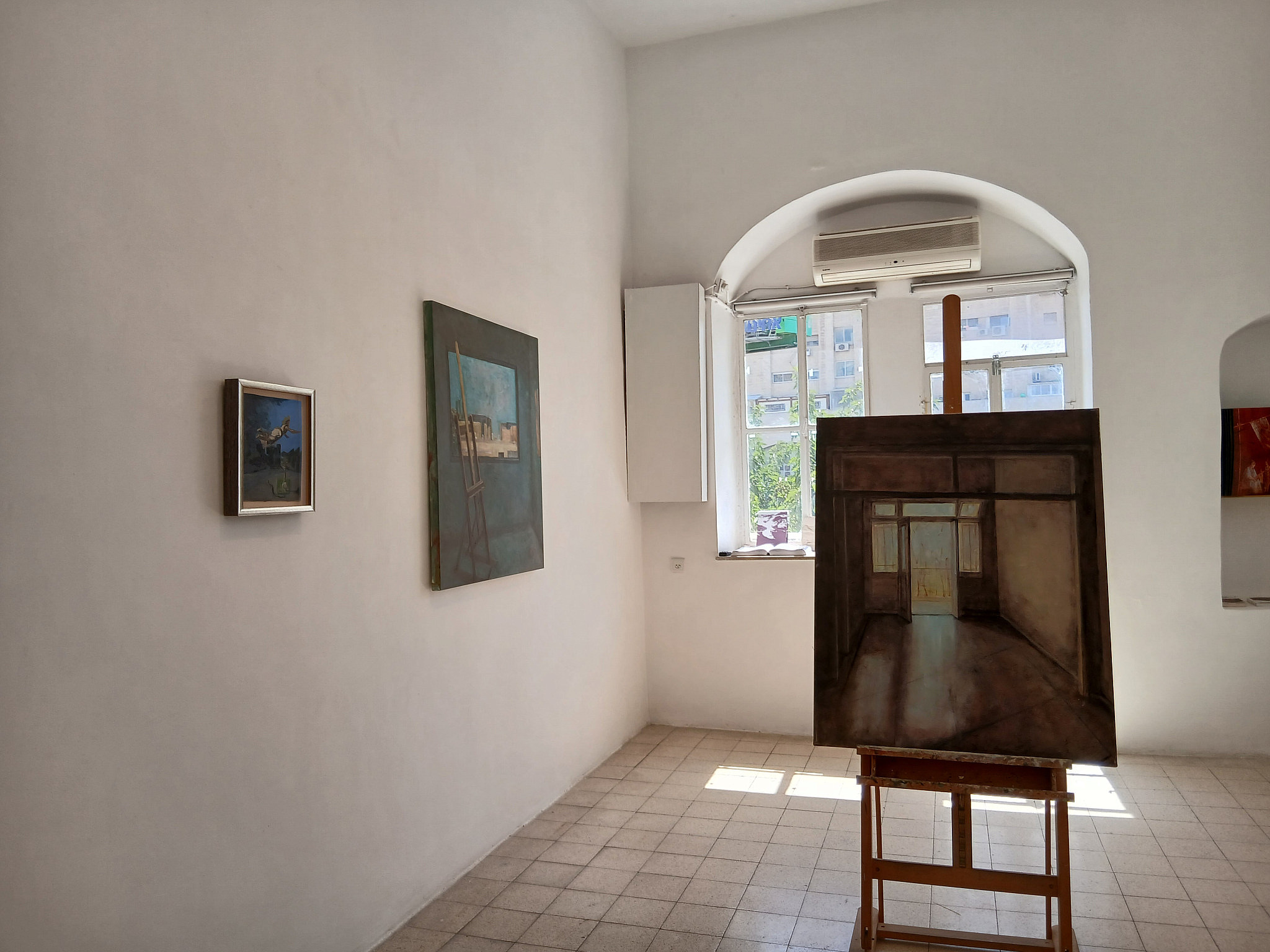
Installation view of Holding Space by Linda Adams at Marie Gallery, Jerusalem, 2025. (Photo: Bonnie K. Goodman)
Stepping into Holding Space means confronting silence, fragility, and unresolved sadness.
Exhibition Details
· Artist: Linda Adams
· Title: Holding Space
· Curator: Gaby Hamburg-Fhima
· Venue: Marie Gallery, Agripas 12, Jerusalem
· Dates: September 26 — October 25, 2025
· Events:
o Opening: Friday, September 26, 11:00
o Music Evening with Roni Ben Sasson & Amiel Mai: Saturday, September 27, 21:00
o Gallery Talk: Wednesday, October 8, 19:00
o Closing Event: Friday, October 24, 11:00
o Additional open days: September 30; October 3 & 10; and by appointment
Entering Marie Gallery on a bright Jerusalem afternoon, I expected to find an exhibition of contemporary painting that would carry the polish or experimentation typical of many collective spaces. Instead, I encountered works that struck with an unexpected force: canvases so subdued and somber that they seemed to exhale sadness into the room. My first impression was not of technique, but of atmosphere — a heaviness that pressed down on the viewer. The effect was powerful enough that I found myself remarking on it to one of the collective artists present: Holding Space felt less like a display of paintings than a testimony of depression laid bare.
The Exhibition’s Frame
Holding Space (September 26–October 25, 2025), curated by Gaby Hamburg-Fhima, brings together nineteen works by Linda Adams in oil, acrylic, and clay. Adams is a Canadian-Israeli painter based in Jerusalem, trained in the Jerusalem Studio School Master Class, and a member of the Studio of Her Own group. Her figurative works have been shown in solo and group exhibitions across Israel, and she is currently an MFA candidate at Haifa University.
The title gestures toward both architecture and psychology: to “hold space” is to create a container for vulnerability, whether in the form of a room, a wall, or a scarred fragment of skin. Hamburg-Fhima’s curatorial essay situates Adams’ practice within a dense theoretical framework, invoking Didier Anzieu’s Skin-Ego, Derrida’s porous boundary between inside and outside, Deleuze and Guattari’s “body without organs,” and the phenomenology of Husserl and Merleau-Ponty. The exhibition promises, in her words, “an intimate topography of being.”
That ambition is visible in the subjects Adams chooses. The works divide broadly into two categories: interiors (corridors, stairwells, windows, basements) and fragments of the body (Skin series). Both are sites of transition and containment, thresholds rather than destinations. They are places where identity is suspended, where the viewer is invited to confront absence as much as presence.
Technique and Execution
Adams works in a muted palette of grays, ochres, pale blues, and skin tones. Her surfaces, however, are often thinly painted, more like underpaintings than finished canvases. In the architectural works, pencil scaffolding frequently shows through, and perspective falters: stairwells tilt slightly, doorways stretch uncertainly, corridors collapse unevenly into light. These irregularities may be intended to destabilize, echoing the curvature of scoliosis that Adams cites as metaphor, but they often appear more unresolved than deliberate.
The Skin series marks a stronger moment. Here, Adams isolates body parts — ear, cheek, wrist, mouth — magnified and rendered almost clinically. In Skin VII (the open mouth), the fragment becomes ambiguous: both scream and silence, exposure and erasure. These canvases succeed because incompleteness is integral to their concept; the fragment is not a failure of execution, but the statement.
Her clay works (2020), include rough reliefs and three-dimensional reclining female figures. They extend this theme of incompletion into three dimensions. Simplified and vulnerable, they echo the fragility of the painted bodies. Together, the paintings and sculpture suggest the body as terrain: scarred, fissured, and subject to time.
Atmosphere and Mood
If Adams’ surfaces remain unresolved, her atmosphere is undeniable. The works convey a pervasive sense of melancholy. Interiors are emptied of people, thresholds are suspended mid-passage, and stairwells descend without destination. Even when figures appear as subjects, as in Masks (2023), they are faceless or obscured, absorbed into anonymity.
The cumulative effect is depression revealed rather than concealed. The viewer feels the weight of silence, the insistence of absence. What is striking is Adams’ willingness to let this darkness be public. Many artists aim to aestheticize despair, to translate it into beauty. Adams refuses. She presents heaviness as heaviness, fragility as fragility. That honesty unsettles, and at moments it can overwhelm.
Yet the rawness also reveals a limitation. While the exhibition succeeds in transmitting mood, it rarely transfigures it. The sadness is evident, but it is not transformed into something larger or universal. The paintings testify; they do not transcend.
Theory and Practice
The gap between conceptual ambition and painterly execution is perhaps the exhibition’s most persistent tension. The curatorial essay promises profound engagements with philosophy, psychoanalysis, and phenomenology. Adams’ paintings gesture toward these ideas — skin as psychic surface, stone as memory, space as psyche — but they seldom embody them with the authority of their theoretical lineage.
Antonio López García, often cited in comparison, distills memory into interior stillness with mastery of light and form. Luc Tuymans allows faded surfaces to carry historical weight. Giorgio de Chirico transformed empty plazas into metaphysical enigmas. Adams’ work shares their concern with absence and interiority, but without their pictorial resolution.
This is not to dismiss her effort. Rather, it places Holding Space in a different register: less about mastery than about exposure. It is an exhibition that dares to make visible what most artists conceal, even if it cannot elevate that rawness into something beyond itself.
Curatorial Vision and Programming
Curator Gaby Hamburg-Fhima situates Holding Space within a broader dialogue of body, memory, and place. She holds advanced degrees from Bezalel in Policy & Theory of the Arts and in Photography/Video, and in 2024 curated A Field Unraveled at Hutzot Public Art Gallery, an installation of unraveling nets and filaments by Dana Cohen that reflected her ongoing interest in material rupture and territory. Her curatorial vision here is consistent: by drawing connections between material, body, and space, she positions Adams’s work within a conceptual framework larger than any single painting.
The exhibition is accompanied by a series of events: the opening on September 26, a music evening with Roni Ben Sasson and Amiel Mai on September 27, a gallery talk on October 8, and a closing on October 24, alongside regular open days. These additions reflect the gallery’s role as a collective hub, situating Holding Space within a living, participatory context.
Yet the programming introduces a revealing irony. The music evening, in particular, with its festive air, stands in stark contrast to the paintings’ despair. To celebrate in sound while surrounded by canvases that confront depression and fragility is a juxtaposition difficult to reconcile. It underscores the tension between art’s raw honesty and the social rituals that frame it: the gallery as a place of celebration, even when the art within refuses consolation.
Conclusion
Leaving Holding Space, I carried with me not admiration for painterly mastery but the weight of its atmosphere. Adams’ thin brushwork and uneven perspectives do not produce the depth or resolution one might expect, yet the exhibition nonetheless achieves a kind of truth. It holds space not for perfection but for vulnerability, not for polish but for exposure.
This is art that does not transform sadness into beauty; it insists that sadness itself can occupy the gallery. Whether one views that as limitation or as courage will determine one’s judgment of Adams’ achievement. For me, the experience was sobering, even unsettling. But it was also real. In a world where surfaces so often mask inner struggle, Holding Space dares to exhibit what is fragile, fractured, and unresolved.
Related Topics
Related Posts